Introduction: Why Acceptance Criteria for PCB Assemblies Matter

In today’s fast-paced electronics manufacturing industry, every electronic product relies on high-quality PCB assembly to underpin its reliability and performance. From consumer electronics to medical devices and high-frequency PCB solutions, the integrity of PCB assembly directly determines the product’s safety, service life and user satisfaction. To meet the highest quality standards, leading manufacturers and original equipment manufacturers (OEMs) commonly adopt a well-defined set of acceptance criteria for electronic assembly.
The industry judges whether a PCB assembly product can stand out from ordinary ones based on the key difference of its adherence to the IPC-A-610 standard. This standard for PCB assemblies receives the broadest recognition within the electronics manufacturing industry, and its stipulated scope covers every aspect of electronic assembly. The IPC-A-610 standard provides comprehensive guidance, offering a quantifiable basis for the inspection process. Simultaneously, it establishes an assembly evaluation benchmark. Adherence to this standard ensures that PCB assembly products achieve the highest performance level, regardless of the industry or application scenario they face.
Understanding IPC-A-610 PCB Assembly Standards: A Widely Recognized Standard
What Is IPC-A-610?
IPC-A-610, Acceptability of Electronic Assemblies, is the most widely recognized and most frequently used acceptance criteria within the assembly of electronic products. This standard defines primary requirements for every assembly process—surface mount, through-hole, fine-pitch, high-frequency PCB and even flexible and ceramic PCB applications.
IPC-A-610 establishes the requirements for solder joints, component placement, PCB cleanliness, material selection, workmanship and inspection processes. As a result, it has become synonymous with assembly quality, guiding the manufacturing process for all major electronics manufacturing sectors—consumer, automotive, industrial, aerospace and medical.
Why Follow IPC-A-610?
- Ensures Consistency: Every operator and inspector, based on uniform standards, clearly understands the specific requirements for solder application, component placement positions, and circuit board cleanliness.
- Reduces Defects: Outlines best practices and visual criteria to prevent and detect typical defects.
- Supports Traceability: Provides the structure for documentation and standard requirements for regulatory and customer audits.
IPC-A-610 defines exactly what makes an assembly acceptable, process indicator (marginal but not defective), or a reject, using illustrations and real-world photos.
Key Points:
- IPC-A-610 is a widely recognized standard for PCB assemblies worldwide.
- IPC standards provide the structure and language for the evaluation of assembly quality.
- Standard helps both LHDPCB and customers synchronize expectations and requirements for electronic assemblies.
- By consistently following IPC standards, products meet the highest global reliability requirements.
IPC-A-610 Classes: Class 1, Class 2 and Class 3 Explained
IPC-A-610 classes ensure requirements for electronic assemblies are tailored to the functional and reliability needs of the end product.
Class 1: General Electronic Products
- Use: Toys, blinking badges, basic consumer gadgets—boards where reliability isn’t critical.
- Requirements: Visual and functional defects tolerated unless they affect basic functionality or safety.
- IPC Class 1: sets minimum criteria for cost-driven markets.
Class 2: Dedicated Service Electronic Products
- Use: Consumer electronics, industrial controls, most non-life-critical assemblies.
- Requirements: Balances appearance, function and long lifespan; minor cosmetic defects permitted if they don’t threaten product reliability.
- IPC-A-610 Class 2: The “workhorse” level, covering most PCB assemblies in the market.
Class 3: High-Performance Electronic Products
- Use: Medical devices, aerospace, defense, automotive safety, advanced PCB where “failure is not an option.”
- Requirements: Zero-tolerance for process indicators and visual/mechanical/electrical defects. Inspection and testing are rigorous.
- IPC-A-610 Class 3: ensures the assembly process meets the highest reliability standards, with full documentation and traceability.
IPC-A-610 Classes Summary
| IPC Class | Typical Assemblies | Reliability Requirements | Key Focus |
| Class 1 | Kids’ gadgets, LED badges | Short life, low risk | Cost, basic function |
| Class 2 | TV, routers, IoT devices | Moderate to long life, good reliability | Quality, durability |
| Class 3 | Pacemakers, avionics, defense | Critical life-long reliability | Zero defects, full trace |
LHDPCB’S Key Acceptance Criteria and Requirements for Electronic Assemblies

IPC-A-610 PCB assembly standards break down acceptance into several critical areas, each with concrete, visual and measurable benchmarks.
Solder Joint Requirements
- Requirements for solder joints: Smooth, shiny, appropriately sized (height/width), and fully wetting both pad and component leads.
- Visual acceptance criteria: No voids, cracks, or “cold” (dull, grainy) joints.
- Solder ball bridging: Not tolerated in Class 2 and Class 3.
- Reticulated/tin whiskers/spatter: Only permitted in Class 1 unless they create a risk of electrical shorts.
Component Placement and Orientation
- Every assembly is checked for accurate placement, no tombstoning, perfect polarity, and conformity to the bill of materials.
- Requirements for electronic assemblies: All specified components must match the PCB design file and assembly documentation, with alignment and orientation controlled to <0.15mm for Class 2 and Class 3.
Cleanliness and Surface Quality
- Assembly evaluation: Checks for flux residue, stains, and contamination. Class 3 requires total cleanliness.
- IPC-A-610 sets requirements for fingerprints, excess solder paste, and mask delamination—all common trouble spots.
Mechanical Integrity
- Acceptability criteria mandate correct trimming of leads, absence of board warpage, no mechanical deformation, and secure terminal connections.
- Mechanical testing and visual inspection ensure PCB assemblies maintain mechanical integrity for their design life.
Inspection and Testing
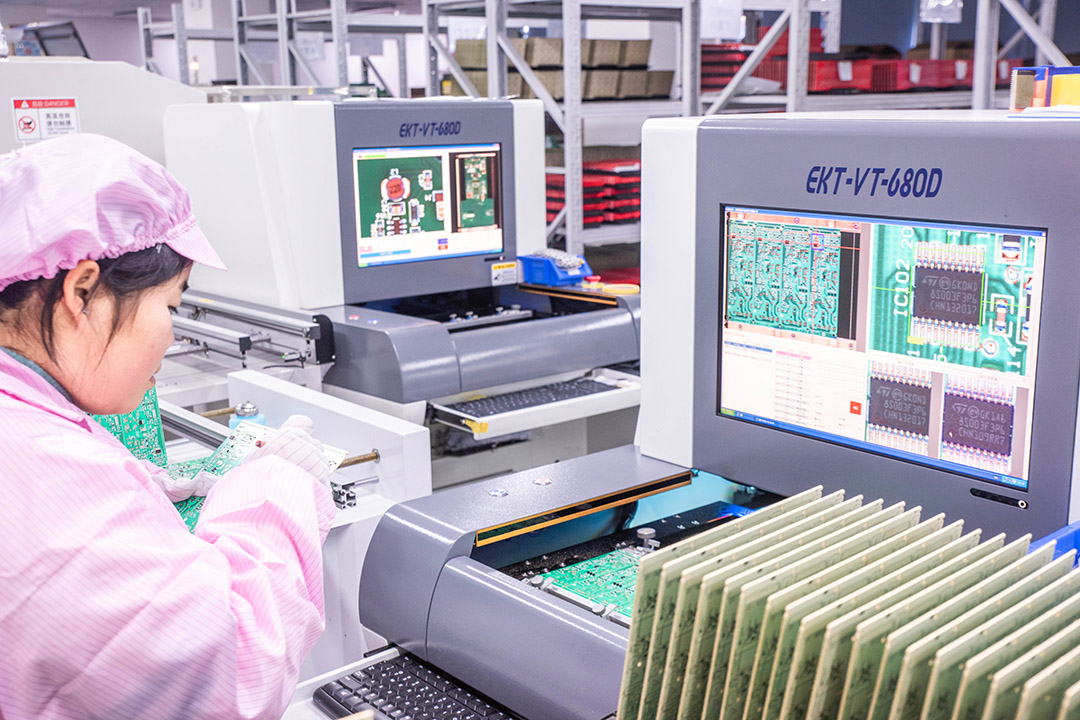
- Inspection processes: AOI, x-ray (for BGAs, µBGAs), flying probe and ICT, burn-in and functional testing for critical circuits.
- Standard provides clear pass/fail definitions.
- Documentation: Class 2 and Class 3 assemblies are documented at each step, with digital records available for audits.
Visual Acceptance Criteria: Inspection and Testing for Every Assembly
Visual Acceptance for Electronic Assemblies
The IPC-A-610 standard specifies the detailed operating procedures for soldering and assembly. It also establishes criteria that guide operators to evaluate assembly quality through visual inspection and mechanical testing.This visual acceptance standard uses high-resolution photos and diagrams to provide corresponding visual references for every detail of electronic assembly.
| Defect Type | Examples Under IPC-A-610 | Acceptable (Y/N, by class) |
| Solder ball bridging | Not permitted for Class 2/3 | N (2,3) |
| Cold solder joint | Not permitted Class 2/3 | N (2,3) |
| Tombstoning | Not permitted | N (all) |
| Pinhole/blowhole | Allowed only if superficial (Class 2) | Y (1/2 Superficial), N (3) |
| Flux residue/contamination | Minimal, non-conductive allowed (Class 2), none in Class 3 | Y/N |
| Lead or terminal deformation | Minor if function not affected (Class 2), none in Class 3 | Y (2), N (3) |
Inspection and Testing Best Practices
- The implementation of IPC standards requires enterprises to establish a complete set of inspection and testing procedures that go beyond routine visual inspection. For any high-end PCB product, practical operations demand a combined application of manual inspection, Automated Optical Inspection (AOI), X-ray inspection and functional testing. The fundamental reason for adopting such a combined inspection approach is that the high-density wiring and ongoing miniaturization of circuit boards may result in potential defects that cannot be directly identified by the naked eye.
- Comprehensive guide tip: Use high-resolution imagery and cross-sectional analysis to train inspectors and avoid subjectivity in pass/fail judgments.
- Acceptance criteria for electronic assemblies should be visible at every inspection station, ensuring inspectors and operators always understand the latest standard requirements and criteria to ensure product quality.
How IPC-A-610 Improves Assembly Quality, Reliability and Product Quality

Why IPC-A-610 Criteria Matter
The IPC-A-610 standard serves three core functions. Its first function is to reduce systematic errors during the production process. Its second function is to lower the incidence of failures during product field use. Its third function is to ensure that PCB assemblies consistently meet the highest requirements for reliability and safety. This standard provides clear specifications for solder joint quality, component placement accuracy, and PCB cleanliness. These requirements ensure that a wide range of electronic products achieve their intended performance targets, covering product categories from general electronic devices to the most advanced PCB applications.
- Assembly quality: Standard requirements cover everything from pad design to environmental testing, reducing the risk of latent defects.
- Reliability requirements: By focusing on factors like thermomechanical stress, corrosion resistance, and high-frequency performance, IPC-A-610 requirements protect advanced PCB designs used in medical, aerospace, and defense products.
- Implementing IPC standards gives original equipment manufacturers (OEMs) and assembly houses a clear competitive advantage—lower rework and warranty rates, higher customer trust, and smoother quality audits.
Applying IPC-A-610 PCB Assembly Standards to Advanced PCB Manufacturing
Standards for Advanced PCB Assemblies
- High-frequency PCB and ceramic PCB: Advanced technologies depend on precise, void-free solder joints and correct component orientation. IPC-A-610’s requirements for solder joints and visual acceptance criteria ensure signal integrity and mechanical stability.
- Requirements for electronic assemblies become more vital as PCBs shrink and layer counts rise in high-density/interconnect, BGA and fine-pitch assemblies.
- Assembly services must provide documentation and traceability, with AOI, x-ray and inline electrical testing as essential tools.
Integrating Quality into the Assembly Process
- Design for Manufacturability (DFM): Ensure that pcb design matches the inspection and assembly quality level prescribed by the selected IPC Class (1, 2 or 3).
- Workmanship standards specified by IPC-A-610 outline not just compliance, but best-in-class methods for achieving high yields even in challenging assembly environments.
- Implement advanced process controls: Statistical process control (SPC), batch-level traceability, and in-line thermal profiling all support IPC-A-610 requirements and higher efficiency in every assembly.
Comprehensive Guide: Inspection Criteria, Documentation, and Traceability
The Role of Traceability in IPC-A-610 Standard Compliance
- Traceability means: Every component, solder lot, operator action, and inspection step can be linked back to a single board or assembly lot.
- IPC-A-610 pcb assembly standards now recommend digital records, tying serial numbers and AOI images to outgoing shipments.
- Standard defines required documentation—Certificates of Conformance are essential for Class 2 and Class 3 projects.
Documentation Best Practices
- Use standard process checklists derived from IPC-A-610 classes.
- Archive all AOI, x-ray, and manual inspection logs for future audits—especially where liability, insurance, or customer regulations demand evidence.
- Train staff not only to follow IPC standards, but also to document every assembly and inspection step with clarity.
How to Choose Quality Assembly Services for High-Frequency PCB and Ceramic PCB Projects

Ensuring Your Service Provider Meets the Highest Standards
- Certified to IPC-A-610 standard (including Class 2 and Class 3 as applicable)
- Demonstrated success in electronics manufacturing: Ask for references and yield statistics from similar high-frequency and ceramic PCB projects.
- Inspection and documentation capability: Tour their facility if possible; review automated and manual inspection logs.
- Ability to provide IPC-A-610 visual acceptance criteria checklists and full traceability.
- Experience with advanced PCB requirements: High layer counts, mixed assembly technologies (SMT/THT) and advanced solder materials.
Checklist for Quality Assembly Services:
- Follows the latest IPC-A-610 and related IPC standards
- Offers in-line AOI, x-ray, flying probe and burn-in testing
- Maintains documentation and visual acceptance criteria for every assembly
- Value-add: DFM/DFT feedback to optimize reliability and yield
Conclusion: Implementing IPC Standards for the Highest Quality
In the global race for performance and reliability in electronics manufacturing, only those who implement and enforce the highest standards—as defined by IPC-A-610 pcb assembly standards—consistently deliver products that meet the highest quality requirements of today’s market. These standards improve not just assembly quality and reliability but the reputation and business success of both OEMs and EMS companies.
Key Takeaways:
- Always specify the correct IPC-A-610 class for every assembly
- Use visual acceptance criteria and documented inspection processes to enforce quality at every step
- Follow IPC standards as a core of your process, not a checkbox at shipping
- Regularly train staff, review standards and update checklists as new technologies and requirements emerge
Choosing partners and processes built on IPC standards provides a foundation for success in every aspect of electronic assembly, from PCB fabrication through box build and system integration.
Final Thoughts
Whether you are advancing your design requirements for high-frequency PCB, ensuring assembly of electronic products for consumer electronics, or seeking zero-defect standards in medical or automotive assembly, IPC-A-610 remains the complete guide for assembly quality. Its guidance on visual acceptance criteria, requirements for solder, and comprehensive inspection criteria provides the assurance that your assemblies meet the highest level of the standard provides.
Implementing IPC standards isn’t just good business—it’s the proven path toward achieving and maintaining the highest quality standards throughout every stage of electronics manufacturing.