

Introduction to Color Code and Resistor Color Code
The color code is the universal language of resistors, providing a fast, reliable way to identify the value and tolerance of resistors used in electronic circuits. The resistor color code system was developed decades ago, and it’s become even more vital as today’s circuit boards pack more functionality into less space. Whether you’re building a digital logic board, a power supply, or an analog sensor front-end, knowing how to read the ohm resistor color code can save your project and make troubleshooting so much easier.
A 2k ohm resistor (sometimes written as “2KΩ”) is one of the most common values in modern circuit design, found in everything from microcontroller GPIO protection to op-amp feedback and analog signal conditioning. This guide will walk you through everything—from understanding “ohm” and “ohm resistors” to applying the 2k ohm resistor color code in the real world.
Ohm Resistor Color and Ohm Resistor Color Code: The Foundation

The key to quick resistor identification is the familiar ohm resistor color system. Each resistor typically has a set of color bands that encode its value using a standardized “ohm resistor color code.” Here’s why it matters for engineers, hobbyists, and anyone designing or repairing electronic circuits:
- Space saving: Some resistors or small plug-in resistors are particularly small. We use color bands to mark the resistance value positions.
- Accuracy and tolerance: The color band shows the significant figures and multiples, as well as the error range of the resistance. The golden ring represents ±5%, the brown ring is ±1%, and the silver ring is ±10%.
- Global standard: The color band reading method for purchasing resistors is the same all over the world. IEC 60062, E24 and E96 are international standards.
- Direct relevance to circuit design: Identifying the color ring can prevent errors, such as in voltage divider circuits, suspended inputs, pull-up/pull-down resistors, and in analog circuits.
Color Band Table for Ohm Resistor Color Codes:
| Color | Digit | Multiplier | Tolerance |
| Black | 0 | ×1 | – |
| Brown | 1 | ×10 | ±1% |
| Red | 2 | ×100 | ±2% |
| Orange | 3 | ×1,000 | – |
| Yellow | 4 | ×10,000 | – |
| Green | 5 | ×100,000 | ±0.5% |
| Blue | 6 | ×1,000,000 | ±0.25% |
| Violet | 7 | ×10,000,000 | ±0.1% |
| Gray | 8 | ×100,000,000 | ±0.05% |
| White | 9 | ×1,000,000,000 | – |
| Gold | – | ×0.1 | ±5% |
| Silver | – | ×0.01 | ±10% |
| None | – | – | ±20% |
Resistor Value, Ohm, and the Importance in Circuit Design
A resistor’s value, measured in ohms, is fundamental to circuit design. Ohm resistors limit current, divide voltage, and help with everything from analog signal scaling to digital input protection.
- Ohm (Ω): According to Ohm’s Law: voltage = Current × resistance (V = I × R), the value of resistance hindering current is calculated, which is the voltage (unit: ohm).
- Resistor value: The color ring indicates the actual resistance value provided by the resistor. The higher the resistance value (the greater the ohm number), the smaller the current.
- Importance: If the resistance value is wrongly selected, it will cause signal distortion in the analog circuit. The GPIO pins of the digital chip may be in an uncertain suspended state. In severe cases, it may even lead to power supply problems and the system not working.
For example, using a 2k ohm resistor vs. a 10kΩ resistor in an I2C communication circuit has a dramatic impact on signal rise times and power draw, and picking a 100Ω or 470Ω instead can burn too much current or overload a sensor signal.
Understanding the 2k: What Does “2k Ohm” Mean?
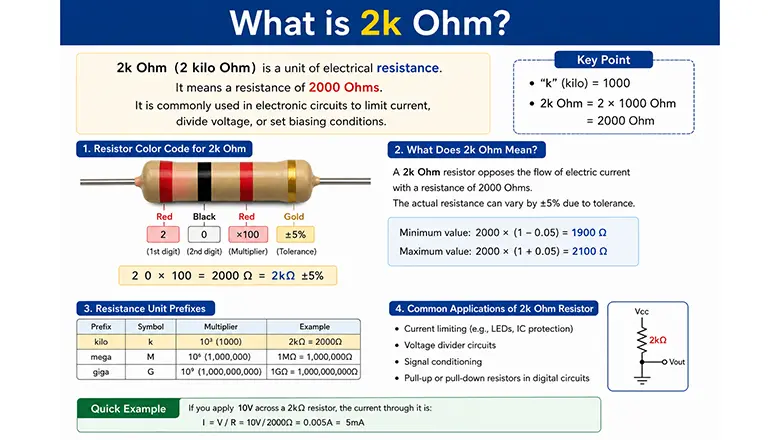
A 2k-ohm resistor (that is, 2000 ohms) belongs to the fixed resistance type and is very commonly used in both digital circuits and analog circuits. It is also the preferred value of the E24 series, a common and easily accessible material in the market.
Why “2k” is special in electronic circuits:
- I2C communication: Using a 2k resistor for pull-up can ensure that the rising edge of SDA and SCL signal lines is both fast and stable while guaranteeing quality.
- Analog circuits: The 2k resistor can provide just the right resistance value – it can suppress noise without making the impedance too high and affecting performance.
- Digital circuits: Pulling down a 2k resistor or pulling the suspended input pin to a definite state can effectively prevent false triggering and reduce spatial electromagnetic interference.
- Current limiting: 2k resistors are very suitable for use in indication circuits to limit the current of leds, keeping the current at a safe and visible level.
2K Ohm Resistor Color Code: How to Read 4-Band and 5-Band Versions
There are mainly two common 2k ohm resistor color code: one is a 4-band type, suitable for general use, with an error of ±5%, and the last band is gold. Another type is the 5-ring one, which has higher precision with an error of ±1%. The last ring is brown.
4-Band 2K Ohm Resistor
The most common and universal one is 4-band 2k ohm resistor color code. Its color rings are in sequence:
- Band 1 (1st Significant Digit): Red (2)
- Band 2 (2nd Significant Digit): Black (0)
- Band 3 (Multiplier): Red (×100)
- Band 4 (Tolerance): Gold (±5%)
So: Red-Black-Red-Gold = 2 × 10 × 100 = 2,000 ohms (2KΩ) with ±5% tolerance.
How to use it in a circuit? This resistance value is highly suitable for current limiting, pull-up or pull-down of GPIO pins, and general signal conditioning – as long as extremely high precision is not required, it can be put to good use.
5-Band 2K Ohm Resistor
Precision circuits demand tighter tolerance and often deploy the 5-band version for improved accuracy:
- Band 1: Red (2)
- Band 2: Black (0)
- Band 3: Black (0)
- Band 4: Brown (×10)
- Band 5: Brown (±1%)
Thus: Red-Black-Black-Brown-Brown = 200 × 10 = 2,000 ohms with ±1% tolerance.
This type of resistor with tighter tolerance is typically used in precision instruments, analog circuits with very definite requirements for circuit behavior, and those more sensitive analog signal paths.
2.2k Ohm and the Difference from 2k
2k ohm resistors (2000Ω) and 2.2k ohm resistors (2200Ω) are very easy to confuse, especially when looking at the color ring. Here’s how to distinguish them using the resistance color band:
2k ohm (4-band): Red-Black-Red-Gold 2.2k ohm (4-band): Red-Red-Red-Gold
- 2k:20 × 100 = 2,000Ω
- 2k:22 × 100 = 2,200Ω
Tolerance: Resistor with a Tolerance for Precision Applications
The error of resistor tolerance refers to the maximum allowable deviation between the actual resistance value and the nominal resistance value, expressed as a percentage. The last color band on the color band is the error band – gold represents ±5%, brown represents ±1%, and silver represents ±10% – it directly affects the actual performance of the circuit:
- ±5% (Gold): Sufficient for most signal conditioning and current-limiting tasks in digital circuits.
- ±1% (Brown): Needed for feedback in op-amp circuits, sensor signals, and any circuit where deviation can affect measurement or stability.
- ±10% (Silver): Used where precision is less critical—simple voltage splits, heater elements, etc.
E24 Series, Standard Values, and Physical Size Considerations
2k ohm resistors are part of the E24 series, which means they’re preferred, widely available, and come in a range of tolerances and form factors for every electronic application:
| Series | No. of Values/Decade | Example Values | Tolerances Available |
| E6 | 6 | 1k, 1.5k | ±20% |
| E12 | 12 | 1k, 2.2k | ±10% |
| E24 | 24 | 2k, 2.2k | ±5% |
| E96 | 96 | 2k, 2.2k, 2.05k | ±1% |
- Physical sizes: 2K ohm resistors are available as axial (through-hole) and SMD (surface mount) for circuits with strict space or power requirements.
- SMD Marking: For a 2KΩ chip resistor, look for a “202” label (ohm resistor color code isn’t used).
Typical Applications: How 2K Ohm and 2.2K Ohm Resistors Limit Current in Circuit Design
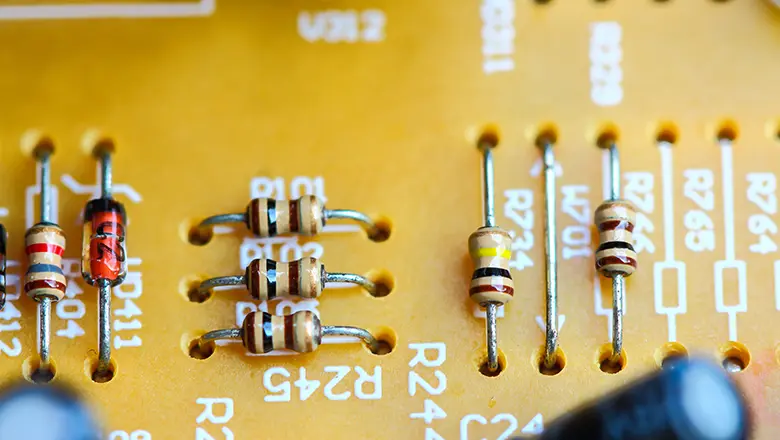
A critical role of ohm resistors in circuit design is current limiting and signal conditioning.
Digital Circuits and Floating Inputs
- Pull-down resistor: It is used to prevent the digital logic or single-chip microcomputer GPIO pins from being left floating – once the pins are not connected to anything, it is easy to bring in noise. 2k ohms is a decent compromise: the pull-down is strong enough and the power consumption is not high.
- Pull-up resistor: Make sure that when the switch or MOSFET is turned off, the input pins remain at a high level steadily. Although 2.2k or 10k are also common, the advantage of 2k lies in its faster and more reliable logical response, making it suitable for scenarios with speed requirements.
Analog Circuits and Signal Conditioning
- Signal path buffering: In analog circuits, a 2k resistor can be connected in series at the input end of an operational amplifier. It not only helps filter out some noise but also protects the sensitive ADC or amplifier input behind it.
- RC filter: When a 2k resistor and a 0.1μF capacitor are connected together, a low-pass filter is formed with a cut-off frequency of approximately 800Hz, which is very suitable for analog filtering of sensor signals.
I2C Communication and GPIO Pins
- I2C pull-up: To ensure that I2C communication is both fast and stable (especially in the fast mode of 400kHz), engineers will use 2k resistors to pull up the SDA and SCL lines, which can guarantee that the signal rise time meets the 300 nanosecond standard.
- Current-limiting: When driving an indicator light with GPIO, a 2k resistor in series can limit the current within a safe range while also achieving the desired brightness.
Power Handling, Substrate, and Precision Instruments
The substrate of a resistor—usually ceramic, film, or metal oxide—along with its physical size, sets its power handling capability.
- 1/8W or 1/4W axial are common for low-current tasks.
- 1/2W and larger are used in power supplies or when dissipating more voltage (e.g., voltage dividers on battery or high-signal lines).
Precision instruments often demand 5-band 2K ohm resistors with a tolerance of ±1% or tighter for stable, repeatable measurements and control.
Troubleshooting: Ohm Resistor Color Code and Circuit Errors
Common circuit errors caused by misreading ohm resistor color codes:
- Non-booting microcontroller: Wrong pull-up causes floating inputs; double-check for red-black-red-gold vs. red-red-red-gold!
- Weak sensor signal: When the original 2k resistor is replaced with 100Ω, the current increases instantly, causing the voltage of the analog signal to be pulled down and the signal to weaken.
- Unreliable I2C communication: The resistance value of the pull-up resistor was not selected correctly, which caused the signal waveform to be damaged – the oscilloscope displayed a slow signal with high noise.
Troubleshooting steps:
- Visual check: Use a color code chart.
- Multimeter confirmation: Every suspect resistor gets a resistance measurement.
- Simulation: LTS pice or circuit sim tools can show the difference between a 2K and 2.2K or 470Ω under real signal loads.
Resistor Substitution: 2.2k, 470Ω, 100Ω, 10kΩ, and More
Ohm resistors come in many values, and sometimes you’ll need to substitute:
- 2KΩ: 4-band color code red-red-red-gold. Slightly higher resistance, useful for reducing current in ultra-low power designs.
- 470Ω : The color band is yellow – purple – brown – gold. This type of resistor is suitable for making leds brighter, providing a larger base current, or being used in precision analog filters.
- 100Ω : The color band is brown – black – brown – gold. It is commonly used as a low-impedance pull-down resistor or as a current-checking resistor to measure small currents.
- 10KΩ : The color band is brown – black – orange – gold. It is highly suitable for use as a high-impedance pull-up resistor or in more sensitive analog circuits.
- Parallel and series tricks: When two 4k ohm resistors are connected in parallel, exactly 2k is obtained. A 1k resistor connected in series with another 1k resistor can also make up a standard 2k.
Summary: Mastering the 2K Ohm Resistor Color Code in Electronic Circuits
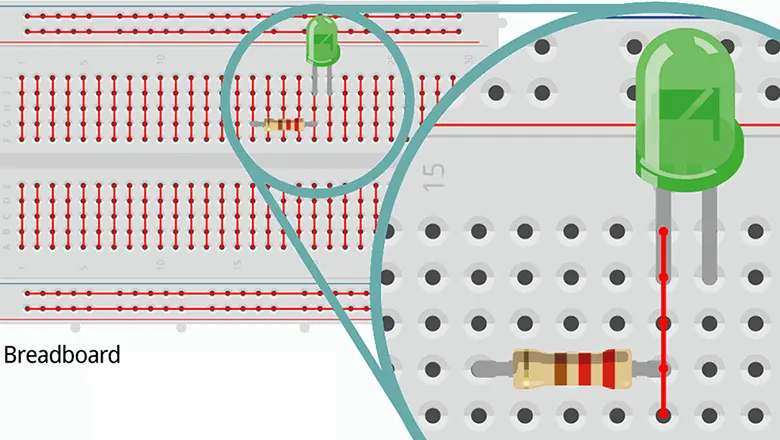
Whether you are now designing a complex analog signal link, building your first circuit on a breadboard, or mounting a bunch of sensors on an I2C bus – first understand the 2K ohm resistor color code. Based on the difference between 2k and 2.2k color bands, choosing resistors with smaller errors or higher power can also conveniently distinguish the reading methods of 4-ring and 5-ring.
Build the habit:
- Use color code charts religiously.
- Organize ohm resistors by value and tolerance.
- Always verify with a multimeter: When working on critical circuits, using a multimeter for testing can prevent confusion among similar resistance values such as 2k, 2.2k and 10k, and also help promptly identify components with mismarked parameters.
- Understand your circuit design’s current, voltage, and power needs: Whether it is analog circuits, digital logic or mixed-signal design, choosing the right resistor (including error, series, package size, material, etc.) is essential to ensure circuit stability, low noise and power saving.
To sum up: For 2k ohm resistor color code – 4-band ones are red – black – red – gold (±5%), and 5-band ones are red – black – black – brown – brown (±1%) – this is the foundation for you to do a good job in circuit design. Whether you are encountering through-hole resistors, surface mount resistors marked “202”, or need to replace 2k with 2.2k, 470Ω, 100Ω or 10kΩ in specific projects, now you can understand the color ring and grasp the meaning of each resistor’s color code.
Frequently Asked Questions
Q1: What is the 2k ohm resistor color code?
A: If it is a common 4-ring resistor, the color band is red – black – red – gold, with an error of ±5%. If it is the high-precision 5-ring version, it would be red – black – black – brown – brown, with an error of ±1%.
Q2: Can I substitute a 2.2kΩ resistor for a 2kΩ in an I2C circuit?
A: Sometimes it’s possible, especially when the speed is not high. However, for the 400kHz fast mode I2C, 2kΩ is the most suitable. If 2.2kΩ is used, the rise time may deteriorate and the signal integrity is also easily affected – it still depends on the size of the bus capacitance.
Q3: Why do ohm resistors limit current in LED circuits?
A: A resistor will generate a voltage drop, thereby limiting the current flowing through the LED within a safe range. This way, not only can the LED be prevented from burning out, but also the brightness can be just right.
Q4: How does the E24 series relate to 2k ohm resistors?
A: What is the relationship between the E24 series and 2k ohm resistors?
The E24 series defines A batch of preferred resistance values, and 2k ohms is one of them. So this resistance value is readily available on the market and can be directly used in the vast majority of circuits.
Q5: What power rating should I choose for a 2k ohm resistor in my design?
A: If it is used for low-power signals (such as logic circuits, pull-up or pull-down), generally 1/8W or 1/4W is sufficient. If it is used in a place with a relatively high voltage (such as a power circuit), then the power consumption needs to be calculated: P = V² / R. When choosing a resistor, it is best that the rated power is more than twice the power you have calculated. This is safer.
Q6: How do I distinguish a 2k ohm resistor color code from a 470Ω or 100Ω?
A:
- 2k: Red-Black-Red-Gold
- 470Ω: Yellow-Violet-Brown-Gold
- 100Ω: Brown-Black-Brown-Gold Always double-check both the color code and measure resistance if uncertain!