Introduction
Printed circuit boards are core components of contemporary electronic equipment. They have evolved from manufacturing processes involving manual operation and small-batch production to precise, large-volume circuit board assembly processes supported by automated production lines and cutting-edge technologies.
In today’s electronics industry, enterprises require the support of large-scale PCB manufacturing services. These services help enterprises produce a large number of high-quality PCB products within a short period of time and achieve cost control at the same time. Enterprises in the telecommunications, automotive, consumer electronics and industrial automation sectors all need to master the methods of large-scale PCB assembly. This process can ensure that product quality meets standards and keep production costs within a reasonable range.
This article describes high-volume PCB assembly in detail. It first explains the specific content of the production process. It then analyzes the inherent advantages of this process. The article also compares the differences from low-volume PCB assembly. Finally, it outlines the key factors in choosing a manufacturing partner for high-volume circuit board production to help readers understand these aspects.
The Evolution and Role of Circuit Boards in the Electronics Industry
High-Quality Printed Circuit Boards: The Backbone of Modern Electronics
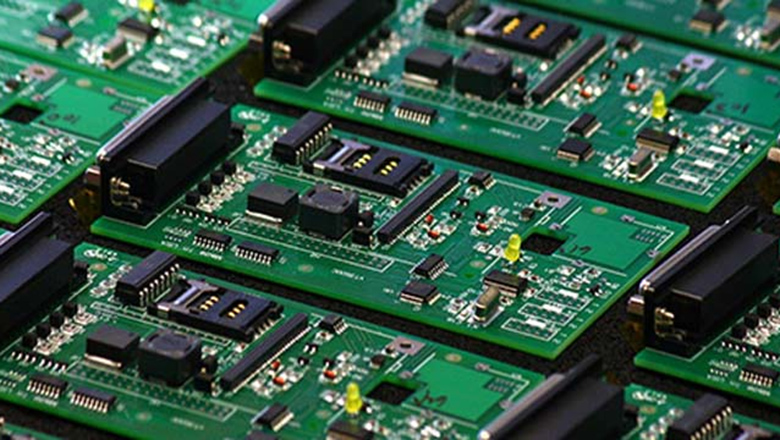
Every electronic device is built on high-quality printed circuit boards. Smartphones, laptops, medical instruments, electric vehicles and other products all adopt such circuit boards.Driven by technological advances and the explosive growth in demand for large-scale electronic products, the PCB industry has now shifted from early-stage small-batch PCB production to mass manufacturing of printed circuit boards.
Key milestones in PCB evolution:
- Switch from manual wiring to PCBs:Early electronics involved point-to-point wiring. The adoption of the linear process with no layout made PCBs scalable, consistent and far easier to design for manufacturing.
- Introduction of automated process equipment:Automated pick-and-place machines and reflow ovens ramped up production rate and quality.
- Emergence of high-volume PCB assembly services:These made it possible to consistently produce PCBs in large quantities at unmatched speeds.
Understanding High-Volume PCB Assembly Services
What Is High-Volume PCB Assembly?
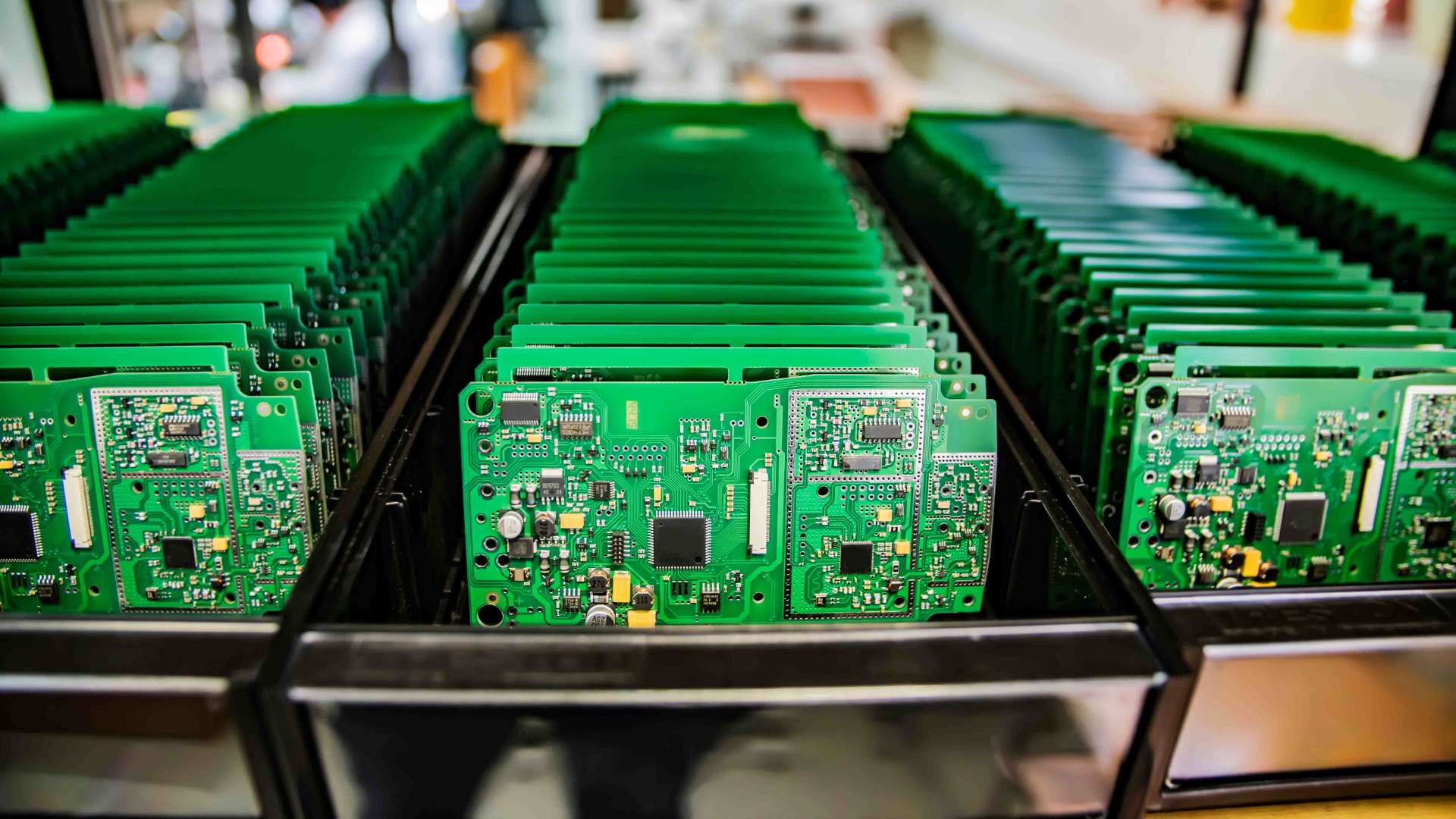
High-volume PCB assembly uses a unified production process to manufacture identical circuit boards. The production volume for this process ranges from tens of thousands to millions of units. This production model relies on highly automated equipment to complete circuit board manufacturing, implements strict assembly procedures, and enforces standardized testing processes. High-standard quality control requirements run through the entire production process.
Core Characteristics of High-Volume PCB Assembly:
- Automated manufacturing:Employs place machines to mount components on boards at high speed, reducing labor costs and errors.
- Consistent production process:A standardized PCB assembly process is strictly followed. High efficiency during production and product reliability in operation are achieved through this process.
- Scalable production and assembly:This design serves the transition from prototype production to large-scale, high-volume printed circuit board manufacturing. The same equipment systems and processes are used for both prototype and mass production, without requiring major adjustments to equipment or procedures during this transition.
- Strong focus on structural integrity:Structural integrity and electrical performance must be consistently maintained across all high-volume PCBs.
High-Volume Assembly Involves:
- Optimizing pcb design for large-scale manufacturability (emphasizing design for manufacturing principles).
- Documenting robust assembly and testing workflows—each step from stencil printing to testing methods is specified and controlled.
- Partnering with a high-volume printed circuit board manufacturer experienced in large-volume printed circuit board production.
Low-Volume vs. High-Volume PCB Assembly: What’s the Difference?
Key Differences:
| Feature | Low-Volume Formation Process | High-Volume PCB Assembly |
| Batch Size | 1–1,000 PCBs | 10,000–1,000,000+ PCBs |
| Flexibility | High; suitable for prototyping | Lower; design must be finalized |
| Production Cost per Unit | High; less automation | Low, due to economies of scale |
| Testing Methods | Manual/spot inspections | Automated AOI, ICT, X-ray, functional |
| Production Process | More manual interventions | Linear, automated, high-throughput |
| Typical Use | R&D, NPI, small market releases | Mass-market launches, global scale |
The Shift from Prototyping to High-Volume Assembly
Low-volume PCB assembly is ideal for mock-ups, proof of concept, and short production runs where PCB design might change. High-volume PCB assembly, on the other hand, is engaged once design files and testing protocols have been fully validated.
Key Advantages of High-Volume PCB Assembly

High-volume PCB assembly offers several compelling advantages for any company scaling their electronics production:
1. Cost Efficiency Due to Economies of Scale
- The bulk purchasing model lowers the unit cost of materials.The automated manufacturing system reduces reliance on manual labor.Together, these two measures drive down both material costs and labor costs.
- Lower cost per board:Increased production volumes of circuit boards lead to a significant reduction in unit costs. This cost-saving effect plays a decisive role in maintaining competitiveness within the consumer electronics or automotive supply chains.
2. Enhanced Quality and Consistency
- Strict quality control protocols are built into every phase of the large-volume printed circuit board production process.
- Automated inspection (e.g., AOI, X-ray) detects errors and inconsistencies much more reliably than manual inspection.
- Standardized assembly and testing ensures each board meets high-quality PCB item expectations.
3. Faster Time to Market
- Automated SMT lines, digital documentation management, and optimized production rates shrink lead times from months to weeks or even days.
- High-volume PCB assembly services can turn orders for tens of thousands of boards in a fraction of the time required by traditional assembly.
4. Superior Testing and Reliability
- Assembly and testing procedures in high-volume PCB assembly involve ICT, AOI, functional tests and environmental cycling for every production batch.
- Detailed tracking of PCB design files and layout files from the prototype producer to the contract manufacturer ensures traceability and quality documentation.
5. Scalable Growth
- High-volume PCB assembly enables easy ramp-up in production volumes when demand spikes, and minimal cost increases compared to small-volume runs.
- Enables market expansion and supports global launches.
The High-Volume PCB Assembly Process

Overview: From Prototype to Production
Design for Manufacturing (DFM):
Before producing PCBs in large quantities, designs are validated and checked for manufacturability, testability and cost efficiency.
Contract producers for your PCB design will review for optimal pad placement, solder mask design and component spacing.
Manufacturing Partner Handoff:
Design files from the prototype producer are transferred to a contract producer for your PCB.
Comprehensive review to ensure production and assembly readiness.
Automated Manufacturing and Assembly
Solder Paste Printing: Optimized stencils or jet printing for even application.
Component Placement: Place machines assemble thousands of boards per hour.
Soldering: Reflow ovens for SMT, wave soldering for THT.
Depanelization: V-cut or tab-routing for efficient panel break-down.
Inspection and Testing Methods:
Automated Optical Inspection (AOI): Checks solder joints and component orientation.
In-Circuit Test (ICT): Verifies electrical connections.
X-ray Inspection: For hidden joints (BGAs, QFNs).
Functional Testing: Ensures that the assembly delivers required system performance.
Final QA and Batch Release
All high-volume printed circuit board assemblies undergo final inspection before release.
Applications of High-Volume PCB Manufacturing
High-volume PCB assembly services make it possible to serve every electronic sector that demands both scale and reliability. Here are just some of the most impactful areas:
1. Consumer Electronics
- Smartphones, wearables, tablets, gaming consoles.
- Need high-volume PCB assembly for seasonal launches and rapid innovation.
2. Automotive & Transportation
- ADAS, infotainment, EV power systems, safety controllers.
- Demands both large quantities and strict quality/testing methods due to regulatory oversight.
- Every high-volume PCB assembly involves rigorous burn-in, traceability for potential recalls and environmental stress testing.
3. Medical Electronics
- Diagnostics, monitoring and imaging equipment.
- High-quality PCB items are not just about yield, but about life-critical reliability and strict quality.
- Only mass production enables the contract manufacturer to provide both FDA/ISO-level traceability and cost-controlled production.
4. Industrial Automation & Controls
- IoT devices, PLCs, robotic controllersand sensor hubs.
- Large-volume printed circuit board production keeps up with industry 4.0 and smart factory deployments.
- Automated manufacturing ensures robust PCB assembly process for harsh or continuous-duty environments.
5. Telecommunications & Networking
- Routers, switches, high-speed comms backplanes.
- High-volume PCB fabrication and assembly are required to keep up with global rollouts.
- Consistent impedance control and advanced assembly and testing guarantee high-frequency signal integrity.
Selecting a Partner for High-Volume PCB Assembly
Choosing the right contract producer for your PCB design is essential—especially when scaling up to millions of units. Here’s what to look for in a manufacturing partner:
Partner Evaluation
| Selection Criteria | Why It Matters | How to Evaluate |
| Experience in high-volume PCB assembly | Reduces scaling risk and speeds up setup | Ask for case studies, visit facility |
| Certifications | Ensures compliance and quality (e.g., ISO, IPC-A-610) | Request audit, review certification |
| Capacity for large quantities | Keeps up with your production forecast | Review equipment, staff, production rates |
| Advanced automated process | Delivers yield and consistency at scale | Examine automation, QA, test methods |
| Testing and QA | Critical for electronics industry reliability | Inspect AOI/X-ray, ICT, FCT capabilities |
| Global logistics support | Cuts delivery/freight risks for global launches | Ask about prior global shipments |
| Communication & documentation | Prevents errors and inefficiencies | Ensure clear file protocols, fast issue response |
Questions to Ask Your PCB Assembly Service:
- What is your annual high-volume PCB assembly output?
- Can you support rapid changes in production rate?
- Are your testing methods and inspection equipment up to date?
- Do you have established procedures for DFM reviews and layout file management?
- How do you handle errors and inconsistencies during mass production?
Common Challenges & Industry Solutions in High-Volume Production

Common Pitfalls
- Errors and Inconsistencies in Design Files:
Ensure all files from the prototype producer are up to date and validated before transfer.
- Component Shortages:
Secure supply chain and alternate approved sources to avoid production bottlenecks.
- Production Rate Issues:
Match projected demand with actual manufacturing capacity; avoid line overload.
- Testing and QA Gaps:
Rely on partners with proven assembly and testing, including batch traceability and automated test logs.
- Communication Lapses:
Maintain real-time updates between your team and your assembly partner for every production cycle.
Solutions
- Utilize file version control and shared documentation platforms.
- Work with partners that provide real-time tracking for both procurement and assembly.
- Standardize approval gates for every key high-volume PCB assembly process.
- Schedule regular “DFM/DFT” feedback reviews to preempt design-manufacturing mismatches.
Emerging Technology Trends in PCB Manufacturing
- AI-driven QA:Next-gen AOI and ICT equipment use machine learning to spot subtler defects and predict process drifts.
- Smart Factory Integration:IoT sensors provide minute-to-minute environment, process and yield data, maximizing uptime and catching issues early.
- Eco-Friendly Manufacturing:Closed-loop PCB processing and RoHS-compliant materials ensure responsible, future-proof production and assembly.
- Blockchain for Traceability:Full chain of custody for every PCB, crucial for high-stakes industries (aerospace, automotive, healthcare).
Advanced technology is not just a marketing boast—it’s now necessary for efficiency, compliance and continuous improvement in high-volume PCB assembly.
FAQs About High-Volume PCB Assembly
Q: What makes high-volume PCB assembly different from small-volume assembly?
A: High-volume PCB assembly utilizes automated equipment and standardized processes. This production model completes large-scale circuit board manufacturing through rigorous testing. Low-volume PCB production relies primarily on manual operations. This model is characterized by production flexibility. The unit production cost for its circuit boards is relatively high.
Q: Why ensure a partner for high-volume PCB assembly has multiple certifications?
A: ISO 9001 and IPC-A-610 are commonly recognized certification standards within the industry. Through these certifications, manufacturers are required to follow verified production processes when manufacturing electronic products. This approach helps reduce deviations and errors during production, ensuring that products meet the entry requirements for global markets.
Q: How does production costs compare for high-volume vs. low-volume PCB assembly?
A: Production costs per unit drop dramatically with volume due to economies of scale, automated manufacturing and more efficient use of materials and staff.
Q: What role do advanced testing methods play in high-volume PCB manufacturing?
A: These methods detect early issues in the assembly and testing procedures, safeguard against errors and guarantee the quality of every printed circuit board.
Q: Can high-volume assembly enable quick turnaround for market launches?
A: Yes! With streamlined DFM reviews, digital file handling, and robust automation, a high-volume printed circuit board manufacturer can support extremely rapid production cycles for new product launches.
Conclusion & Next Steps
As the electronics industry accelerates, high-volume PCB assembly services are essential for delivering reliable circuit boards in large quantities and at optimized costs. The move from PCB design to high-volume assembly involves careful planning, validated files from the prototype producer, a reliable contract producer for your PCB and rigorous assembly and testing throughout the production process.
Choosing the right manufacturing services and assembly partner unlocks all the advantages of high-volume PCB: affordability, uniformity, scalability and global reach. High-volume PCB assembly involves much more than just making a lot of circuit boards—it ensures your product delivers quality, reliability and speed to market in every electronic you build.
Are you interested in such services or planning to scale up your circuit board assembly?
Contact LHDPCB, your trusted high-volume printed circuit board manufacturer and assembly partner, today for a quote, friendly engineering advice or a comprehensive DFM/DFT review. Let’s build electronics for the world—at the speed, quality and scale you need.