Introduction to the World of PCB Glue
Amid the rapid wave of innovation in the electronics industry, printed circuit boards (PCBS), as the cornerstone of modern technology, drive every evolution from smartphones and computers to medical devices and automotive electronics. However, in this precisely constructed microscopic world, there is an unsung hero who quietly guards the integrity and long lifespan of circuits and is often overlooked – PCB encapsulation adhesive. As a leader deeply engaged in electronic process solutions, LHD TECH is well aware of this. This comprehensive application guide for PCB adhesives, which we have painstakently crafted, not only deeply analyzes the applications and types of various adhesives, but also gathers LHD TECH’s professional wisdom in the field of electronic adhesives.The most important topic of questions about PCB glue that aims to reveal to you how to inject reliable genes into high-performance electronic products through the right material selection and process.
Whether you focus on PCB assembly, design and development, or precision maintenance, LHD TECH always emphasizes that choosing the right glue for electronics is the inevitable path to outstanding product performance. From high-strength epoxy resin, flexible protective silicone to convenient and reliable hot glue, a deep understanding of the diversified PCB glues solutions provided by LHD TECH will ensure that your circuit boards remain as solid as a rock and perform as well as before even in the most demanding application environments.
What is PCB Glue?

From our professional perspective, PCB glue – or circuit board adhesive – is a type of special adhesive specifically developed for printed circuit boards. Its core mission is to firmly fix components, achieve electrical insulation and provide all-round protection.
This is a world of different types of PCB adhesives you can casually buy in a hardware store. In the rigorous electronic manufacturing process, only professional PCB glue solutions can meet the ultimate requirements of high-reliability products.
Our adhesives precisely protected the PCB every critical position: tiny surface mount components (SMDS), slender wires, precise connectors, and even entire functional modules. What is even more worth mentioning is that different type of adhesive can also play their respective roles – some are good at absorbing vibrations to reduce the burden on circuits, some are proficient in heat conduction or insulation management, some are responsible for precise conductivity or tight insulation, and some can build a defense line against the erosion of moisture and chemical substances. The solutions we offer all aim to maximize value where it is most needed.
What Does PCB Glue Do?
- PCB glue secures is like providing a bodyguard for each pcb components on the circuit board. Whether it is experiencing bumps on the production line or running for a long time in terminal equipment, it can maintain a firm fit.
- Put on a “shock-absorbing suit” for the delicate chip. Glue is like an elastic armor that can absorb all these external impact forces, glue to protectsensitive components stable on the board.
- Strictly adhere to the bottom line of insulation and prevent “wire stringing” accidents. PCB adhesive is a reliable insulating wall, ensuring that both current and signals are safe and smooth.
- Build an all-weather protective cover that is moisture-proof, dust-proof and corrosion-proof. After the adhesive is fixed on the board, it forms a tough protective film, allowing the circuit board to work safely anywhere.
Why PCB Glue is Crucial in Electronics

In our view, the reason why PCB glue is crucial in the electronics industry is far more than simply sticking components onto the board. Today, let’s delve into how this seemingly unremarkable glue for electronics ensures the best performance and ultra-high reliability of the product.
1. Mechanical Stability
Whether on the pcb assembly or during transportation, the most important thing for circuit boards is shock resistance. Choosing the right type of glue is like fastening a “safety belt” to each component, pcb glue holds firmly fixing it in place and ensuring the safety of the board no matter how diverse the external environment is.
2. Thermal Management
Some high-power components operate like small furnaces. If the temperature is too high, their lifespan will be shortened. At this point, a special epoxy pcb glue with thermally conductive adhesives has to be used. Its function is to dissipate heat rapidly, protected components from damage and extend the lifespan of the entire board.
3. Electrical Insulation
Most pcb glues are non-conductive, separating the densely packed pins and circuits to prevent them from crossing and causing short circuits or signal crosstalk especially for hardware applications requiring EMI control. Except in special circumstances where grounding or shielding of electromagnetic interference is required.There are also conductive PCB glue that can directly replace welding and solve problems neatly and efficiently.
4. Environmental Protection
In those damp, dusty or chemically corrosive environments, high-precision circuit boards are directly exposed and prone to corrosion. Our pcb glue is like putting on an all-weather protective and electronic components or hardware, keeping out moisture, dust and corrosive substances. Especially in harsh environments like automotive applications, this layer of protection is indispensable.
5. Flexible and Miniaturized Designs
Nowadays, flexible circuit boards are becoming increasingly popular electronics manufacturing. The boards can even be bent, so the glue should not be too hard. We have different types of PCB glue, which can not only bend along with the board but also firmly hold the components, ensuring that the structure of the circuit remains stable during bending, without breaking or cracking.
Applications and Types: Using PCB Glue in Electronics
PCB glue is used in a wide range of applications due to its versatility as well as the different types of PCB adhesives available today.
Applications like:
- Component attachment: No matter how large the surface mount component (SMD) is, or whether it is a precise connector or sensor, as long as PCB adhesive is applied, it can be immediately fixed on the board.
- Wire tacking glue: First, use the wire harness fixing adhesive to firmly adhere the signal line or power line to the edge of the pad, and then continue the welding work to improve work efficiency.
- PCB lamination:How are the inner circuits of some high-end multilayer circuit boards bonded together? Through our laminating adhesive, each layer is firmly bonded together to ensure that the internal circuits fit tightly.
- Thermal interface: Do chips with high heat generation need to be equipped with heat sinks? I use thermal conductive adhesive, sticking one end to the heat-generating element and the other end to the heat sink to speed up the heat dissipation.
- Encapsulation and potting: Some circuit boards need to operate in damp and corrosive environments, especially when potting compound is used to seal them as a whole, which is equivalent to putting on a high-molecular protective suit for the entire board.
- Vibration protection:Especially in fields such as automotive applications, industrial control, and aerospace, the equipment shakes non-stop as soon as it starts up. Glue specifically designed for this type of scenario is needed to firmly solidify all components.
Popular Circuit Board Adhesive Applications and Types
| Application | Best Glue Type | Notes/Key Benefits |
| SMD fixation | Epoxy, acrylic, UV-curable | Fast cure, strong mechanical stability |
| Wire tacking | Cyanoacrylate (super glue), silicone | Temporary, rapid, flexible |
| Edge bonding (flex to rigid) | Silicone adhesives, flexible epoxy | Prevents delamination in flexible electronics |
| Heatsink & power device attachment | Thermally conductive epoxy glue | Superior heat dissipation |
| Full PCB encapsulation (potting) | Silicone, polyurethane resin | Max waterproofing, chemical shielding |
| EMI/grounding/ESD protection | Electrically conductive adhesives | Grounding, shielding in high-frequency PCBs |
| Quick repair / prototyping | Super glue, hot glue, acrylic | Fast fixes, not for production |
Types of PCB Glue and PCB Adhesives

There are many applications and therefore many pcb glue types. The best type of glue depends on board material, production process, and end-use case.
1. Epoxy PCB Glue
- The standard for pcb assembly due to great mechanical strength, thermal stability, and chemical resistance.
- There are two-component ones that should be mixed and used immediately, and there are also single-component ones that can be used directly after opening the lid. Whether it is for fixing components, potting protection, or temporarily fixing wire harnesses, there are applicable epoxy adhesives.
- Once the epoxy glue cures, it becomes like a “golden shield and iron shirt”, remaining stable and reliable in insulation no matter how the electronics and hardware applications.
2. Silicone Adhesives
- Flexible and vibration-resistant, capable of bending and extending: In scenarios where impact resistance, vibration protection, or where the board itself can be bentwith silicone.
- Edge reinforcement, wire harness “unbinding” : It is particularly suitable for edge reinforcement of boards, stress release of cables, or potting protection for heat-sensitive components.
- Alternating between hot and cold, handle it calmly: If the equipment is repeatedly turned on and off, the board will experience sudden changes in temperature, and ordinary glue may crack.
3. Acrylic Adhesives
- Known for fast curing (often under a minute with UV-curing).
- Useful in automated high-speed pcb production.
- Suitable for heat-sensitive components and often used for surface-mount glue.
4. UV-Curable PCB Adhesive
- Allows precise application and fast cure with UV light—ideal for high-volume, consistent production.
- Preferred for attaching miniature sensors, cameras, and connectors where heat from traditional curing could be damaging.
5. Conductive Adhesives
- It is not merely glue; it is mixed with conductive PCB fillers such as silver, nickel or graphite. After curing, it forms an electrical “highway”, allowing current to pass through as usual.
- Transparent circuits, precision display screens, or places where electromagnetic shielding is required. At this point, conductive adhesive comes in handy. Once stuck, it can conduct electricity, and the process is simple.
6. Cyanoacrylates (Super Glue)
- The classic “super glue” is a staple in PCB repair, fast prototyping, and wire-tacking glue applications.
- It should be used sparingly; it tends to become brittle and is NOT ideal for parts under regular stress.
7. Hot Glue
- In scenarios such as laboratory debugging, prototype verification, or DIY by enthusiasts, hot melt adhesive is a versatile tool without any problem. It is often used to temporarily fix components, relieve stress on cables, or simply insulate them.
- If it is only a short-term test or a quick verification of the design is needed, a dot with hot glue can not only prevent the wire ends from breaking but also quickly position them. Although it is not the first choice for those pursuing high reliability, it has the advantages of convenience and affordability.
- Use hot glue for PCB repair only on non-critical points—never for structural support of heavy components, nor where heat may melt the glue over time.
- Hot glue can be used to secure wires inside enclosures, hold connectors temporarily during testing, or as a removable mask for coating operations.
Best Practices for Using PCB Glue

Success in electronics manufacturing depends on both choosing the right glue type and best practices for using PCB glue in each scenario.
General Best Practices
- PCB Surface Preparation preparations must be made. The board should be clean and firmly adhered. Before starting, be sure to wipe the board clean with isopropyl alcohol. flux residue, oil stains on hands and dust should be cleaned up first.
- Apply the Glue Evenly Whether using a manual syringe, automated dispenser, or screen printing, ensure even application. PCB glue holds most effectively when spread thinly and evenly, without air bubbles.The application of adhesive should be uniform, with a thin layer being sufficient, whether it is for needling, machine spraying or screen printing. The glue should be spread thin and flat without any bubbles, so that the adhesive force is the greatest.
- Allow Proper Curing Time must be sufficient. Some type of adhesive need to be heated, some need to be exposed to a UV lamp, and some can dry on the spot. Please operate strictly in accordance with the requirements, especially those are sensitive components to heat.
- Avoid Excess Glue the mean is not the more the better. For instance, as components become smaller and smaller, if there are too many glue dots and they overflow, it can easily lead to short circuits (especially conductive glue), or the adjacent components may get stuck. Just to the point, just right.
- Before batch production, Check Compatibility test must in the first. Material matching is very important.With many types of PCB materials FR4, ceramic plates, flexible plates, aluminum-based plates… The compatibility of different boards with adhesives varies.
- Document & Inspect Process traces should be recorded. It is necessary to develop the habit of noting down details such as process batches, operators, temperature and humidity levels, and curing duration. After completion, check it again with a magnifying glass to ensure that the glue is properly covered, there are no voids, and the components are in the right position to guarantee the normal performance of the board.
How to Choose the Right Type of Glue for Circuit Boards

Selecting the right glue for circuit boards requires a careful match of glue type, pcb materials, and hardware applications.
Considerations When You Choose the Right PCB Glue:
- Component Weight and Size: If the board is equipped with heavy components such as transformers and large inductors, ordinary glue will not meet the requirements. High-strength epoxy adhesive must be used, and both tensile and shear strengths must be hard enough.
- Environmental Exposure:For automotive-grade or industrial-grade boards, toughened epoxy should be used. It is both strong and impact-resistant, and is a tough player in shock resistance and water resistance.
- Thermal and Electrical Needs: For leds or power chips, thermal conductive epoxy should be used to help dissipate heat as quickly as possible. If there is a need for electromagnetic shielding, conductive adhesive should be used, which can both stick and conduct.
- Assembly Method: High-speed mass production lines emphasize efficiency and require rapid curing. UV curing glue or acrylic glue dries in just a few seconds after being exposed to light, and the flow rate is extremely fast.
- Need for Flexibility: Nowadays, there are more and more flexible boards and rigid-flex boards. If the glue is too brittle, it will crack as soon as it is bent. It is necessary to choose elastomers such as silicone or polyurethane glue.
- Rework and Repair Requirements: During the sample-making stage or in maintenance scenarios, models that can be softened by solvents or peeled off without damage after heating should be used. Only in this way can the pads not be pulled off during rework.
Application Methods: How to Apply PCB Glue Effectively
Modern PCB glue applications employ several methods, each suited for different circuit board adhesive applications and volume scales.
Application Techniques:
- Manual Dispensing: Using a syringe or a narrow-mouthed bottle to manually apply glue requires good hand steadiness and precise eyesight. It is most suitable for making samples or repairing single boards. It is very flexible, but the drawback is that it is slow.
- Automated Dispensing: Mass production requires machines, with the procedures set up properly. Every drop of glue is placed and used in exactly the same way, resulting in extremely consistent boards. This solution is the key to ensuring both efficiency and quality for high-volume electronics manufacturing.
- Screen Printing or Stencil Application: This is the most commonly used method when attaching SMD components. Make a steel mesh that is precise down to the exact spot for dispensing glue. This method is extremely efficient and almost no waste is produced.
- Jet Dispensing: The smaller the board is, the more densely the components are packed together. Traditional needles may not be able to fit in. At this point, a jet valve has to be used. Just like in an inkjet printer, it sprays tiny droplets of glue onto the target in a non-contact manner, which is fast and accurate.
- Brushing/Spraying: Should we apply a protective coating to the entire board (such as a three-proof paint)? Using a brush or a spray gun is the most straightforward method. Covering the entire area quickly will provide the board with protection against moisture, dust and corrosion.
- Rolling Application: When making multi-layer circuit boards, the layers need to be bonded together. Use a roller to evenly apply the glue onto the board, then stack several layers of boards and press them together to ensure there are no air bubbles and the thickness is consistent.
PCB Glue vs. Soldering: Differences and Use Cases
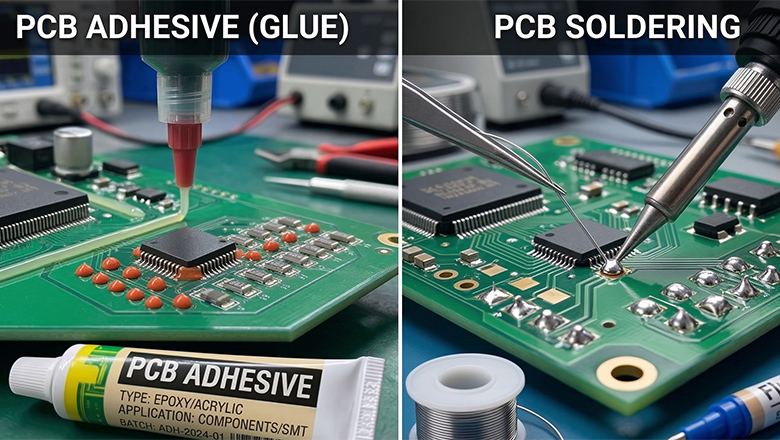
Both gluing and soldering play roles in pcb assembly. PCB glue is used for structural, thermal, and sometimes electrical roles, while soldering is primarily for electrical connectivity.
When to Glue, When to Solder?
Glue for electronics:
- Component fixation before wave or reflow soldering (especially SMDs)
- Bonding flexible PCBs
- Potting, encapsulation, or where thermal/electrical insulation or conduction is needed
- EMI/ESD/grounding via conductive adhesives
Solder for:
- Direct electrical connection of leads/pads
- When maximum electrical conductivity and mechanical strength are both required
Hybrid Approach: For the most reliable circuit boards, use solder to connect and the right PCB glues to anchor, protect, and seal components.
Troubleshooting PCB Glue Issues & PCB Surface Preparation
Implementing best practices for using PCB glue helps, but issues still arise. Here’s how to solve the most common problems:
| Problem | Cause | Solution |
| Poor adhesion | Dirty PCB surface, wrong glue type | Clean with alcohol; use correct adhesive |
| Bubbles/voids | Fast application, trapped air | Slow down application; degas glue |
| Glue overflow | Over-application | Calibrate dispenser; use templates |
| Incomplete cure | Wrong cure process/environment | Verify time, temp, humidity; check UV/oven |
| Component misaligned | Too much glue or slow fixture | Reduce glue; speed up cure or use jigs |
Surface Preparation:
- Use lint-free wipes with isopropyl alcohol to prep the PCB surface.
- Avoid touching cleaned surfaces; fingerprints introduce oils that sabotage adhesion.
Removing and Softening PCB Glue Properly
Whether fixing design mistakes, reworking to replace failed components, or updating assemblies, knowing how to remove and soften the glue can save both time and product value.
Removal Techniques By Glue Type
- Epoxy/thermally cured adhesives:Soften by heating and gently pry.First, use a hot air gun to heat it up to 80 to 120 degrees. When it softens slightly, you can gently scrape it off with a plastic prying tool or your fingernail.
- Acrylic/hot glue:Solvent dissolution, heating assistance, hot melt adhesive is the simplest, or a few drops of alcohol (IPA) and soaking for a while can also loosen it. If it is acrylic, you can use a cotton swab dipped in acetone to wipe it carefully.
- Silicone:Tear first and then wipe. Finish with solvent. Remove the main part by hand or with tweezers. The remaining oil film needs to be removed with a special silica gel remover.
- Cyanoacrylate:A special de-gummer is the most reliable. Use a de-gummer (acetone is also fine, but be careful) and drop it on. After it reacts for a while, it will become soft.
- Conductive glues:When using alcohol, handle it gently. Conductive adhesives usually contain particles like silver powder. When repairing, dip a cotton swab in an adequate amount of IPA, gently roll and wipe it off while soaking. Do not scrape it with hard objects to protect the conductive layer well.
- UV-cured glues:First, use a hot air gun to blow, then soften it and scrape it. When it changes from a glassy state to a softened state, use a plastic rod to gently pry open this layer.
FAQs About PCB Glue Removal
LHD TECH is often asked, “Can Gorilla Glue be used for electronics or PCB repair?” Here’s a clear statement for you:
Although Gorilla glue is indeed powerful in the field of home repair, when it comes to the precise repair of circuit boards, it is really not ideal for circuit board. The problem lies in three aspects: First, it will expand during the curing process, which may tilt or even crack the surface mount components. Secondly, its heat resistance cannot compare with that of genuine electronic glue. Once the board gets hot, it is prone to breaking. Thirdly, its chemical composition may be incompatible with the PCB board, and over time, it may even corrode the circuit.
For professional and reliable repair results, LHD TECH still recommends using the right tools – epoxy glue for strong fixation and silicone adhesives rubber for flexible protection. These are forces specifically developed regular for electronic environments. Only by choosing the right glue can the repaired board last for a long time.
How do you soften the glue when repairing circuit boards?
Depending on the type of adhesive:
- Epoxy resin adhesive: First, use a hot air gun to adjust the temperature to 80-120 °C for gentle heating. Once the adhesive slightly soften, use a plastic prying tool to slowly lift it. Do not force it to avoid breaking the solder pads or copper sheets.
- Hot gule: Reheat it to a molten state with a low-temperature hot air gun. While it’s still hot, gently wipe it off with tweezers or a cotton swab. If there is any remaining adhesive after cooling, wipe it clean with alcohol.
- Acrylic or cyanoacrylate (CA adhesive) : A small amount can be dipped in isopropyl alcohol (IPA) or acetone for local softening and dissolution. While soaking, gently wipe. Be sure to test it in an inconspicuous place first to ensure that the solder mask is not corroded before expanding its use.
- Silicone adhesives: Some silicone gel requires a special remover to completely dissolve the residue. It is recommended to first refer to the supplier’s specification sheet or directly consult LHD TECH technical support to obtain a matching removal solution.
We often encounter customers asking this question: “Does any glue conduct electricity?”
Here’s a clear explanation for you:
The vast majority of pcb glues are inherently insulators, which is to ensure that there are no random connections or signal crossovers between circuits. But if you do need to conduct electricity, there are also specialized electrically conductive adhesives available on the market – usually by adding silver powder, nickel powder or carbon powder to epoxy or silicone substrates, making the glue both adhesive and conductive PCB.
Emerging Trends: Innovations in PCB Glues
The electronics industry is fast-moving, and pcb glue types are evolving for more demanding applications:
- Eco-Friendly and Low-VOC Formulations:As sustainable development has become a consensus in the industry, the market is introducing more type of adhesive low-VOC (volatile organic compounds) or even zero-VOC adhesives. These environmentally friendly products not only reduce the impact on the environment but also improve the safety of operators during their work.
- Smart Glues for Predictive Maintenance:The new generation of adhesives is beginning to possess “sensing capabilities”. For instance, some will change color after curing, which makes it convenient for quality inspection personnel to confirm with the naked eye whether the glue is completely cured. Some are mixed with nanoparticles, which can be more easily identified as defects by optical equipment during pcb production inspection, achieving early fault warning.
- High-Thermal Conductivity and Low Dielectric Constant:For high-frequency and high-speed application scenarios such as 5G radio frequency and LED lighting, LHD TECH has launched special glue for circuit boards that combine high thermal conductivity and low dielectric constant. While quickly dissipating heat, it can also ensure that the interference to high-speed signals is minimized, achieving both performance and heat dissipation.
- Reworkable Adhesives:In high-value fields such as automobiles, industrial control, and medical electronics, single-use is becoming a thing of the past. Removal and re-bonding in various applications emerged as The Times require. While maintaining sufficient fixed strength, it can be gently softened and removed, facilitating component upgrades or replacements and reducing electronic waste from the source.
- Multi-Functional Glues:When the board becomes smaller and smaller and the components are squeezed more and more densely, single-function glue is no longer sufficient. The multi-functional adhesives launched by LHD TECH, such as those with both electromagnetic shielding (EMI) capabilities and high mechanical strength, can solve two pain points with a single application, leaving more space for the design of high-density, mixed-process boards.
Industry Use Cases: Automotive, Consumer, Medical, Industrial, Aerospace
Automotive Applications
- In ECUs (Electronic Control Units) and various safety sensors, the core use of PCB glue lies in providing strong vibration resistance protection, ensuring that every critical connection remains intact throughout the vehicle’s entire life cycle.
- Silicone adhesives with its resistance to high and low temperatures and flexibility, has become the preferred choice for protecting sensitive circuits in harsh environments such as engine compartments. Conductive adhesives, on the other hand, focus on electromagnetic shielding (EMI) to clear the field and reduce noise for high-speed vehicle-mounted communication.
Consumer Electronics
- Acrylic adhesives, with its rapid curing property, is perfectly adapted to the high-speed assembly lines of wearable devices, TWS headphones and smart phones, facilitating lean production.
- During the prototype verification and R&D debugging stages, hot glue remains a flexible and reliable tool at the hands of engineers, often used for the temporary fixation and rapid positioning of wiring harnesses.
Medical Devices
- For medical devices that need to undergo sterilization treatment, come into contact with body fluids or be implanted in the human body, the PCB assembly must use biocompatible epoxy adhesives and polyimide These materials not only need to meet strict regulations such as ISO 10993, but also ensure absolute stability of insulation and protection in extreme environments.
Industrial Controls, Aerospace
- PCB glues with precise thermal and dielectric properties prevent field failures in PLCs, robotics, and avionics.
- Low-outgassing pcb glue types are mandatory for satellite or aircraft electronics to protect sensitive optical or RF paths.
PCB Glue FAQs: Questions About PCB Glue
What are some common types of PCB glue?
Epoxy, silicone, acrylic, UV-curable, hot glue, and electrically conductive adhesives. Each has unique applications and strengths—epoxy for mechanical and thermal, silicone for flexibility, acrylic for speed, and conductive for EMI.
Can I use hot glue on a PCB?
Hot glue can be used in certain non-critical, insulated, or temporary tasks, but it isn’t a substitute for purpose-made PCB adhesives in high-performance or safety-critical applications.
Which glue type should be used for surface-mount glue?
Surface-mount adhesives are often acrylic or epoxy-based, UV- or heat-cured, and selected for rapid assembly and compatibility with surface-mount glue processes.
Does glue conduct electricity?
Most glues for PCB assembly are insulating. Only those labelled as “conductive” will carry current, and even then, not at the same level as a solder joint.
How do I select the right type of adhesive for my application?
Check requirements for strength, flexibility, environmental resistance, curing time, rework needs, and electrical/thermal characteristics. Consult supplier datasheets and, if needed, request samples for in-house qualification.
How can I protect the PCB from vibration or shock?
Choose silicone adhesives or flexible epoxies. For edge bonding on flex-to-rigid or in high-vibration zones, these glues are ideal.
How do I soften the glue to remove a failed part?
Refer to removal section—gentle heating, IPA, or solvent according to glue type. Some adhesives are specifically designed for rework.
Does using PCB glue interfere with soldering?
If applied correctly, no. It’s critical to avoid glue on pads or traces that require solder; use adhesive only as recommended for mounting areas.
Conclusion: PCB Glue in Electronics Manufacturing
As this ultimate guide to PCB glue has demonstrated, understanding the types of PCB glue, their applications and types, and best practices for using PCB glue is critical for everyone in the electronics industry. The right glue for electronics not only improves durability and reliability but also enables modern innovations—from ultra-thin devices to rugged automotive modules.
PCB glue provides more than just stick: it is the foundation of thermal management, vibration absorption, electrical integrity, and protection against real-world hazards. By following best practices, choosing the right glue type, and staying updated on innovations in PCB adhesives, designers and engineers can ensure that electronic products thrive even in the most demanding environments.
For further insights, always consult with experienced partners or suppliers who have direct experience in the PCB industry. The “right glue” is the one that makes your design reliable, manufacturable, and ready for the future.