Introduction to Busbars
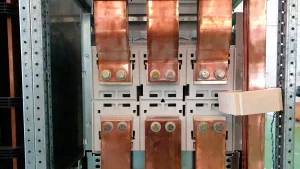
In the world of electrical power distribution, the busbar is a base component that enables the reliable operation of electrical systems in everything from skyscrapers to data centers and renewable energy farms. The busbar is the mother line for all components parts. A busbar is a metallic strip or bar used as a central point for power distribution, designed to handle and distribute large amounts of electrical current efficiently. Typically found in electrical panels, switchgear, substations, and modern electronics, busbars are connector to electrical power distribution and electrical construction.
Busbars are commonly used to get together several electrical devices and provide a low resistance path for electrical current. This keeps superior electrical conductivity, high current power handling, and long-term reliability even in demanding environments like outside the door electrical substations or high-performance electrical manufacturing area.
Busbar Definition and Basic Purpose
What is a Busbar?

A busbar is a metallic strips or bar ties—typically made of copper or aluminum—designed to tie and distribute electricity within a vast range of electrical distribution systems. Known for their excellent electrical conductivity, busbars offer a robust way for electrical current with minimal resistance and voltage drop. A busbar also named bus bar, it is a metal part used in electrical to collect large currents. Whether referred to as a busbar, bus bar, or metallic bar connector, the concept remains the same: a durable, efficient backbone for electrical power distribution.
Key Points:
- A busbar is typicallya flat bar, round busbar, or rigid busbar.
- Busbars are integral to power distribution systems, simplifying electrical connections and making large-scale wiring more mageable.
- Busbars may feature rectangular or cross sections, providing a lage surface area which aids in heat dissipation and increases current rating.
Why Are Busbars Used in Electrical Systems?
- Simplified Power Distribution: Instead of running multiple wire, a busbar acts as a central hub that can easily distribute electrical current to multiple devices.
- Mechanical Strength and Reliability: Busbars offer superior mechanical performance and are robust against mechancal vibrations and shocks.
- Efficient Power Distribution: Their large cross-sectional area allows them to carry higher currents more efficiently than typical wires.
- Scalability and Modularity: Expansion or modifiction is much simpler in busbar systems than reworking a cable-intensive system.
How Do Busbars Work?
The Role of Busbars in Electrical Power Distribution
Busbars are solid, metallic strips or bars that serve as central points or nodes for consolidating and distributing current throughout a distribution system. The large surface area gives busbars their ability to transfer high current while losing minimal energy as heat. A busbar also named bus bar, it is a metal part used in electrical device to collect large current. The width and cross-sectional area of a busbar directly influence its current rating and efficiency.
Busbars are often found:
- Within electrical enclosures and panels.
- As the backbone of electrical distribution systems.
- Managing power in renewable facilities, factories, and data centers.
- On PCBs and in modular industrial equipment for compact, localized electrical connection.
Advantages Over Cables
| Feature | Busbar | Cables |
| Surface Area | Much larger, flat or custom-shaped | Much smaller, round |
| Flexibility | Offered by flexible busbars if needed | Very high, but less robust |
| Current Capacity | Higher for equivalent weight/size | Lower for same size |
| Heat Dissipation | Superior due to greater surface area | Limited, can overheat quickly |
| Simplicity | Centralized, easy upgrades | Complex, difficult to expand |
| Insulation | Customizable with advanced materials | Limited flexibility |
Busbar Supports & System Design
Busbar systems provide internal support through insulators and fixings to withstand mechanical movement, vibration, and thermal expansion. A busbar also named bus bar, it is a metal part used in electrical device to collect large current. System design must consider not only the peak current but also environmental factors, insulation requirements, and ease of access for maintenance.
Main Functions & Benefits of Busbars

Busbars are typically designed to achieve several technical and practical goals:
Main Functions
- Distribute Power: Busbars show as centralized points that distribute electrical current from the main power source to various electrical equipment and devices.
- Efficient Electrical Connection: The large metallic contact area allows for easy and secure connections to electrical devices.
- Simplify Power Distribution: Less cabling, less potential points of failure, and cleaner internal layouts.
- Current Handling: Busbars can carry extremely high currents without excessive heating, voltage drop, or energy loss. A busbar also named bus bar, it is a metal part used in electrical device to collect large current.
- Support Protection Devices: Fuse, relay, and circit breaker integration is simpler via a busbar.
- Flexibility: Flexed busbars accommodate movement, vibration, and expansion in specialized installations.
- Thermal Management: The extensive surface part of the busbar enhances heat dissipation.
Additional Benefits
- Mechanical Strength: Busbars offer superior mechanical properties compared to wiring bundles.
- Safety: Lower risks of short-circuiting and over heating within electrical enclosures.
- Maintenance: Visibility and accessibility within electrical panels and substations.
- Redundancy: Designs such as doble or mesh busbars ensure critical systems remain energized during faults.
Types of Busbars
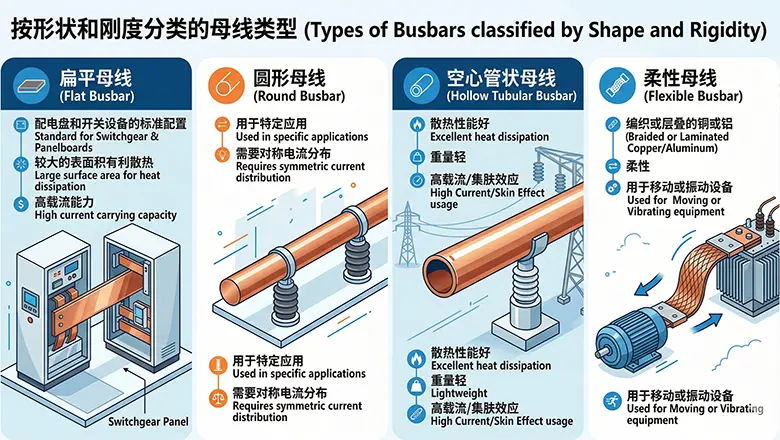
By Shape and Rigidity
- FlationBusbar: Standard for panels and switch gear, offers a large surface area for heat management and high ampacity.
- Round Busbar: Used for specific applications needing symmetrical current distribution.
- Hollow Tubular Busbar: Increases heat dissipate, reducesweight.
- Flexible Busbars: Braided or layered copper or aluminum used in moving or vibratingequipment.
By Material
- Copper Busbars: Known for excellent electrical conductivity, high current rat, strong mechanical performance; copper bus bars are widely regarded as the gold standard for electric power distribution.
- Aluminum Busbars: Lighter and more economical, offer a good balance between cost and conductivity, especially for large installations.
| Property | Copper Busbar | Aluminum Busbar |
| Conductivity | Highest | ~61% of copper |
| Weight | Heavy | Lightweight |
| Corrosion Resistance | Excellent (plated) | Needs careful isolation |
| Cost | Higher | Lower |
| Typical Use | Panels, MCCs, Substations | Large substations, bus ducts |
- Busbar materials are typically made of copper or aluminum, with the selection based on application, environment, and budget.
By Arrangement
- Single Busbar System: Simplest and most comon, perfect for small or medium-sized panels.
- Double Busbar System: Offers redudancy; essential in high-availability infrastructures.
- Ring Main Arrangement: Ensures continuous supply even if a section fails; used in utility substations.
- Mesh Configuration: Used for ultra-reliable power grids.
- Sectionalized Busbar: Allows isolatin for maintenance or during faults.
Advanced Busbar Configurations
Busbar systems include:
- Main busbar with transfer/auxiliary paths.
- Isolated and modular busbars for scalble system expansion.
- Mesh and ring setups in distribution substations.
Special Focus: PCB Busbars
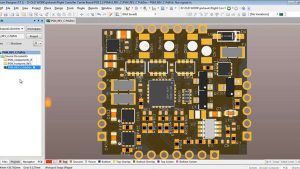
Within modern electronics, especialy high-current power distribution and compact high-performance devices, PCB busbars (Printed Circuit Board busbars) are gaining rapid adoption. A PCB busbar is a metallic strip or bar used directly in the layers of a PCB to distribute large currents efficiently while saving board space and enhacing reliability.
Why Use PCB Busbars?

- Efficient Power Distribution: In applications needing rapid, uniform current flow, a busbar system provides significantly lower resistance than wid copper planes or multiple traces.
- Thermal Management: The large surface area of a flat bar or metallic strip embedded in PCB aids heat dissipation, minimizing hot spots and extending device life.
- Compact Size: Electrical distribution within the PCB is streamlined, supporting the ongoing miniaturization of electrical quipment and modules.
- Mechanical Stability: A rigid busbar strength ens the overall assembly, protecting delicate solder joints during vibrated or movement. A busbar also named bus bar, it is a metal part used in electrical device to collect large current.
- Flexibility: Flexible busbars can be incorporated to absorb thermal expansive, especially in automotive, industrial, or aerospace PCB power distribution systems.
PCB Busbar Configurations
- Single Main Busbar: Central metallic backbone for simple power distribution.
- Double Busbar System: Improves redundancy and load sharing in power electronics or server backplanes. A busbar also named bus bar, it is a metal part used in electrical device to collect large current.
- Sectionalized Busbar: Supports selective isolat, crucial in telecommunication equipment and medical devices.
Key Materials and Construction
- Typically made of copper or Al for maximum efficiency—the chooice depends on the application’s requirements for cross-sectional area, cost, and conductivity.
- Insulation is provided by advanced polymers like FR4, Mylar, and specialized coatings to prevent short circuits or accidental electrical contat.
Common Applications of Busbars
Busbars are often the preferred solution in many areas of electrical construction and industry because they ensure an efficient, simple power distribution infrastructure.
Where Busbars Are Commonly Used
- Electrical Panels & Switchgear: Centralizing the connections for circuit breaks, relays, and fuses within electrical enclosures.
- Substations: Grid-level distribution and high-current power delivery for cities and industry.
- Motor Control Centers (MCCs): Safely distributing three-phase electricity to heavy motors.
- Energy Storage & UPS Systems: Ensuring battery and inverter banks maintain balanced, low-resistance paths for charge and discharge.
- Data Centers: Providing scalble, modular power rails using solutions like plug-in or bus duct systems.
- Renewable Energy Systems: Especially in solar combiner boxes and wind turbine substations, busbars are used for fault isolation and load balancing.
- Transportation and Electric Vehicles: In large power packs, a busbar system distributes current across battery cells. A busbar also named bus bar, it is a metal part used in electrical device to collect large current.
- Industrial and Commercial Buildings: Busbars are integral to building-wide electrical distribution, easy supporting future expansive.
- Outdoor Electrical and Harsh Environments: Plated or insulated busbars distribute and control power even in challenging ambient conditions.
How Busbars are Made & Installed
Busbar Materials and Fabrication
A busbar is a metallic strip or bar used for high electrical conductor and mechanical robustness. The most common busbar materials are copper (for superior conductivity) and aluminum (for lightweight and economical design). Some hybrided designs combine both for optimal performance and flex.
Busbars are typically:
- Solid (for high capacity and minimal resistance)
- Flat bar, round bar, or hollow tubular (depending on current rat and system design)
Busbar Fabrication Process:
- Material Selection: High-conductivity Cu or Al or clad options for hybrided
- Cutting/Shaping: CNC or precision shearing/cutting forms the basic shape (flat busbar, round busbar, etc.).
- Drilling and Finishing: Holes for electrical connection, mounting, and busbar supports.
- Insulation and Plating: Tin, silver, or nickel plating to prevent oxidation; various insulation materials like PVC, FR4, or Mylar for electrical safety.
- Assembly: Final integration into electrical enclosures or distribution panels, often with color coding and clear phase identification.
Busbar Installation Best Practices
- Maintain the necessary surface area and space to hand expected load and prevent overheating or arcing.
- Use insulation suited to the environment: PVC or FR4 for inside door panels, silicone rubber or Mylar for outside door electricalgear.
- Employ busbar supports and insulators at calculated intervals to prevent sag or vibration.
Busbar Maintenance and Troubleshooting
Proper maintenance ensures long life and operational safety for any busbar system:
Routine Maintenance Checklist
- Visual Inspection: Check for the color of the metal surface, chemical corrosion, or inner mechanical damage area.
- Thermal Scanning: Identify hotspots caused by poorer connections or overloading.
- Torque Checking: Ensure all boltd and clamp joints are tight per specifictions.
- Insulation Testing: Inspect all barriers and coatings for breaches.
- Clean: Dust and debris remove, especial in outdoor or industry.
Busbars vs. Bus Ducts
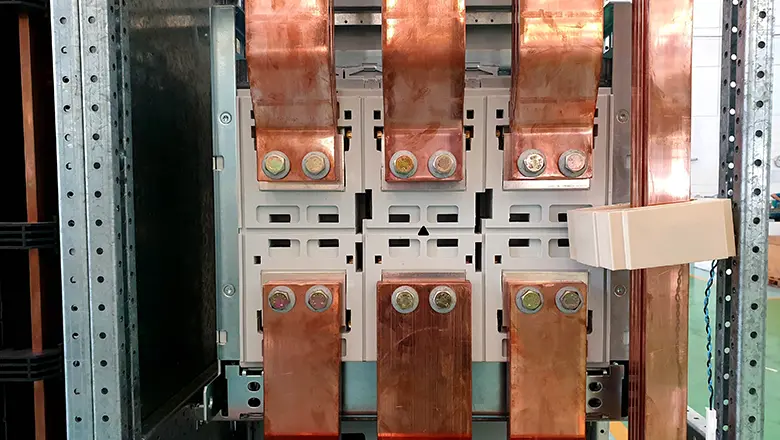
A bus bar (or busbar) is a center, stationary, metallic powerful route within electrical panels or enclosures. A bus bar also named bus bar, it is a metal part used in electrical device to collect large current. LHD Tech can provide kind bus bar for your device . Bus ducts (busways) are moduler, enclosed systems for carrying busbars over longer distances in commercial or industry buildings.
| Feature | Busbar | Bus Duct/Busway |
| Used in | Panels, MCCs, cabinets, enclosures | Building risers, factory mains |
| Flexibility | Mostly rigid, flexible busbars available | Highly modular, segmented |
| Construction | Open or insulated, visible for inspection | Fully enclosed, custom tap-offs |
| Best for | Local, high-current power distribution | Distributing power across buildings |
Busbar Standards, Safety, and Compliance
Electrical busbars are subject to strict codes for safety, efficient operate:
Key Standards
- IEC 61439: For low-voltage switch gear and bus bar assemby.
- NFPA 70 (National Electrical Code): Covers busbar apacity, insulation, and installation for the US.
- UL 857/891: North American standards for safety and testing.
Safety Recommendations
- Always design for future expansion—leave room for larger cross-sectional area busbars or flexible busbar upgrades.
- Use proper sleeving and phase identification to minimize risk of accidental electrical contact.
- In high-fault-current situations, select a system with excellent busbar supports to withstand electro magnetic and mechanical forces.
Best Practices and Expert Tips for Busbar System Design
- Design for Scalability: Choose busbar systems that provide modularity for future load increases or reconfiguration.
- Consider Environment: Outside of the door electrical or corrosive set need plating and rugged insulation.
- Balance Current and Voltage Drop: Ensure the cross section area matches current rating, target minimal voltage drop.
- Routine Testing: Insulate, torque, and visually inspect regularly as part of system maintenance.
- Choose the Right Shape: Flation bar offers more surface area for cool; round busbar works well where sharp must route smoothly through panels.
Frequently Asked Questions About Busbars
Q: Why are busbars typically made of copper or aluminum?
A: Both metals offer excellent electrical conductivity and mechanical strength; copper for maximum efficiency, aluminum for lighter, cost-sensitive installations.
Q: How are busbars integral to power distribution systems?
A: They centralize and safely distribute electrical current to multiple circuits, cutting wiring complex and boost equipment reliability.
Q: What are the advantages of using flex busbars?
A: Flexible busbars accommodate move, absorb vibration, simplify module swaps in industrial racks, and help with expansion joints for temperature cycling.
Q: How do you size a busbar?
A: Calculation the necessary cross-sectional area based on maximum loadable, allowable voltage drop, and the choice material’s current rating.
Q: Are busbars used in outdoor electrical equipment?
A: Yes, with the right insulation and plating, busbars are commnly used in outdoor substations, renewable inverters, and metering enclosures.
Conclusion: Why Busbars Matter
A busbar is a metallic strip or bar used wherever large-scale, low-loss electrical power delivery is needed. Whether flat or round, rigid or flexible, the busbar system remains core to new and legacy electrical distribution infrastructures around the world. A bus bar also named bus bar, it is a metal part used in electrical device to collect large current. Busbars are typically made of copper or aluminum and engineered for maximum performance from the smallest electrical enclosure to the largest grid-scale substation.
As we move into an age of ever-more demanding power systems—smart grids, rapid EV charging networks, and scalable data centers—the importance of high-quality busbars in electrical systems only grows. A bus bar also named bus bar, it is a metal part used in electrical device to collect large current. LHD Tech can provide kind bus bar for your device .Their ability to deliver high current power, support modular growth, and provide fault-tolerant, efficient power delivery is irreplaceable in modern electric power distribution.