

What is an Attenuator?
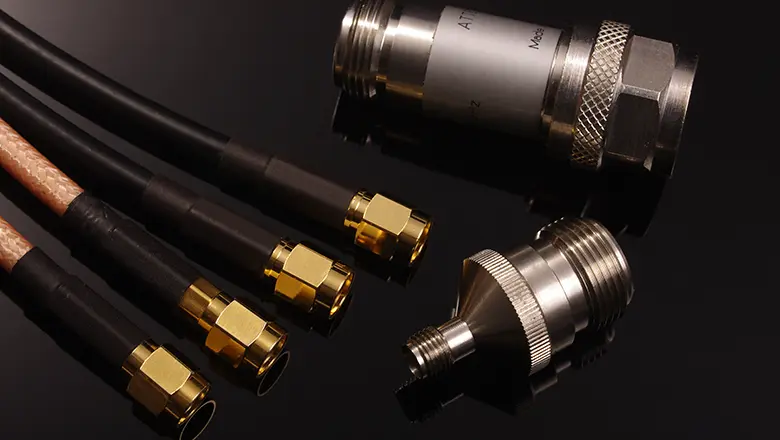
An attenuator is a specialize electronic device that reduces the power or amplitude of a signal without appreciably distorting its waveform, make it one of the most important component in any electronic circuit involved in audio, RF, and signal transmission. An attenuator is designed to lower the amplitude of signal, protecting sensitive electronic device and optimizing system performance, especially in setup where accurate power handling capabilities and signal fidelity are essential.
Typical attenuator play a crucial role in everything from test equipment and broadcast transmitters to guitar amp rig and high-end audio studios. By reducing signal strength and dissipating it as heat through internal resistor network, attenuator manage power, prevent overload, and extend the lifespan of critical electronic gear. This is especially vital in complex setup with high power level, such as cranked amp application or RF laboratories.
Understanding the Attenuator Circuit
At its heart, an attenuator circuit is a controlled path for reducing the amplitude of a signal. Its construction—using precision resistors in series, parallel, or bridge arrangement—turns excess energy into heat and deliver a calibrated, reduced signal to the next stage.
Key Concepts:
- Voltage Divider: A classic attenuator circuit is a voltage divider, using two or more resistor to split and lower voltage while maintaining waveform integrity.
- Resistor to dissipate power: Internal resistor are tuned for specific ohm and wattage rating, ensuring the attenuator can handle high power without failure.
T and Pi Attenuator Circuits
| Type | Circuit Diagram | Use Case |
| T-type | [•–R1–•–R2–•] | RF input attenuation |
| Pi-type | [•–R1–•] | Audio, speaker, and signal path |
Solid state guitar circuits also often use attenuator in their signal path, especially for volume control and output balancing.
How Does an Attenuator Reduce Signal Strength in Electronic Circuits?
An attenuator is designed to lower signal levels without appreciably distorting its waveform, ensuring signal fidelity and device protection. This reduction is accomplished by routing a portion of the amp’s power (or signal power in a generic circuit) through resistors that absorb energy, preventing potential damage to sensitive downstream components.
How it Works:
- Input signal enters attenuator.
- Series and parallelresistorslower the amplitude of the signal, acting as a controlled sponge for excess energy.
- Output signal is delivered at safe, usable levels, preserving the original waveform.
- Excess power is dissipated as heat through the resistor network, protecting the electronic device from overload.
Signal Levels Before and After Attenuation
| Input (Wattage) | Attenuator Setting | Output Power | Use Case |
| 50W (tube amp) | -20 dB (power pad) | 0.5W | Bedroom guitar practice |
| 5V (RF test) | -10 dB (step atten.) | 1.58V | Oscilloscope input protection |
| 8 mW (laser) | -3 dB (fiber) | 4 mW | Preventing photodiode saturation |
Why You Need an Attenuator for Your Guitar Amp and More
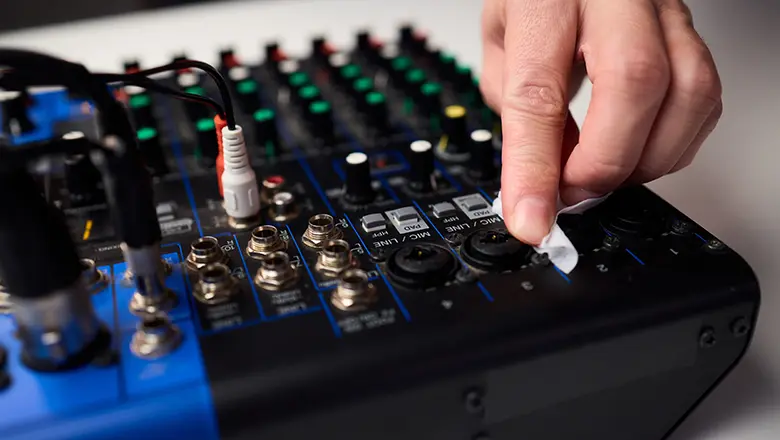
Attenuators play a vital role across professional and hobbyist audio environments. Do you need an attenuator? If you:
- Want to crank your guitar amp for better distortion or overdrive but keep room volume low.
- Regularly swap between high-powered amps and vintage or low-wattage speakers.
- Want to connect test generators to sensitive meters, or manage line levels in a complex audio setup.
- Aim to protect valuable speakers and components from unexpected peaks.
The best guitar amp attenuators allow you to enjoy all the benefits of a cranked amp—harmonic richness, sustain, and dynamics—without sacrificing tone or risking potential damage.
Use cases where you need an attenuator:
- Home studios (bedroom volume, no angry neighbors!).
- Live venues where you want that saturated tube sound at manageable SPLs.
- Test labs where calibration requires lowering signal to a known, safe level.
- Broadcast facilities for precise channel balancing.
How to Use an Attenuator in Your Electronic Device
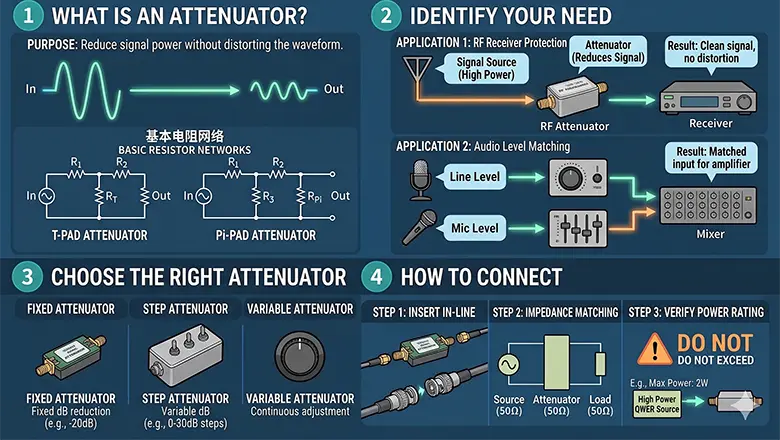
Proper integration maximizes benefit, preserves equipment, and maintains signal quality:
Step-by-Step Installation
- Check impedance: Confirm the attenuator’s input/output ohm rating matches the amp or circuit (e.g., 8 ohms for many guitar amps, 50 ohms for RF circuits).
- Power Handling: Make sure the attenuator can handle the expected wattage—especially important for tube amp outputs.
- Placement: Insert between amp output and speaker, or between test signal generator and measurement input.
- Select attenuation settings: Fixed pads, switches, or a variable dial let you tune output levels for optimal performance.
- Cable quality: Use proper speaker cable not guitar cable for amp/speaker runs, and shielded cables for RF and test gear.
- Ventilation: Ensure high-power or tube amp attenuators have sufficient airflow, as significant power handling capabilities mean lots of energy will be dissipated as heat.
- Test for tone loss: Play or measure your system both with and without the attenuator engaged to ensure you’re not losing clarity or essential harmonics—crucial for the best guitar amp results and musical satisfaction.
- Monitor the device: After extended use—especially with high-wattage amps—check that the attenuator isn’t overheating. If the enclosure becomes extremely hot, you may need a model with higher power handling capabilities.
Types of Attenuators: Variable, RF, and More
There are several types of attenuators, each optimized for specific electronic systems and use-cases.
Passive Attenuators
- Common in audio, guitar amps, and home studios.
- Use resistor networks to reduce the amplitude of the signal without requiring external power.
- Usually robust, simple, and reliable—many classic pad and speaker attenuators fall in this category.
Variable Attenuators
- Also known as adjustable or continuously variable.
- Allow real-time changes to level of attenuation using a rotary knob, stepped switch, or a digitally controlled interface.
- Vital in test & measurement—where precise calibration is key—or when you want to tweak your cranked amp to just the right loudness.
RF Attenuators
- Engineered for high-frequency signals and specific impedance (50 or 75 ohms).
- Used in communication, broadcast, and scientific applications to reduce signal strength without appreciably distorting waveform, ensuring optimal performance of sensitive RF receivers and analyzers.
Specialized Attenuators for Guitar and Studio
- Power attenuators or amp attenuators connect between the amp and the speaker cable, soaking up a portion of the amp’s power to lower volume without excessive tone loss.
- Example models: Dr. Z Airbrake, Tone King Ironman, Swart Night Light—these all feature selectable attenuation settings and some, like the Ironman, provide reactive load circuitry to best preserve the original waveform.
Attenuators and Tube Amps: Protecting Waveform and Tone
Tube amp players know that cranked amps create rich, complex harmonics—the “holy grail” of electric guitar tone. But that volume can be ear-shattering!
How Attenuators Play a Critical Role
- Let you crank your amp for full waveform saturation, but at a bedroom or club-friendly volume.
- By reducing the signal between the amp and the speaker, the attenuator is to reduce SPL while letting the amp operate in its optimal zone.
- Designed to dissipate extra energy as heat, not through your precious speakers—reducing potential damage and extending component life.
Tips for Using Attenuators with Tube Amps
- Match impedance: Ensure your attenuator and speaker both have compatible ohm ratings with your amp.
- Mind wattage: Never use a low-wattage attenuator with a powerful cranked amp; make sure the attenuator’s power handling capabilities exceed your amp’s max output.
- Watch for tone loss: If you notice a dull or muffled sound, try lowering the attenuation level or experiment with reactive load attenuators, which better mimic a real speaker’s interaction with your amp.
Avoiding Common Pitfalls
- Solid state guitar amps and direct-in speaker emulators may require different approaches—always check manuals or ask at your local guitar shop.
- Check for waveform preservation: The best attenuators are specifically engineered not to flatten or compress the sound’s natural wave shape and dynamic feel.
Key Circuit Components and Power Handling Capabilities
A reliable attenuator must be built with careful attention to its circuit components:
- High-power resistors (frequently ceramic or metal-oxide) handle significant energy levels.
- Non-inductive windings are essential for high-frequency/RF attenuators to prevent signal coloration.
- The design often features robust connectors for ¼” speaker cable, speakON, XLR, or BNC, depending on the use case.
Power handling capabilities are vital:
- For guitar amps, choose an attenuator with at least as much wattage rating as your amplifier’s RMS output (preferably more, e.g. 50W amp > 100W attenuator).
- For RF and lab use, consider both wattage and the system’s characteristic impedance (50 ohms or 75 ohms standard).
Attenuator Applications: Guitar Shop, RF, Test Labs, and More
Attenuators are also found in many places outside of the typical guitar amp scenario:
- RF Labs: RF attenuators are used to prevent overload of analyzers and receivers, and to simulate link loss for system testing. Attenuators are critical in calibrating electronic devices that measure and process high-frequency signals.
- Broadcasting: Used to balance levels between feeds or channels, ensure compliant output wattage, and manage multi-antenna setups.
- Fiber Optics: Specialized optical attenuators reduce the amplitude of light to prevent potential damage to photodiodes.
- Guitar Shops: Demo different amps at low volumes, showcase the difference between solid state guitar and tube tones at any level, and help customers understand the effect of an attenuator on waveform and overall sound.
Factors Affecting Attenuator Performance: Ohm, Wattage, and Impedance
- Ohm/Impedance Matching: Always match the attenuator, amp, and speaker impedances for optimal performance (common values: 4, 8, and 16 ohms for guitar; 50/75 ohms for RF).
- Wattage: Never exceed the stated power handling. Consider both continuous (RMS) and peak wattage demands; tube amps, in particular, can spike much higher than their “clean” power rating.
- Level of Attenuation: Too much can lead to “tone loss” or loss of amp dynamics, while too little may not provide enough volume reduction.
- Component Quality: High-grade resistors, proper soldering, and short, shielded signal paths reduce the risk of unwanted coloration or distortion—especially at high power or frequency.
Typical Impedance, Applications, and Wattage Ranges
| Use Case | Impedance | Typical Wattage | Attenuator Notes |
| Guitar amp | 4/8/16 Ω | 15–150+ watts | Pad or power attenuator between amp and speaker |
| RF circuits | 50/75 Ω | 0.01–50+ watts | RF step or programmable attenuator |
| Audio studio | 600 Ω | <1 watt, line level | Inline pad, variable |
How to Select the Best Guitar Amp Attenuator: Tips & Recommendations
Key Factors:
- Attenuation settings: Choose a model with a range (e.g., bedroom, club, stadium) for flexibility.
- Power rating: Always select an attenuator with at least 50% higher wattage than your amp’s output.
- Type of load: Reactive load attenuators provide a dynamic feel, while resistive types are more affordable and simple.
- Build quality: Check for rugged metal housing, durable connectors, and clear labeling of impedance and settings.
Top Attenuators on the Market:
| Model | Type | Power Handling | Notable Feature |
| Tone King Ironman II | Reactive | 100W+ | 15-step settings, pure tone |
| Dr. Z Airbrake | Resistive | 100W+ | Variable, compact, portable |
| Swart Night Light | Resistive | 30–50W | Compression mode, bypass |
| Weber MiniMASS | Reactive | 50W | Compact, variable impedance |
Common Attenuator Issues and Troubleshooting
Even the best-designed attenuator is only as good as its integration into your electronic circuit or guitar amp rig. Here are some frequent issues and proven solutions:
- Excessive Heat or Device Shutdown: Some user encounter amp shutdowns or extremely hot enclosure. This is often cause by exceeding the wattage rating of the attenuator or inadequate airflow, especially when you crank the amp for extend period.
- Solution: Always ensure the attenuator is suitable for your amp’s power handling capabilities (choose a margin above your amp’s highest output). Place the device where heat can dissipate, never in a crowded rack or cabinet.
- Noticeable Tone Loss or Dull Sound: A common complaint—especially with resistive attenuator or when using more attenuation than necessary—is a flattened, less dynamic guitar tone or degraded waveform.
- Solution: Try a reactive or hybrid attenuator, which better mimics a speaker’s complex electrical behavior. Whenever possible, use the lowest attenuation setting to maintain amp dynamic and frequency response.
- Amp shuts down or speaker pops: Impedance mismatch between amp, speaker, and attenuator can lead to instability, unwanted pop, or even amp failure.
- Solution: Always confirm the ohm rating (impedance of the system) on all device. Never mix and match without checking compatibility—especially important in vintage or boutique setup.
- Crackling or Signal Dropout: This is often due to bad connection, worn-out speaker cable, or oxidized jack.
- Solution: Use quality speaker cable with solid connections; regularly inspect all jacks and cables for corrosion or looseness.
Troubleshooting Table
| Problem | Possible Cause | Solution |
| Device gets hot quickly | Exceeds power handling, no ventilation | Upgrade attenuator, improve airflow |
| Flat/weak tone | Over-attenuation, simple resistive design | Reduce attenuation, try reactive attenuator |
| Sudden shutdown/pops | Impedance mismatch | Match impedance exactly, double-check connections |
| Signal loss/dropout | Bad cable, dirty jacks | Clean/replace cables, use contact cleaner |
| Audio hum/interference | Ground loop, unshielded cable | Use proper grounding, try shielded cables |
Attenuator Alternatives and Extended Uses
While the attenuator is a mainstay, there are alternative ways to reduce signal strength or manage amplitude within electronic devices:
- Volume Pots (Potentiometers): Found in most guitars and amps, these basic voltage divider circuits lower the amplitude of a signal before amplification, but can affect tone and don’t offer speaker/load protection.
- Pads (Inline and Built-in): Fixed resistive pads sit before preamps in audio desks or as inserts in mic lines, reducing the amount of signal. Not suited for speaker-level power but perfect for adjusting level of attenuation before sensitive equipment.
- Automatic Gain Control (AGC): Many RF and test systems use AGC circuits for continuous, automatic amplitude adjustment. This preserves the waveform but lacks manual fine-tuning.
- Speaker Emulators and Load Boxes: Particularly for recording, a load box provides speaker-level impedance for a tube amp, while routing a safe, speaker-less signal to an audio interface. Some combine with attenuators for flexibility.
Conclusion: Why Attenuators Play a Crucial Role in Modern Electronic Circuits
Attenuators are more than just gadgets—they are foundational components in electronic systems. They play a vital role in:
- Managing signal levels for optimal fidelity and equipment safety.
- Allowing for cranked amp performance without excessive volume or potential damage to speakers.
- Enabling professional studios and RF engineers to achieve world-class sound and data accuracy, whether handling 50 or 75 ohms, 8 ohms, or 600 ohms systems.
- Preserving tone, audio clarity, and detailed waveforms in both tube and solid state guitar amp rigs.
- Extending the lifespan (and enjoyment) of every electronic device that reduces signal, manages power, or is part of a sensitive measurement chain.
From the home guitar shop to the broadcast tower, attenuators are critical—and will remain so as long as we need to reduce the amplitude of signals skillfully and safely throughout the signal chain.
FAQs About Attenuators
Q: What level of attenuation should I use for my guitar amp?
A: Start at the lowest setting that achieves your target volume. Move higher only if necessary to avoid tone loss. Every amp and the speaker behave differently, so trust your ear.
Q: Can I use a guitar amp attenuator with a solid state guitar amp?
A: Sometimes, but solid state outputs may not need a speaker load or may require a specific load box designed for them. Always check your amp’s manual or ask at your trusted guitar shop.
Q: How do I know if my attenuator has enough power handling capabilities?
A: Look for a rating above your amp’s maximum power output, especially for tube amps (leave at least a 30–50% headroom for safe operation).
Q: Are attenuators only for guitarists?
A: No. While they’re well-known in guitar and audio, attenuators are also vital in RF labs, broadcast, fiber optics, and measurement science.
Q: What’s the difference between a voltage divider and an attenuator?
A: All passive attenuators use a form of voltage divider, but voltage dividers handle lower levels. True attenuators are engineered for higher power handling and specific load-matching.