
Introduction: What Are Microcontrollers and Microprocessors?
We can start with embedded systems, followed by computing tasks and electronic systems, as well as their derived microcontrollers and microprocessors.
What is a Microcontroller?
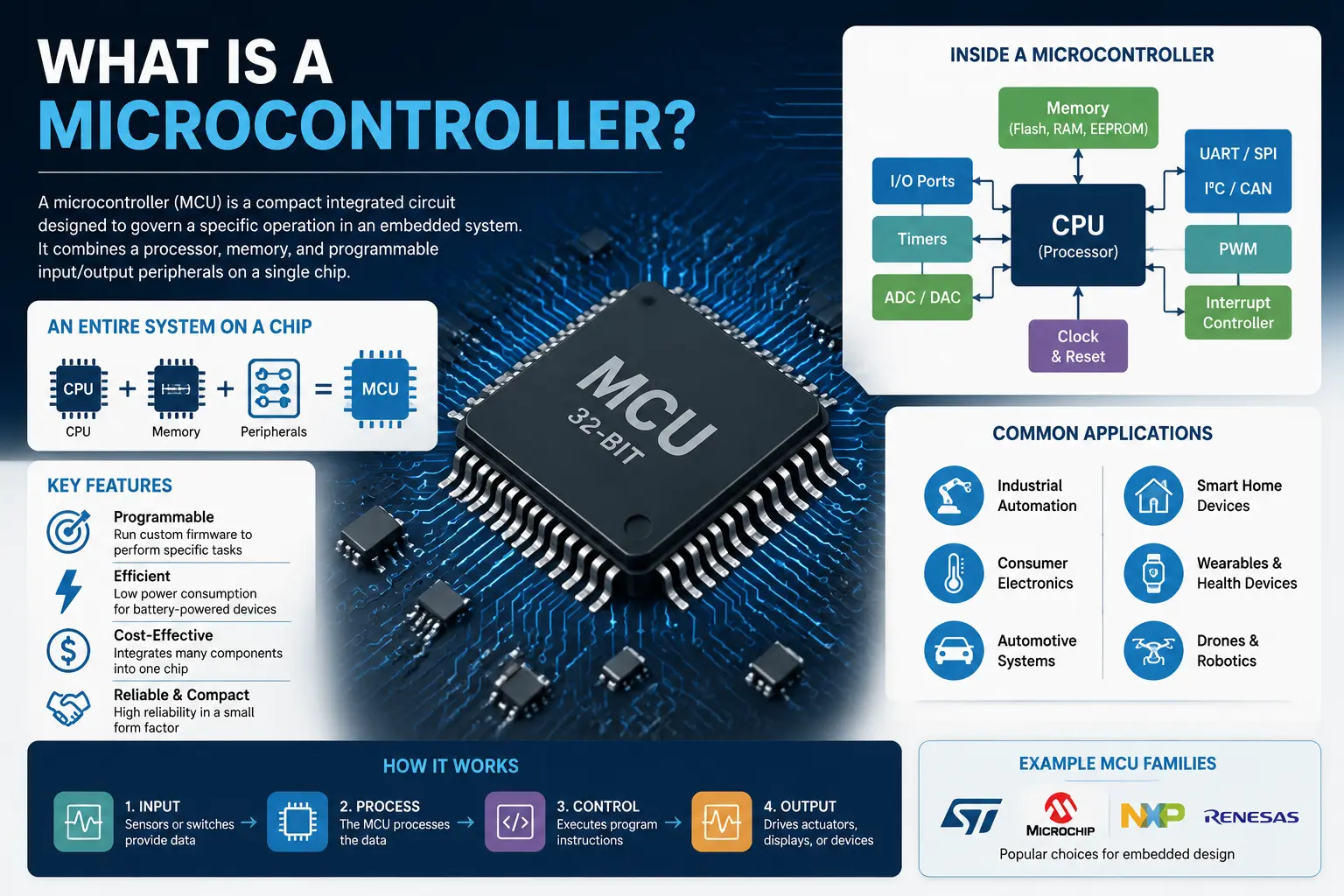
So you’re staring at a chip datasheet, wondering if you need an MCU or something bigger. A microcontroller – yeah, the MCU – is basically a whole computer shrunk onto one piece of silicon. Not just a CPU, but actual RAM for temporary scratch space, ROM or flash to lock down your firmware, and a pile of built‑in peripherals that would’ve required extra chips back in the day: timers, ADC, UART, GPIO pins you can toggle at will. All of it sits on the same die, which is exactly why they’re cheap, sip power, and respond to events almost instantly – no bus delays, no external memory bottlenecks.
Where do you find these little beasts? Everywhere. Medical gear, car ECUs, smart fridges, wireless sensor nodes dotting a field – they all run on MCUs. And the real selling point isn’t speed; it’s how little juice they drink. They’ve got sleep modes that kill power to unused blocks, and they come in tiny footprints that fit on cramped boards. So when engineers pick one, they’re usually sweating over standby current and package size, not megahertz – because in embedded land, efficiency is king, and brute force just wastes battery.
What is a Microprocessor?
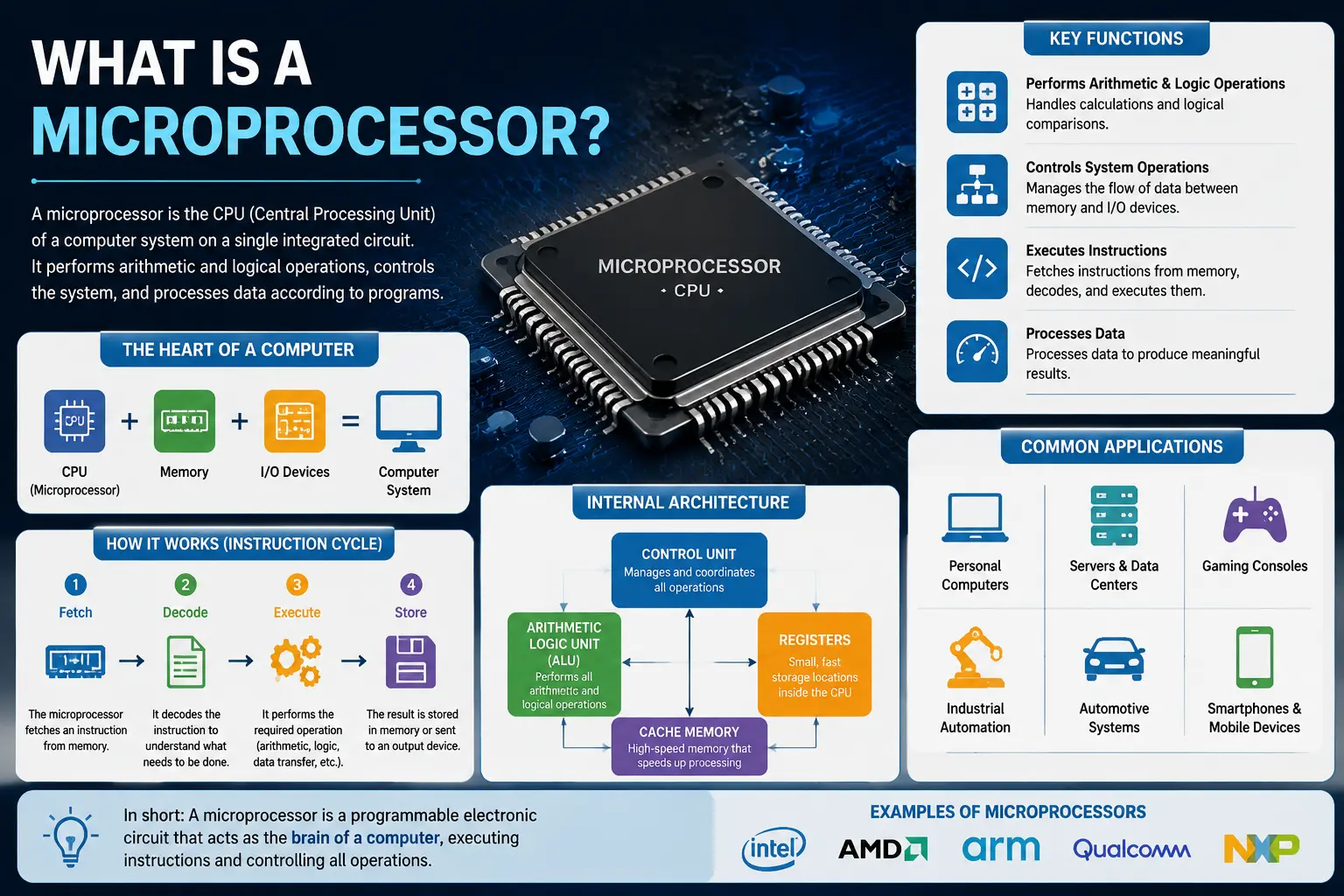
A microprocessor (MPU) is a more general‑purpose computing chip – essentially the main processor you’d find inside personal computers, laptops, tablets, servers, and complex networking gear. Unlike a microcontroller, which packs memory and peripherals right onto the same die, a microprocessor is built around a high‑speed CPU core (or multiple cores) that’s geared toward heavy‑duty number‑crunching and data‑intensive workloads. It normally relies on external memory chips and a full suite of off‑chip peripherals to get the job done. Where it really shines is running full‑featured operating systems – think Linux, Android, or Windows – and handling big data streams across a wide spectrum of computing tasks.
For engineers, getting a clear handle on the distinction between the two is pretty important, especially since both types are showing up more and more in embedded systems and smart devices these days.
Microcontroller Basics: The Integrated Embedded Solution
A microcontroller is sometimes called an “embedded microcomputer” because it provides a full computing platform on a single chip. Let’s look more closely at what makes up a modern MCU:
Components of a Microcontroller (MCU)
| Functionality | Description |
| CPU core | The central processing unit (ALU, control logic) that executes program instructions |
| RAM | Volatile, high-speed memory for variables and stack |
| Flash/EEPROM | Non-volatile, rewritable storage for code and non-changing data |
| Embedded peripherals | Timers, counters, ADC/DAC converters, PWM modules, UART/SPI/I2C communication protocols |
| GPIO Ports | General-purpose input/output pins for sensors, switches, relays, and displays |
| On-chip oscillator | Timing for reliable system operation |
| Interrupt system | Hardware-based event-driven reactions |
Why Microcontrollers Dominate Embedded Applications
- Designed for specific application or task
- Low power/power-saving modes for battery operation and standby
- Integrated peripheral support (ADC for sensors, PWM for motors, UART/I2C/SPI for communication protocols)
- Low overall cost and simple PCB design due to single-chip approach
- High reliability due to fewer external components
Use Cases (“Microcontroller Applications”)
- Medical devices (portables, monitors, pumps)
- Industrial control systems
- Smart home/IoT devices
- Legacy systems in factory automation
- Robotics and agriculture
- Automotive engine control, safety systems
- Appliances (microwave, HVAC, washing machine, garage door openers)
Understanding Microprocessor Technology
A microprocessor is designed to deliver outstanding processing power and extend the computational reach of electronics into the domain of high-speed, multi-purpose computing. Let’s dig into the major features of MPUs:
What Is in a Microprocessor?
A microprocessor often consists of:
- Processing units(usually one or multiple processor cores, each with its own ALU and register file for high performance)
- Arithmetic Logic Unit(ALU) for complex mathematical and logical operations
- Cache memory (L1, L2, sometimes L3) for storing instructions and frequently accessed data
- Data bus, address bus, and control logic for fast communication to RAM and peripherals
- No on-board RAM or storage—external memory is mandatory
- Support for external components(memory buses, display drivers, PCIe/USB ports)
Types of Microprocessors Found in Modern Electronics:
- General-purpose CPUs (Intel Core, AMD Ryzen, ARM Cortex-A for personal computers)
- Application-specific processors (DSPs, GPUs, ASICs for specific high-speed processing tasks)
- Embedded MPUs used in complex industrial systems, smart gateways, or advanced network switches
Key Differences Between Microcontrollers and Microprocessors
Let’s break down the differences between these two essential technologies, not just in features, but also in engineering impact:
| Feature | Microcontroller | Microprocessor |
| Core function | Embedded control for a specific application | High-speed, general-purpose computing tasks |
| Integration level | CPU, RAM, ROM/Flash, peripherals, clock on-chip | CPU (processor core) only; needs external memory and peripherals |
| Power consumption | Extremely low power, sleep modes, power-saving mode | Higher; careful thermal management and supply design required |
| Cost | Low; ideal for high-volume products | Higher BOM; greater design complexity |
| Peripheral | ADC, PWM, UART, SPI, timers built in | I/O via external controller chips |
| Programming | Baremetal, RTOS, direct hardware control | Full OS (Linux, Windows), support for complex operating systems |
| Application domain | Embedded system, real-time, control systems | Computers, cloud, servers, multimedia, advanced HMI |
| PCB/Hardware | Simple design, few external components | Fast buses, complex multilayer PCB, more ports |
| Example use case | Medical sensor, automotive brake controller | Desktop computer, industrial vision system |
Key difference: A microcontroller is a single-chip, application-specific system, while a microprocessor is a high-performance, general-purpose computational engine that requires external support for memory and I/O.
Microcontroller Architecture vs Microprocessor Architecture

Microcontroller Architecture
Take a look at any modern microcontroller, and the first thing that stands out is how much they pack onto a single piece of silicon – CPU, memory, and all the usual peripheral blocks are right there on the same die, connected by short, fast internal paths that keep latencies low. The architecture you’re most likely to encounter in today’s embedded designs is the Harvard type, which keeps instruction memory and data memory in completely separate physical domains, each with its own dedicated bus. Why does that matter? Because it allows the processor to grab an instruction and access data at the same time – no bus contention, no waiting. That parallel fetch really speeds things up, which is exactly why MCUs shine in real‑time, deterministic applications where you can’t afford unpredictable delays.
Here are the standout features you’ll typically find:
- Harvard architecture separate buses dedicated to instructions and data, so they don’t contend for the same path.
- Integrated bus system a unified data and address bus that ties together all the on‑chip peripherals and memory blocks.
- Onchip memory RAM, ROM, and flash all built in, which cuts down access delays and keeps system costs low.
- Builtin analog/digital converters, timers, and event counters ready to handle real‑world signals without extra external chips.
- Standard communication peripherals UART, SPI, I²C ports, plus a watchdog timer and power management logic, all integrated.
- Flexible powersaving modes highly configurable sleep states that let you fine‑tune energy consumption for battery sensitive designs.
Microprocessor Architecture
Most microprocessors are based on the von Neumann architecture, which uses a single bus for both instructions and data, simplifying hardware and memory expansion. Microprocessors, designed for a wide range of computing tasks, typically lack embedded peripherals and on-chip memory, other than the instruction and data cache. The memory and peripheral integration is handled with external chips.
Key points about microprocessor architecture:
- Von Neumann architecture: Shared memory space and buses for code and data.
- Sophisticated instruction set architectures supporting complex computations and multitasking in computing systems.
- Multiple processing units (cores) often present in a single chip, each with its own ALU (Arithmetic Logic Unit).
- Deep pipeline stages and large cache hierarchies for high-speed performance.
- External memory controllers to manage large, expandable RAM (DDR, LPDDR) and non-volatile storage.
- Variety of I/O controllers and interfaces for external peripherals—including SATA, PCIe, Ethernet, USB, HDMI.
Types of Microcontrollers and Microprocessors
Type of Microcontroller
Microcontrollers come in many types and sizes to suit every application—ranging from simple control to advanced digital signal processing. Here’s a breakdown:
| Type of Microcontroller | Typical Bit Width | Example Uses | Common Brands |
| 8-bit MCU | 8 | Toys, appliances, sensors | Microchip PIC, Atmel AVR, ST |
| 16-bit MCU | 16 | Medical, industrial | TI MSP430, Renesas |
| 32-bit MCU (ARM Cortex-M, RISC-V) | 32 | IoT devices, automotive, smart home | STMicro STM32, NXP Kinetis, Espressif ESP32 |
| DSP Microcontrollers | 16/32 | Audio, motor control | TI C2000, Microchip dsPIC |
| FPGA-SoC MCUs | Any | Custom, high-speed processing | Microsemi, Xilinx Zynq |
Microprocessor Types
Microprocessors aren’t a one size fits all affair they come in a variety of flavors, each tailored to a different class of computing demands:
- General‑purpose CPU processors – when you crack open a typical PC or tablet, the chip inside is almost certainly one of these: an Intel Core, an AMD Ryzen, or an ARM Cortex‑ They’re built to handle a wide variety of everyday tasks without breaking a sweat – think office documents, video calls, web browsing, and even a bit of casual gaming on the side.
- High‑speed embedded processors – head into industrial control cabinets, network switches, or communication base stations, and you’re likely to spot chips like NXP’s i.MX series, TI’s Sitara family, or ST’s STM32MP1 line. These processors strike a practical balance: they pack enough horsepower for control loops and data handling, yet stay responsive enough for real‑time deadlines. Plus, they usually come with integrated peripherals that save you from adding extra external components in the field.
- Application‑specific processors cover a wide spectrum ASICs, DSPs, and GPUs all fall into this bucket. These chips are heavily optimized for a narrow set of tasks: image recognition, cryptocurrency hashing, 3D graphics rendering, or telecom baseband processing, where general‑purpose CPUs would be too slow or power
- Network processors and coprocessors are essentially the dedicated muscle for handling packet inspection, routing table lookups, and other CPU‑intensive networking tasks. Instead of bogging down the main cores with all that housekeeping, these specialized units take over the heavy lifting, which means the system stays snappy and responsive even when traffic spikes or the network gets congested.
RAM, ROM, and Flash Memory in Microcontrollers and Microprocessors
A foundational difference between microprocessor and microcontroller is how they handle memory space:
- Microcontrollers feature on-chip RAM (for temporary data), flash memory or EEPROM (for non-volatile code/data), and often do not need external memory for most embedded applications.
- RAM and ROM in microcontroller designs are sized for specific application use, making them highly power-efficient.
- Microprocessors are designed to connect to external memory—large, high-speed RAM, ROM, and storage devices—allowing them to process large amounts of data and complex software. The performance of modern CPUs and their cache system is critical in these architectures.
| Microcontrollers | Microprocessors | |
| RAM | On-chip, up to a few MB, for temporary data | External modules, expandable to GBs |
| ROM/Flash | On-chip, stores program code and non-volatile data | External SSD/HDD/NAND/eMMC, OS, etc. |
| Cache | Usually small or absent | Large multi-level cache (L1/L2/L3) |
Peripheral Integration: Ports, Interfaces, and More
One of the greatest strengths of the microcontroller is its on-chip integration of essential peripherals, which include:
- GPIO (General Purpose Input/Output ports): Interface with switches, LEDs, and actuators.
- ADC (Analog-to-Digital Converter): Reads sensors and analog signals.
- PWM generators: For controlling servos, motors, and lighting.
- Timers/counters: Track time-critical events, pulse measurement, delay functions.
- Built-in serial communications: UART (for debugging and device-to-device communication), SPI, I²C for connecting sensors, displays, and memory.
- On-chip clock and reset logic: Enable simple system startup and recovery.
Microprocessors, meanwhile, rely extensively on external components for peripheral expansion via high-speed interfaces and buses, such as PCI Express, USB, and SATA.
Engineering Insight: The interface options in microcontrollers and microprocessors are key design factors. For quick prototyping or integration with sensors, MCUs save board space and PCB complexity. For multimedia or advanced networking, MPUs are equipped for high-throughput data paths and “hot-plug” I/O.
Power Consumption and Power-Saving Modes
Power design is a significant difference in MCU vs MPU choice:
- Microcontrollers are typically designed for low power consumption and support multiple power-saving modes (sleep, standby, deep power-down, low-power peripheral wake).
- Some MCUs feature runtime current draws under 100μA, and sleep currents in the single-digit μA or nA, making them ideal for battery-powered embedded applications.
- Microprocessors are typically high-performance and require stable, higher-wattage power supplies due to clock speeds, multiple cores, large RAM banks, and external devices—especially in extended or always-on operation.
Comparison Table: Microcontroller vs Microprocessor
| Feature | Microcontroller | Microprocessor |
| Integration | Single-chip (CPU, RAM, peripherals, flash) | CPU-only, external memory and peripherals |
| Power Consumption | Very low, supports deep sleep/power-saving | Higher, rarely low-power |
| Peripheral | On-chip ADC, PWM, timers, ports | Off-chip, via I/O controllers |
| RAM | KB–MB, on-chip | GB, always external |
| External Memory | Not required for basic operations | Required for functionality |
| Operating Systems | RTOS/baremetal, rarely Linux | Runs Linux, Android, Windows, etc. |
| Processing Power | Modest, “just right” for control | High, “overkill” for embedded tasks |
| Applications | Designed for specific, real-time control tasks | Range of computing applications |
| PCB Design | Simple, few layers, limited EMI concerns | Complex, high-speed/routed, care for signal int. |
| Price | $0.30–$10 per unit | $8–$200+ per unit |
Embedded System Applications: Choosing the Right Processor
Microcontroller in Embedded System Design
Microcontrollers dominate used in embedded systems due to their cost, availability, and low power consumption:
- Smart home devices—locks, thermostats, plugs.
- Healthcare monitors and portable medical gear.
- Automotive networks (CAN/LIN), engine and safety systems.
- Agriculture—climate control, livestock monitoring, field sensors.
- Robotics—motor drives, encoders, environmental feedback.
Microprocessor in Embedded System Use Cases
Microprocessors serve best in complex control and compute-heavy roles:
- Human Machine Interfaces (HMI) and touchscreens in industrial control.
- Routers, edge computing, gateways with advanced networking and security.
- Multimedia playback/decode (televisions, set-top boxes, infotainment).
- Edge AI—image recognition or machine learning inference at the edge.
- High-speed data loggers and industrial vision systems.
- Advanced networking—industrial routers, gateways, security appliances.
Engineering Tips and Design Insights
When to Prefer Microcontroller
- Power budget is critical: For battery-operated, low-power, or solar/energy-harvesting applications, pick a microcontroller with leading power-saving features.
- Real-time determinism required: Choose MCUs when precise timing or event response is mandatory—such as industrial robotics or safety controllers.
- Integration saves cost and board space: Use MCUs to minimize dependency on external components and shrink your PCB.
- Design simplicity: Go MCU for smaller firmware, less complicated boot, diagnostics, and field service.
When to Choose Microprocessor
- Operating systems needed: Only MPUs support complex operating systems, GUI frameworks, and software ecosystems.
- Need for high computational performance: If complex computations or handling large amounts of data are required—say, video streaming or secure transactions—a microprocessor is the answer.
- Future scalability/expandability: Select MPUs in smart gateways or products where user demand or software requirements may change dramatically during product lifetime.
- Networking and multimedia: Fast Ethernet, gigabit networking, graphic acceleration, and HDMI/USB-C ports for advanced interface options.
Mixed-Signal & Hybrid Designs
- For best-in-class reliability, consider a hybrid system using an ultra-low-power MCU (handling power-up, watchdog, safety logic) and an MPU (or more powerful CPU processor) for the main OS or graphical interface. This is increasingly the standard in automotive, industrial, and healthcare devices—where safety and user experience are both crucial.
FAQs About Microcontroller vs Microprocessor
1. What is the main difference between a microcontroller and a microprocessor?
A microcontroller integrates the CPU, memory, input/output ports, and peripherals on one chip. A microprocessor mainly provides processing power and usually requires external memory and peripheral components.
2. Is a microprocessor a microcontroller?
No. A microprocessor is primarily designed for computation, while a microcontroller is a complete control system designed for dedicated embedded applications.
3. Is a microprocessor just a CPU?
A microprocessor is essentially a CPU implemented on an integrated circuit. It may include cache and memory controllers, but it generally relies on external RAM, storage, and peripherals.
4. What are the main components of a microcontroller?
A microcontroller normally contains a CPU, program memory, RAM, input/output ports, timers, and communication interfaces such as UART, SPI, or I²C.
5. What is a microcontroller mainly used for?
Microcontrollers are used for dedicated control tasks in embedded systems, including motor control, sensors, industrial equipment, automotive electronics, appliances, and IoT devices.
6. What devices use microcontrollers?
Microcontrollers are commonly found in washing machines, automotive control units, thermostats, security systems, medical devices, industrial controllers, and smart sensors.
7. What are the limitations of microcontrollers?
Microcontrollers generally have less processing power, memory, storage, and graphics capability than microprocessors. They are optimized for low power, low cost, and real-time control rather than complex computing.
8. What programming languages do microcontrollers use?
Most microcontrollers are programmed in C, C++, or assembly language. Some platforms also support MicroPython, Rust, and other higher-level languages.
9. Is Arduino a microcontroller or a microprocessor?
Arduino is a development platform rather than a single processor type. Most classic Arduino boards use microcontrollers, such as the ATmega328P used on the Arduino Uno.
10. Is the Raspberry Pi a microcontroller or a microprocessor?
Most Raspberry Pi single-board computers use microprocessor-based system-on-chips and run an operating system such as Linux. However, the Raspberry Pi Pico is based on the RP2040 microcontroller.
Conclusion & Future Trends
Choosing between an MCU and an MPU isn’t just a technical exercise – it has real impact on your product’s cost, power envelope, and how quickly you can get it to market. And the old boundaries are getting hazier by the day. New‑generation SoCs are packing multi‑core CPU clusters right alongside memory and peripherals that used to be off‑chip, so the lines are constantly shifting.
Here’s a simple litmus test: does your application need heavy number‑crunching and a full OS? Or does it need to run for years on a coin cell while responding to events in microseconds? Your answer will steer you one way or the other.
Pick a microcontroller when power is critical, the task is well‑defined, and cost matters – think wearables, remote sensors, motor controllers, or anything battery‑driven.
Pick a microprocessor when you’re facing complex algorithms, multitasking, or a rich OS, and you need room for high‑speed expandable interfaces – think industrial HMIs, networking, or AI inference boxes.
Looking forward, the convergence will only accelerate. We’re already seeing MCUs that borrow MPU tricks RISCV cores with vector extensions, Cortex‑M chips with built‑in ML accelerators and MPUs that borrow MCU efficiency, adding power‑saving domains and tighter peripheral integration. It’s a two‑way street.
No matter which direction technology takes, a solid grasp of each architecture’s strengths will put you in a much better position to design systems that are both competitive today and adaptable for whatever comes next. That’s the real value – knowing your tools inside out.