

Complete Analysis of 5G UW, 5G UC and Ordinary 5G Networks

At present, global mobile communication is ushering in the full popularization of 5G network, but 5G is not a single standard. Logos such as 5G UW and 5G UC are not just marketing terms of operators, but represent 5G network types with completely different performance, frequency bands and coverage ranges. Their network speed, latency and carrying capacity far exceed ordinary 5G and 4G LTE.
Many people wonder: What is the difference between 5G UW, 5G UC and conventional 5G? What do these icons on mobile phones stand for? Why can high-level 5G represented by 5G UW support a new generation of data applications such as VR, cloud gaming and smart cities? This article will comprehensively disassemble various types of 5G networks, compare core differences, and help you find the 5G network suitable for your own needs.
Evolution of Mobile Communication Generations: From LTE to 5G
Before 5G UW and 5G UC innovated the mobile communication landscape, 4G LTE was the mainstream network, but it could no longer meet the current demand for large-traffic and low-latency data applications. The core comparison of several generations of mobile communication technologies is as follows:
| Network Generation | Launch Year | Full English Name | Maximum Rate | Core Features |
| 3G | 2001 | Third Generation | 2 Mbps | Basic mobile data, video calls, standard-definition streaming media |
| 4G LTE | 2009 | Long-Term Evolution | 100 Mbps-1Gbps | Stable HD video, high-quality mobile web experience |
| 5G | 2019 onwards | Fifth Generation | 10+ Gbps | Massive IoT connections, ultra-low latency, 5G UW/5G UC high-level services |
As the fifth-generation mobile communication technology, 5G is not only faster in network speed, but also reconstructs the capability of wireless connection. Mainstream operators such as Verizon and T-Mobile have launched exclusive 5G deployment schemes such as 5G UW and 5G UC to adapt to network needs in different scenarios.
Basic Understanding of 5G: The Core of Fifth-Generation Mobile Communication

The overall performance of 5G network is nearly a hundred times higher than that of 4G LTE, achieving a qualitative leap in transmission speed, network capacity and response latency.
Core Value of 5G network
- Faster network speed and lower latency, suitable for real-time cloud gaming, HD video conferences, and 4K/8K streaming media.
- 5G UW has ultra-large bandwidth, supporting large-scale data applications and fully connected IoT ecosystems.
- Empowering industries such as medical care, smart cities and autonomous driving with stable 5G network support.
Three Types of 5G Networks: Performance Differences of Different Frequency Bands
5G networks are divided into three categories according to frequency bands, which is the core to understand 5G UW and 5G UC. Different types vary greatly in coverage, speed and applicable scenarios:
| Network Type | Full Name | Frequency Range | Coverage & Speed | Operator Logo |
| Low-band Ordinary 5G | Standard 5G | <1GHz | Wide coverage, medium speed | T-Mobile “Nationwide 5G”, AT&T “5G” |
| Mid-band 5G UC | Ultra Capacity | 1-6GHz | Metropolitan coverage, faster than ordinary 5G | T-Mobile “5G UC”, Verizon/AT&T “C-Band 5G” |
| High-band 5G UW | Ultra Wideband | 24-40GHz+ (mmWave) | Ultra-fast network speed, small coverage | Verizon/T-Mobile “5G UW”, AT&T “5G+” |
When your mobile phone displays 5G UW or 5G UC, it means you are connected to a high-level 5G network, and the network speed and latency performance are far better than conventional 5G.
In-depth Interpretation of 5G UW: Millimeter Wave Ultra-wideband 5G
5G UW is the full name of Ultra Wideband, a top-level 5G solution mainly promoted by Verizon, and also used by other operators as the logo for high-frequency millimeter wave 5G.
Core Advantages of 5G UW
- Extreme network speed: Download rate can reach 3Gbps in an ideal environment.
- Ultra-low latency: Latency is less than 10 milliseconds, suitable for real-time applications such as VR and cloud gaming.
- Ultra-large capacity: It can still carry massive data transmission in dense crowd scenarios.
Working Principle of 5G UW
It relies on millimeter-wave high-frequency bands to achieve high-speed transmission, but the signal has weak penetration and small coverage. Therefore, operators deploy dense small base stations in urban core areas, venues and airports to make up for coverage shortcomings.
5G UW vs 5G UC vs Ordinary 5G: Core Parameter Comparison
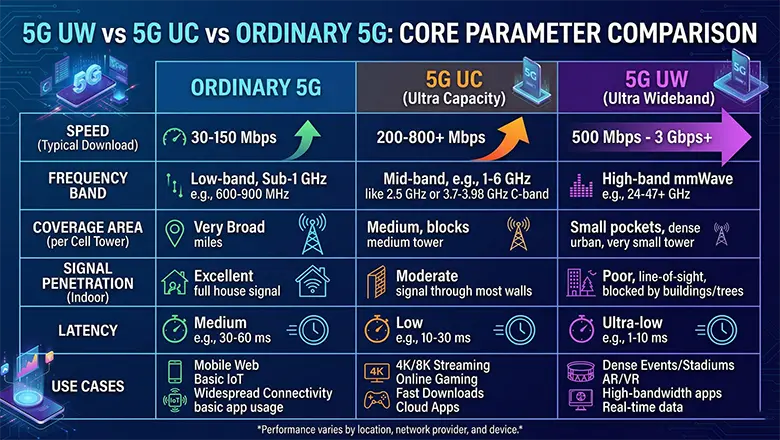
The core differences of the three types of 5G networks focus on four dimensions: frequency band, coverage, speed and latency. The specific comparison is as follows:
| Indicator | 5G UW (Ultra Wideband) | 5G UC (Ultra Capacity) | Standard 5G (Low-band) |
| Frequency Band | Millimeter wave 24-40GHz+ | Mid-band 1-6GHz | <1GHz |
| Coverage Range | Urban blocks, dense venues | Cities, suburbs | Nationwide, rural areas |
| Download Speed | 1-3Gbps | 300Mbps-1Gbps+ | 50-200Mbps |
| Network Latency | <10ms | 20-50ms | 30-100ms |
| Optimal Scenario | VR, major sports events, high-speed upload | Daily mobile office, business districts | Basic calls, wide-area coverage |
How to Choose Between 5G UW and 5G UC?
Both are high-level 5G, but with different positioning:
- 5G UW: Focuses on extreme speed and low latency, suitable for high-density high-speed demand scenarios such as venues, airports and core business districts.
- 5G UC: Focuses on metropolitan wide coverage and balanced performance, faster than ordinary 5G, suitable for daily large-traffic use in cities and suburbs.
Actual Experience of 5G Network: Measured Speed and Latency
The measured data of network speed, latency and icon correspondence that users care about most are as follows:
| Network Type | Actual Download Rate | Latency | Mobile Phone Icon |
| 4G LTE | 20-100Mbps | 50ms+ | LTE |
| Standard 5G | 50-200Mbps | 30-100ms | 5G |
| 5G UC | 300Mbps-1Gbps+ | 20-50ms | 5G UC, 5G+ |
| 5G UW | 1-3Gbps+ | <10ms | 5G UW, UWB |
Among them, the speed of 5G UW is more than 10 times that of ordinary 5G, and the speed of 5G UC is 3-5 times that of ordinary 5G, with more obvious advantages in dense scenarios.
Practical Application Scenarios of 5G UW and 5G UC
High-level 5G networks not only improve mobile phone experience, but also reconstruct the application model of various industries:
- Smart Medical Care: The low latency + high speed of 5G UW support remote diagnosis and robot-assisted surgery.
- Autonomous Driving: Vehicles realize vehicle-road collaboration based on 5G UW, with millisecond-level response to ensure safety.
- Immersive Entertainment: 5G UW in venues supports 10,000 people to upload videos and real-time AR replay at the same time; 5G UC in cities enables AR glasses to use without lag.
- Home Broadband Replacement: 5G UC can replace home broadband in urban apartments without optical fibers, supporting simultaneous networking of multiple devices.
5G Device Compatibility: How to Choose Terminals Supporting 5G UW/UC
Not all 5G mobile phones can access 5G UW and 5G UC networks. Pay attention to the following when purchasing:
- 5G compatible devices: Only support basic 5G network, not necessarily adapted to millimeter-wave 5G UW.
- High-level 5G devices: Need to be marked with support for millimeter wave (mm Wave)and C-band to use 5G UW and 5G UC.
- Suggestion: Choose models that support both 5G UW and 5G UC for optimal full-scenario adaptation.
Industrial Impact and Technical Challenges of 5G Network
Promotion to the PCB Industry
5G UW and 5G UC put forward higher requirements for component design. PCBs (Printed Circuit Boards) need to adopt high-end materials and strict tolerances to ensure signal integrity. PCBs in base stations and terminal equipment need to adapt to large-traffic transmission of Massive MIMO antennas and millimeter-wave modules.
Existing Limitations of 5G UW
- Coverage shortcomings: Millimeter-wave signals are easily blocked by walls, with insufficient coverage in suburbs and rural areas.
- Power consumption problem: High-speed transmission will increase device power consumption.
- High cost: The cost of terminals and base stations supporting 5G UW is higher.
- Slow deployment: Only core cities have completed large-scale coverage.
Tips for Using 5G Network: Maximize 5G UW/UC Experience
- Check the operator’s coverage map to confirm the coverage areas of 5G UW and 5G UC.
- Check device parameters; only flagship models (iPhone 12 and above, Galaxy S21 and above) support 5G UW.
- Turn on “5G Auto Switch”, and the device will automatically adapt to 5G UW, 5G UC and ordinary 5G.
- When the mobile phone displays 5G UW, it is the fastest 5G network state at present.
Future Development of 5G UW and 5G UC
In the future, the coverage of 5G UW will continue to expand from core urban areas to communities and parks; indoor coverage will be optimized through small base stations, and office buildings and shopping malls can also enjoy stable 5G UW. At the same time, 5G UW will be integrated with edge computing, AI and blockchain to implement scenarios such as fully connected smart cities and industrial automation, and also lay a foundation for 6G technology research and development.
Conclusion: Which Type of 5G is Suitable for You?
- If you are in a core city, venue or airport and need extreme network speed: 5G UW is the best choice.
- If you pursue high-speed and stable coverage across the city: 5G UC is suitable for daily office, home networking and other scenarios.
- If you need wide-area basic 5G coverage: Ordinary 5G is enough to meet calls and basic Internet access.
The core value of 5G network lies not only in faster network speed, but also in supporting massive data transmission and low-latency applications. 5G UW and 5G UC are the core network supports for future digital life and industrial upgrading.
Frequently Asked Questions
What does UW after 5G stand for?
UW stands for Ultra Wideband, a high-level 5G based on millimeter waves, representing top-level network speed and low latency.
What does UC after 5G stand for?
UC stands for Ultra Capacity, the logo of T-Mobile’s mid-band 5G, with wide coverage and faster speed than ordinary 5G.
What is the difference between 5G compatible and 5G supported?
Both mean that the device can access the 5G network. To use 5G UW/UC, confirm that the device supports millimeter waves and C-band.
Can 5G UW replace home broadband?
In urban areas with complete 5G UW coverage, 5G home routers can be used to replace optical fiber broadband, suitable for mobile office and temporary networking.
How about the security of 5G network?
The security mechanism of 5G is better than previous generations of networks. Keep devices updated and choose regular operators to ensure network security.