

Introduction: Why Learn Resistor Color Code and Color Coding?
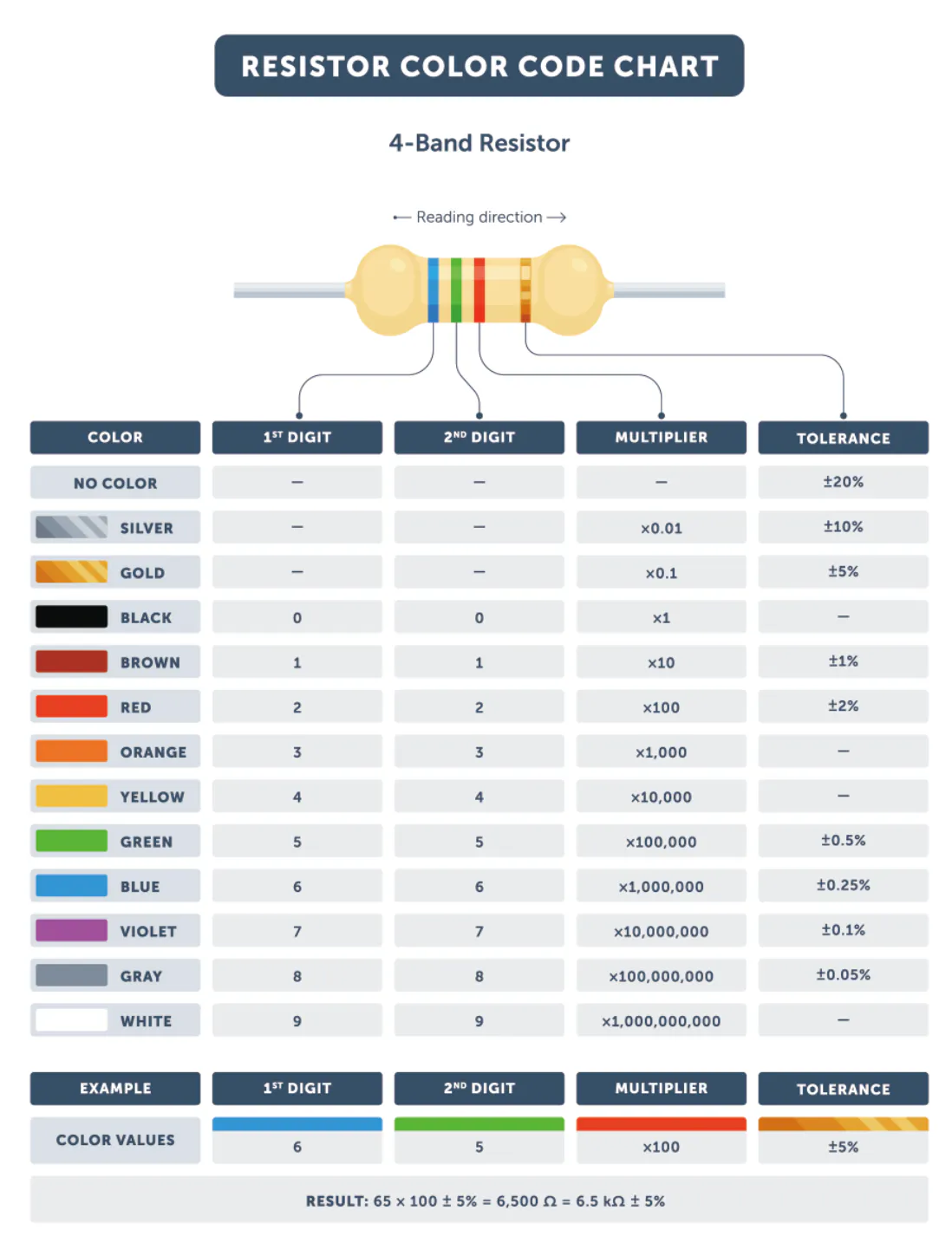
Resistor color code is the language of electronic. Anyone who wants to build, troubleshoot, or repair circuits must learn how to read resistor color code value. Color coding is the most common way to mark resistor with a huge range of value on even the tiniest component. If you want to read resistor quickly and accurately, use the color band on a resistor is essential for every project.
The ability to interpret the code not only let you use resistor value confidently but also helps you avoid costly mistake or hours of troubleshoot. Color coding connect the physical world of components to the digital work-flow of modern electronic—with the resistor color code chart forming the backbone of quick and accurate identification.
Whether you’re looking at a four band resistor, a 5 band resistor, or a precision 6 band resistor, this guide will teach you:
- How each band on the resistor indicate value, tolerance, or temperature stability.
- How to use a resistor color code calculator as a tool for reading resistor color bands.
- Why burnt color bands or an extra band appear, and what the final band specifies on premium resistors.
- How to memorize the color order and gain a rock-solid understanding of resistor color code chart conventions.
Resistor Color Code Chart: The Foundation of Resistor Identification
The resistor color code chart is your indispensable reference when reading resistor color or calculating a value of the resistor from the color band.
| Color | Digit | Multiplier | Tolerance | Temp. Coefficient (ppm/°C) |
| Black | 0 | ×1 | 250 | |
| Brown | 1 | ×10 | ±1% | 100 |
| Red | 2 | ×100 | ±2% | 50 |
| Orange | 3 | ×1,000 | 15 | |
| Yellow | 4 | ×10,000 | 25 | |
| Green | 5 | ×100,000 | ±0.5% | |
| Blue | 6 | ×1,000,000 | ±0.25% | 10 |
| Violet | 7 | ×10,000,000 | ±0.1% | 5 |
| Gray | 8 | ×100,000,000 | ±0.05% | |
| White | 9 | ×1,000,000,000 | ||
| Gold | ×0.1 | ±5% | ||
| Silver | ×0.01 | ±10% | ||
| None | ±20% |
How to Use the Resistor Color Code Chart
- Bands represent the significant digit (first, second, and sometimes third band).
- The next band is the multiplier, multiplying the digits by the specified factor.
- The last band specifies tolerance, which shows how much the resistor may vary.
- On a 6 band resistor, the extra band on the right is the temperature coefficient.
How to Read Resistor Color: Step-By-Step Instructions

To read resistor color code value with confidence, use these basic steps:
- Identify the number of color bands on the resistor:Most common are four, five, or six band.
- Find the band closest to the edge:This is the starting (leftmost) band. The last band is typically spaced farther away (or is gold/silver).
- Assign each band its value using the color code chart.
- Calculate:
- For a 4 band resistor, the third band represents the multiplier.
- For a 5 band resistor, the fourth band represents the multiplier.
- The final band specifies tolerance.
- For a 6 band resistor, the extra band at the end is the temperature coefficient.
Learn how to read resistor color code is easier when you visualize the process, use a calculator, and memorize the color order.
Understanding Color Coding for All Band Resistors
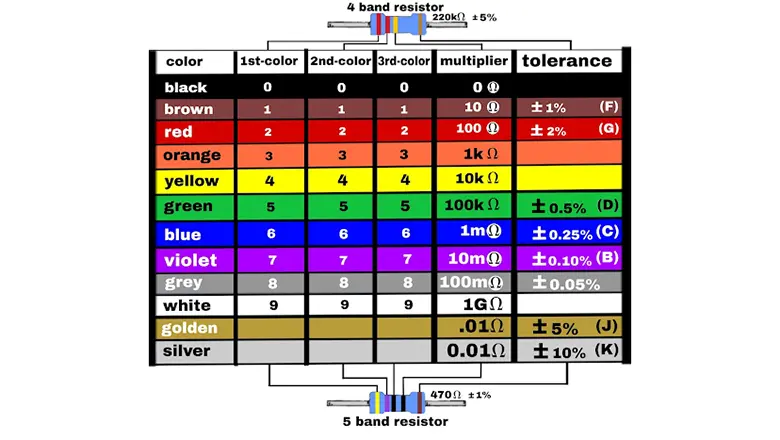
The color band to indicate value is not random—every hue corresponds to a specific number or function. Color coding isn’t just for show; it’s the industry standard. Here’s what each type of band resistor tells you:
- Two bands represent the significant digits(on a four-band resistor).
- In a 5 band resistor color code, three bands represent the significant digits, the next band is the multiplier, and the last band is the tolerance.
- On a 6 band resistor, the sixth band (far right) is usually the temperature coefficient, sometimes referred to as a reliability bandin military or aerospace applications.
Why does understanding resistor color codes matter?
- Accurately identifying band color is crucial to using the color code for mission-critical circuit performance.
- Decoding the band that indicates the multiplier prevents errors in resistor value by factors of ten or hundred.
- Recognizing what the last band means tells you about reliability and possible variations in a circuit.
4 Band Resistor: The Classic Standard
The four-band resistor remains the backbone of most non-precision electronics today.
| Band | Meaning |
| 1st Band | First significant digit |
| 2nd Band | Second significant digit |
| 3rd Band | Multiplier (third band represents multiplier) |
| 4th Band | Tolerance (band specifies tolerance) |
Example
Bands: Yellow, Violet, Red, Gold
- Yellow (4), Violet (7): 47
- Red (×100): 4,700
- Gold: ±5%
Calculation: (4, 7) × 100 = 4,700 Ω ±5%
That’s how a 4 band resistor uses color coding to convey its resistor value. Use the resistor color code chart to double-check each band color.
5 Band Resistor and 5 Band Resistor Color Code Techniques
A 5 band resistor is used when greater accuracy is required. Here’s how the 5 band resistor color code works:
| Band | Meaning |
| 1st Band | First significant digit |
| 2nd Band | Second significant digit |
| 3rd Band | Third significant digit |
| 4th Band | Multiplier (fourth band represents multiplier) |
| 5th Band | Tolerance (fifth band specifies tolerance) |
Example: Reading 5 Band Resistor Color Code
Suppose you have a 5 band resistor with the following bands:
- Brown (1)
- Black (0)
- Black (0)
- Red (×100)
- Brown (±1%)
Step-by-step:
- First three bands represent the significant digits: 1, 0, 0 → 100.
- The fourth band is the multiplier: Red= ×100.
- Calculate: 100 × 100 = 10,000 Ω (10 kΩ resistor).
- Fifth band represents the tolerance: Brown= ±1%.
Why use a 5 band resistor?
- Tighter tolerances (±1%, ±0.5%, ±0.25%) for voltage dividers, precision analog, and instrumentation circuits.
- The third band allows for more accurate resistor values not achievable with only two significant digits.
6 Band Resistor: Extra Stability and the Reliability Band
What is a 6 Band Resistor?
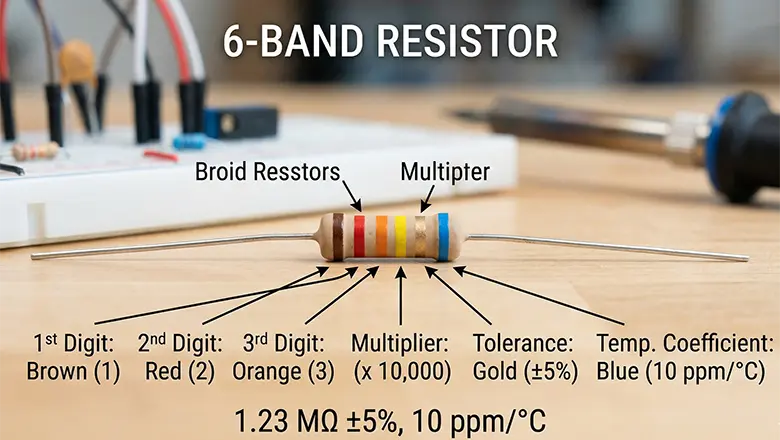
A 6 band resistor adds an extra band beyond the 5 band system—usually at the far right—to convey additional reliability or temperature stability information such as the temperature coefficient.
| Band Position | Meaning |
| 1st band | First significant digit |
| 2nd band | Second significant digit |
| 3rd band | Third significant digit |
| 4th band | Multiplier (fourth band represents the multiplier) |
| 5th band | Tolerance (fifth band specifies tolerance) |
| 6th band | Reliability or temperature coefficient |
Example: Reading a 6 Band Resistor
Bands present: Blue (6), Gray (8), Black (0), Brown (×10), Brown (±1%), Red (50 ppm/°C)
- First three bands: 6, 8, 0 → 680
- Fourth band: ×10 → 6,800 Ω
- Fifth band: ±1%
- Sixth band: 50 ppm/°C
How to use the sixth band:
On a 6 band resistor, if the final band is brown, red, orange, or another color, it signals the resistor’s stability or reliability. For instance, red (50 ppm/°C) means for every 1°C change, the resistor value shifts by 0.005%.
How Each Band Indicates the Value of the Resistor
Which Band Represents What?
- The first band(closest to an edge or grouped with others) always represents the first digit of the value.
- The second bandis always the next significant digit.
- The third bandfor 4-band gives the multiplier, but for 5 or 6 band resistors, it is usually a third significant digit.
- The fourth bandrepresents the multiplier in 5 and 6 band systems.
- The fifth bandis for tolerance, and the sixth band (if present) reveals reliability or temperature coefficient.
Quick Reference Table
| Bands | 1st Band | 2nd Band | 3rd Band | 4th Band | 5th Band | 6th Band |
| 4 | Value | Value | Multiplier | Tolerance | – | – |
| 5 | Value | Value | Value | Multiplier | Tolerance | – |
| 6 | Value | Value | Value | Multiplier | Tolerance | Temp. Coefficient |
Mnemonic (memorize the color order): Black, Brown, Red, Orange, Yellow, Green, Blue, Violet, Gray, White (BB ROY Great Britain Very Good Wife).
Using the Resistor Color Code Chart to Memorize the Color Order
The resistor color code chart is not only useful for values but is also a tool for memorizing the sequence. Many electronics professionals recommend taping a color code chart to your toolbox or bench. If you regularly read resistors or use resistor color code calculator, repetition will help you learn how to read resistor value by instinct.
Decoding Common Problems: Burnt Bands, Extra Bands, and Special Cases
Color Bands Are Burnt or Faded
If the color bands on the resistor are burnt so badly they’re unreadable:
- Use a multimeter to measure resistance directly.
- In critical circuits, always replace burnt or unclear resistors to avoid hidden faults.
Encountering an Extra Band
Some resistors include an extra band not for stability, but for a manufacturer’s lot code or reliability band. Always consult the manufacturer’s datasheet for special color patterns, especially for military, high-voltage, or aerospace applications.
Special Case: The Zero-Ohm Resistor
A resistor with a single black band is called a zero-ohm resistor. Rather than limit current, it acts as a PCB jumper so you can join traces or allow for option selection in circuits. Even though it “looks” like a resistor, it is a conductor.
Special Use: Gold and Silver as Multiplier
While gold and silver most often appear as tolerance bands, sometimes these are used as multipliers:
- Gold multiplier: ×0.1 (e.g., a 0.47 Ω resistor: Yellow, Violet, Gold, Gold).
- Silver multiplier: ×0.01.
Resistor Color Code Calculator: Best Tools for Reading Resistor Color
If you want an error-proof way to read resistor color code values, a resistor color code calculator is indispensable. Whether physical or software-based, these calculators can:
- Instantly convert color bands into resistance, tolerance, and stability values.
- Help double-check manual readings.
- Prove invaluable when color bands are hard to distinguish.
Pro Tips: How to Read Resistor Color Code Values in Real Circuits
- Lighting matters:Use natural light or neutral white LEDs to avoid color perception errors.
- Double-check using the resistor color code chart for every new part.
- Band spacing:The last band (for tolerance) may be spaced farther apart—double check orientation before reading a resistor.
- Use the calculator on old, dirty, or legacy resistors.
- Document values:When you repair or prototype, note both color codes and measured values to catch discrepancies later.
Reading SMD, Surface-Mount, and Non-Standard Color Coding
Surface-mount resistors don’t use color bands—there’s physically no space. Instead, they use:
- 3-Digit Codes: “102” = 10 × 100 = 1,000 Ω
- 4-Digit Codes: “1001” = 100 × 10 = 1,000 Ω
- EIA-96: Two digits and a letter for 1% tolerance resistors.
Frequently Asked Questions: Answering the Most Common Band Resistor Questions
Q1: What does the third band represent?
A: On a four-band resistor, the third band represents the multiplier. On a five-band or six-band resistor, the third band is a significant digit.
Q2: If I have a fifth band, does that mean my resistor has a tolerance?
A: Yes! The fifth band represents the tolerance in both five-band and six-band resistor codes.
Q3: Why is the last band important?
A: The last band always specifies tolerance (on 4- and 5-band resistors) or, on a six-band resistor, may specify the temperature coefficient.
Q4: How do I identify resistor value with burnt or missing bands?
A: Use a digital multimeter. Never rely solely on ambiguous color code—especially in safety-critical circuit.
Q5: Can different numbers of color bands mean anything special?
A: Yes—4 band is standard, 5 band is higher accuracy, 6 band (with an extra band) give temperature coefficient or reliability.
Q6: What is the value of the resistor if color bands are faded or burnt?
A: If color band burns out, the safest way to identify the resistance value is to use a digital multimeter. For critical or highly reliable circuit, replace the resistor instead of guess.
Q7: Why does a resistor sometimes have an additional band compared to others of similar value?
A: The extra band may represent a temperature coefficient, a special reliability band, or serve as a manufacturer lot identifier in high-reliability or military-grade band resistor types.
Q8: Can gold and silver bands serve as multipliers as well as tolerance?
A: Yes, for low-value resistors, gold (×0.1) and silver (×0.01) can serve as multipliers. Most commonly, though, gold and silver are used as tolerance bands (±5% and ±10% respectively).
Q9: Can I exclusively rely on resistor color code calculators for all resistor reading needs?
A: While a resistor color code calculator is a powerful tool for reading resistor color and verifying your results, you should always double-check using a physical measurement or cross-reference with a color code chart—especially when bands are unclear or the calculator output is unusual.
Downloadable Resistor Color Code Chart and References
Please be sure to save or print the resistor color code chart for quick reference. Put a chart on your bench or in your notebook can help build confidence when read resistor or discuss values with colleague or student.
Printable Color Code Chart
| Color | Digit | Multiplier | Tolerance | Temp. Coefficient (ppm/°C) |
| Black | 0 | ×1 | 250 | |
| Brown | 1 | ×10 | ±1% | 100 |
| Red | 2 | ×100 | ±2% | 50 |
| Orange | 3 | ×1,000 | 15 | |
| Yellow | 4 | ×10,000 | 25 | |
| Green | 5 | ×100,000 | ±0.5% | – |
| Blue | 6 | ×1,000,000 | ±0.25% | 10 |
| Violet | 7 | ×10,000,000 | ±0.1% | 5 |
| Gray | 8 | ×100,000,000 | ±0.05% | – |
| White | 9 | ×1,000,000,000 | – | |
| Gold | – | ×0.1 | ±5% | – |
| Silver | – | ×0.01 | ±10% | – |
| None | – | – | ±20% | – |
Conclusion: Mastering Resistor Color Code for Every Application
Gaining expertise in use the resistor color code system empower your electronic journey, from simple repairs to advanced product design. Reading resistor color codes is a must-have skill for anyone build, troubleshoot, or analyzing circuit—across all platforms from breadboard hobby project to high-reliability, military, or industrial system.
The Takeaways:
- The color coding system is the most common and standard method for marking resistor values, tolerances, and sometimes temperature coefficients on virtually every band resistor.
- By remembering which band indicates the significant digits, which band represents the multiplier, and that the last band specifies tolerance (or reliability/tempco for a sixth band), you’ll always be able to identify the value of the resistor with the color code—even if color bands are burnt or faded (using a meter for confirmation).
- Color codes for 4-band resistors and 5-band resistors can be found throughout the industry, while 6-band resistors – sometimes with reliability bands – add extra data for the highest stability and performance.
Whether you learn how to read the color of resistors through chart memorization, calculator usage or careful practice, mastering this language means you will never be stumps by the mysterious resistors again.
Quick Color Coding Best Practices
- Always read from the band closest to the edge—away from the tolerance band.
- Use the resistor color code chart or a calculator until it’s second nature.
- In high-value projects, document resistor color codes and readings for audit and troubleshooting.
- If you encounter a sixth band, check whether it’s a temperature coefficient or reliability band before installation.
- When in doubt, measure directly—and always double-check in mission-critical circuits.
Recommended Steps for Every Electronics Enthusiast:
- Print a resistor color code chart and stick it on your working area.
- Practice reading random resistors with your eyes and verify the instrument and calculator.
- Memorize the color order mnemonic for fast mental conversion.
- Use a resistor color code calculator for new or confusing combinations.
- Be alert for special bands (gold/silver multipliers, reliability bands) and verify with datasheets when needed.