

Introduction
Aerospace PCB assembly is the foundation upon which aviation, defense, and space innovation rest. With the aerospace industry evolves, the complex of a aerospace, demanding much higher reliability, precision, and durability than any other sector. A big fault on a printed circuit board can halt a satellite launch, jeopardize a spacecraft mission, or put lives at risk in commercial or defense aerospace operations.
PCB assembly in aerospace is not just to connect components—it’s also about manifesting uncompromising reliability, addressing regulatory compliance, and operating under harsh conditions with high temperatures, vibration, and pressure. This explains the reason why the manufacture and assembly of aerospace PCBs require the industry’s most stringent requirements, world-class engineering, and advanced quality control.
Scope of Aerospace PCB Assembly Examples:
- Avionics control systems in aircraft and UAVs
- Onboard electronics in spacecraft and satellites
- Communication and navigation systems
- High-reliability radar, passive detection, and defense systems
In this guide, we’ll explore the entire spectrum of aerospace PCB assemblies—from stringent specifications for aerospace PCB assembly, materials, layout, and the assembly process, to relevant tests for aerospace products, key challenges in aerospace PCB assembly, and upcoming trends impacting the aerospace sector.
What is Aerospace PCB Assembly?

Aerospace PCB assembly solder electronic components to the circuit boards for aircraft, satellites, UAV board and space hardware. Not like standard electronics, it prioritizes peak performance or ultra-high reliability under extreme harsh operating conditions.
Aerospace PCBA needs a stable long-term mission performance amid drastic temperature shifts, intense vibration, radiation and pressure fluctuations. All units must meet AS9100 and strict IPC standards for production quality, cleanliness and inspection.
Key Features of Aerospace PCB Assemblies:
- Use of aerospace-grade substrates, solder, and components
- Specialized design and PCB layout using specialized software for noise, EMI, and thermal resilience
- Documented traceability for every aerospace part and process step
- Comprehensive testing regimen to ensure the assembled PCB will not fail in service
High-reliability standards also means the aerospace PCB assembly services will include advanced techniques for example redundant circuit paths, rein forced mechanical and solder joints, conforma coating for environmental protection, and rigorous document throughout the manufacturing process.
Key Requirements for Aerospace PCB Assemblies
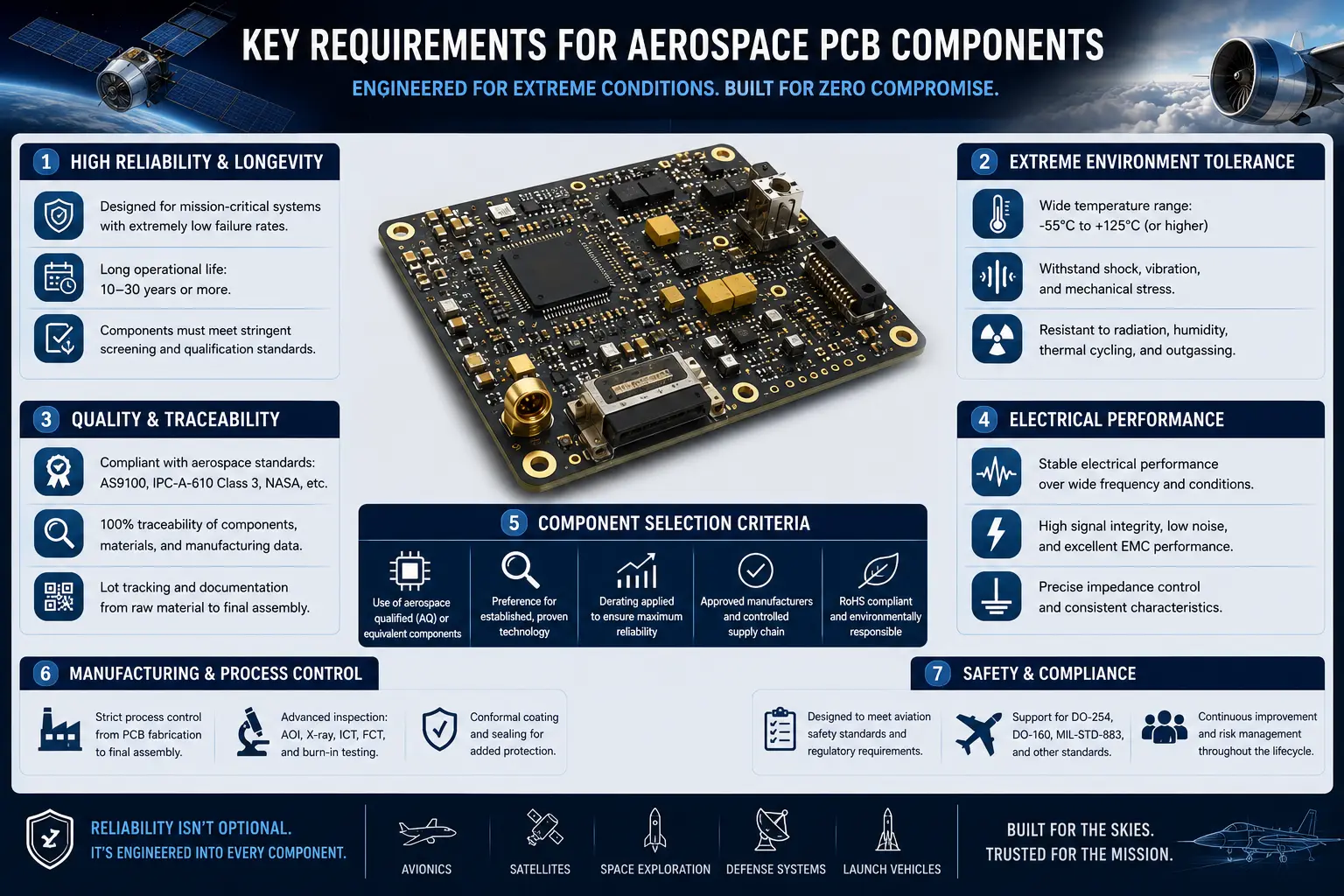
Stringent aerospace standards are mandatory for high-performance aerospace PCBA. Below are core factors to guarantee reliability and full compliance with industry safety & regulatory rules.
1. Extreme Reliability and Durability
Aerospace hardware requires failure-proof PCB assemblies. Unexpected circuit faults may trigger disastrous outcomes. Thus, all PCB production and assembly steps prioritize reliability via durable material selection, rigorous QC and stress performance verification..
2. Withstanding Harsh Conditions
- Extreme Temperatures: From deep-space chill to engine-adjacent heat, aerospace PCB assemblies must operate flawlessly.
- Vibration and Shock: Aircraft, spacecraft, and launch vehicles, assembly to relentless mechanical stress.
- Pressure Variations: Aerospace electronics not only can shift rapidly from sea level to the vacuum of space.
- Radiation and Humidity: Especially crucial for spacecraft and satellites, PCBs must resist degradation over years of exposure.
3. Stringent Quality Control and Documentation
- Full Traceability: Each circuit component is tracked, from sourcing through final assembly.
- Stringent Quality Control: Multi-layered inspection using AOI, X-ray, and functional tests at every assembly step.
- Conformance to International Quality Standards: Such as AS9100, ISO 9001, IPC-A-610 Class 3.
4. Longevity and Maintainability
Aerospace PCBs may need to operate for 20+ years. Material and process choices are made for longevity, minimal drift, and maximum durability in aerospace environments.
The Role of Stringent Standards and Certifications
Why Standards Matter
Aerospace standards including AS9100, IPC-A-610 and ISO 9001 set full criteria for aerospace PCBA, covering solder joint specs, paperwork and traceability.
Core Aerospace Certifications
| Standard / Certification | Purpose |
| AS9100 | Aerospace industry quality & QMS (mandatory) |
| ISO 9001 | Broad quality management system |
| Nadcap | Special process control for aerospace and defense |
| IPC-A-610 Class 3 | Assembly workmanship and reliability (assembly) |
- Case Study: Upgrading from IPC-A-610 Class 2 to Class 3 cut an aerospace electronics supplier’s field failures by 90%. AS9100 certification also unlocked Tier-1 aerospace deals and boosted internal production capabilities.
Specifications for Aerospace PCB Assembly
Under these standards, every manufacturing process—from pre-drilled holes on the PCB to solder mask application and final assembly—is governed by meticulously detailed documentation and records, ensuring no step is left to chance.
Aerospace PCB Assembly Process: A Step-by-Step Guide
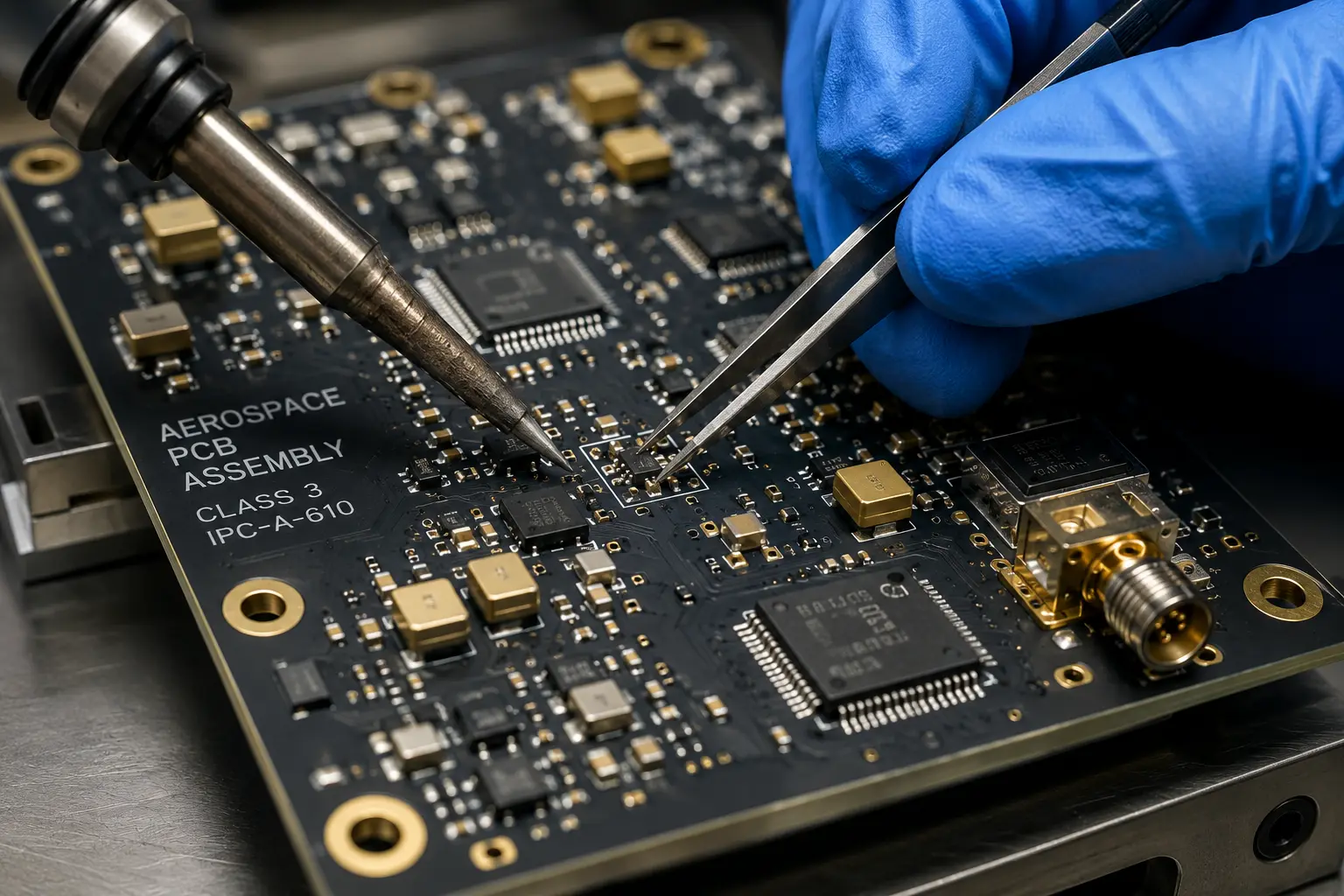
Let’s break down the full aerospace PCB assembly process so you can understand what high-reliability circuit assembly truly requires.
1. PCB Design and Layout
- Use of dedicated PCB layout using specialized software to ensure controlled impedance, EMS suppression, and optimal thermal management.
- Placement of components to minimize mechanical stress and thermal buildup.
- Multilayer stack-up for power, ground, and signal integrity.
2. Material Selection and Preparation
- Rigid, flex, rigid-flex, and high-performance aerospace substrates selected per aerospace application
- Sourcing only from approved aerospace and defense vendors
3. Component Placement and Mounting
- High-speed pick-and-place machines for consistent, repeatable component positioning.
- Through-hole parts inserted into predrilled holes on the PCB for mechanical strength.
4. Soldering
- Lead-free or aerospace-compliant solder applied to every joint, both SMT and THT.
- Nitrogen reflow for oxide-free, high-integrity joints.
5. Assembly Process Monitoring
- AOI verification, X-ray of concealed solder joints, and in-circuit test of complex boards.
6. Conformal Coating and Protection
- Application of specialized conformal coating for durability and protection against moisture, chemicals, and corrosion.
- Protection for circuits exposed to harsh conditions in aerospace environments.
7. Final Assembly and Inspection
- All assemblies underfunctional, environmental, and reliability testing.
- Comprehensive documentation, including FAI (First Article Inspection) reports.
Types of Aerospace PCB Assembly
Given the diverse needs of the aerospace industry, various PCB assembly solutions and technologies are in use:
- Single-Sided and Double-Sided PCBs: Suitable for basic aerospace components and systems.
- Multilayer PCBs: Applied to high-density core electronic equipment for radar and airborne electronic systems.
- Rigid-Flex and Flexible PCB Assemblies: Deployed in satellite modules with strict weight limits and compact unmanned aerial vehicle structures.
- Hybrid Substrate Assemblies: Integrate ceramic, PTFE and metal core materials to meet the requirements of high-end aerospace electronic devices.
Advanced aerospace applications may combine several types within one system to optimize both function and footprint.
Challenges in Aerospace PCB Assembly & Solutions

The challenges of aerospace PCB assembly require unique expertise and innovative engineering. The aerospace sector not only faces the complexities of aerospace design and the precise requirements of mission-critical circuits, but also demands continuous innovation in assembly process and materials.
1. Operating in Harsh Conditions
Aerospace PCB assemblies are constantly exposed to vibration, mechanical impact and wide temperature swings. These conditions can lead to tiny cracks in solder joints, PCB layer separation and loose electronic parts. Manufacturers adopt aerospace-standard polyimide and ceramic base materials with outstanding thermal stability, together with robust mounting processes to mitigate such failures. Protective conformal and three-proof coatings are also coated on boards to block pollutants and prevent damage caused by repeated temperature changes.
2. Managing Electromagnetic Interference
Dense aerospace electronics face EMI risks that trigger system faults and signal attenuation. Reliable PCB layout practices resolve this: refined plane design, ground shielding, precise signal routing and low-loss dielectric substrates.
3. Tight Weight and Space Constraints
In order to reduce the size and mass of PCB assemblies, it is critical for both aircraft and spacecraft. Solution: In order to use flex pcb, rigid-flex hybrids, and high-density interconnects to max function in a min footprint and reduce unnecessary connectors.
4. Obsolescence and Supply Chain Risks
Many aerospace projects run for decades, long after commercial electronic parts are discontinued. Solution: Work with a pro-active PCB manufacturer and electronics contract manufacturing partner. Establish a robust lifecycle management plan and maintain relationships with suppliers who can support “last time buy” and long-term stock solutions.
5. Stringent Testing Requirements
All finished PCB assemblies need to pass tests that replicate the extreme thermal, vibration and pressure conditions encountered during actual aerospace missions. Solution: Adopt a complete PCB assembly workflow covering environmental stress screening, thermal cycling and vibration testing, alongside routine quality control inspections.
Material Specifications for Aerospace PCB
The manufacturing process requires strict material selection and verification, which directly affects manufacturability and the long-term reliability of finished productsy.
Common Aerospace PCB Substrate Materials:
- Polyimide: Well received for its flexibility, stable performance and outstanding heat resistance under harsh aerospace working conditions.
- Ceramic: Applied to power modules and radio frequency devices that demand good heat conduction and solid mechanical performance.
- PTFE: Ideal for high-frequency communication parts of satellites and radar systems, featuring low dielectric loss and low water absorption.
- FR-4 (High Tg): Suitable for aerospace products with low performance risks and tight budget limits, offering medium heat resistance.
Coatings, Inks, and Finishes:
- High-temperature soldermarking inks maintain clear printing over long service periods.
- ENIG, ENEPIG, and Immersion Silver finishes for corrosion resistance, solderability, and longer
- Conformal coating is applied toshield circuits from moisture, chemical erosion and mechanical wear.
Testing and Quality Control in Aerospace PCB Assembly
No aerospace pcb assemblies are delivered without passing rigorous, multi-stage testing. The ability to survive and operate flawlessly in aerospace operations is proven through a documented assembly process.
Critical Tests and Control Measures:
- Automated Optical Inspection (AOI): Immediately detect a missing, misaligned, incorrect components on every assembled PCB.
- X-ray and 3D X-ray Inspection: It required for high-density, multilayer, and BGA assemblies to check the hidden solder joints.
- In-Circuit and Functional Testing: Electrical performance validation of the entire printed circuit against design specifications.
- Environmental & Highly Accelerated Life Testing (HALT): Simulates decades of operation via cycles of thermal shock, vibration, humidity, and voltage surges.
- Traceability: Digital records for each assembled PCB, including origin of parts, operator logs, and all test results—critical for aviation agency audits and incident root cause analysis.
Relevant Tests for Aerospace Products
| Test Type | Purpose/Benefit |
| Thermal Cycling | Verifies durability under extreme temperatures |
| Vibration Test | Ensures mechanical stability and solder reliability |
| Burn-in/ESS | Accelerates latent defects for early detection |
| Pressure Testing | For space/vacuum-suitable assembly |
| EMI/EMC Validation | Verifies no critical interference or emissions |
Quality control and testing they are the backbone for reliability in aerospace PCB and a key differentiator in the aerospace industry.
Critical Design and Manufacturing Tips for Aerospace PCB Assemblies
Here are practical, field-tested tips for premium aerospace PCB assembly:
Engage your assembly partner early: Complete DFM and DFA checks before prototyping to prevent expensive design errors.
Document Everything: Preserve complete build files, BOMs, test data and process revision logs for all aerospace units.
Design for Manufacturability: In order to adopt standard pad&via specs, and align SMT/THT parts to suggested angles for good solder joints.
Prioritize redundancy and fail-safes: Backup circuits and solid thermal design lift big mission performance&reliability.
Choose advanced assembly techniques: Laser micro via , controlled impedance circuit and nitrogen reflow can deliver better quality and lifespan.
Audit suppliers and sub-suppliers regularly: In order to ensure paperwork, credentials and quality standards (AS9100, IPC-A-610 Class 3) are up-to-date always fully followed.
Applications and Modules in Aerospace PCB Assemblies
Aerospace PCB assemblies support a vast variety of electronic systems in aerospace:
- Aircraft Control and Avionics: Engine management, cockpit displays, flight data computers
- Satellite Payloads: Communication transceivers, navigation modules, power converters
- Spacecraft Navigation and Telemetry: Guidance computers, telemetry transceivers
- UAV Controllers and Payloads: Flight controllers, sensors, mission management modules
- Radar and Ground Systems: Phased array modules, passive sensing circuits
| Aerospace Application | Unique PCB Assembly Requirements |
| Avionics processor | HDI, controlled impedance, redundancy |
| Satellite transponder | PTFE, ENIG, EMI shielded |
| UAV mission control | Polyimide rigid-flex, vibration-tolerant |
| Spacecraft power module | Ceramic, thick copper, heavy conformal coating |
| Ground station array | Multilayer, EMI suppression, board-level shielding |
Future Trends in Aerospace PCB Assembly
The aerospace industry continues to push the limits in electronics manufacturing services. Here’s where the next generation is heading:
- Ultra-High-Density PCBs and System-in-Package (SiP): Compact lightweight boards with integrated functions, suited for nanosatellites and autonomous drones.
- Digital Twin and Smart Factory: Aerospace PCB plants use digital systems to forecast equipment faults and raise production yields.
- New Material Innovations: Conductive paste, 3D printed circuits and molded substrates for high-performance aerospace modules.
- Autonomous Modular Systems: Plug-and-play PCB units allow flexible spacecraft and UAV setup for quick launch and maintenance.
- Sustainable Electronics: Aerospace circuits adopt halogen-free sheets, energy-saving production and eco-friendly waste handling.
Conclusion
Aerospace PCB assembly requires advanced techniques, strict quality checks and consistent reliability standards. In this field, even one defective solder joint can ruin costly aerospace missions, so every detail must be precisely controlled.
From process review, manufacturer selection to full assembly workflow mastery, you need an experienced partner complying with aerospace standards, offering tailored products and full lifecycle project support.
- Choose certified, responsive manufacturers with solid aerospace production experience.
- Specify only tested, documented materials and processes.
- Enforce strict quality inspection and full traceability for all finished PCBs.
Prioritize precision, cooperate with professional electronic manufacturing partners, and follow updated quality standards to maximize performance and reliability for aerospace projects, guaranteeing safety, smooth missions and technical innovation..
Want to develop your aerospace product? Reach out to professional aerospace PCB assembly suppliers for technical consultation, quick prototyping, document audit and detailed quotations.