

Introduction: Capacitor Discharge and Electrical Safety
Learning to discharge a capacitor is a very important in electronics safety skill. Capacitors is exist in power supplies, circuit boards, amps, TVs, microwaves, computers, cars and industrial machinery. We can knowing capacitors hold stored energy makes the risk clear: to improper discharge can cause shocks, circuit damage or fires.
This comprehensive guide suits a hobbyists and pros. It details the reason, when and how to safe s discharge capacitors, resistor-based safe discharge methods, full discharge checks, even error prevention to protect circuits, components and yourself.
What Is a Capacitor? Understanding How Capacitors Store and Discharge Energy

A capacitor not only can store electricity via an electric field between two conductive plates split by dielectric insulation. But also can charge piles electrons on one plate and removes them from the other. Its charge storage capacity is capacitance, measured in farads (F); some common units are microfarads (μF) and picofarads (pF).
How Capacitors Work
- In a circuit, a charged capacitor hold most energy, releasing it instantly for voltage stabilization, noise filtering or power surges.
- Voltage and capacitance can relies on voltage and capacitance via formula E = ½ CV²: E = energy (joules), C = capacitance (farads), V = voltage.
| Capacitor Type | Capacitance Range | Voltage Rating | Typical Uses |
| Ceramic | pF–μF | Up to 10kV | Noise filtering, high-frequency circuits |
| Electrolytic | μF–100,000μF | Up to 600V | Power supplies, audio amplifiers, energy storage |
| Film/Polyester | nF–μF | Up to 2kV | AC applications, signal coupling |
| Supercapacitor | 0.1–10,000F | Low voltage | Energy maintenance, memory backup |
Pro tip: The charge in the capacitor is proportional to its voltage and capacitance. Even “low-voltage capacitors” in large values (like 4700μF at 35V) can deliver enough energy stored to create a dangerous spark.
Where Is Energy Stored in the Capacitor?
Stored electrical energy is usually between the plates, not “used up” until the plates are shorted, a load is attached, or the energy leaks anyway. Capacitors can retain a charge for mins, hours, or sometimes days, it depends on the leakage current or the applied voltage.
Why and When a Capacitor Needs to Be Discharged

A capacitor needs to be fully discharged before our handle, modify, or repair a circuit. Why?
- Capacitors can retain a charge well after power-off. Some high-voltage capacitors can still hold several hundred volts even after days unplugged.
- Touching a charged capacitor—even one “across the circuit board” or in a simple household appliance—can shock you, burn tools, and even damage the capacitor or other parts in the circuitry.
- Discharge the cap before soldering, removing, or testing with a probe or meter.
When to Discharge
- Before working on any circuit: Never assume electrical energy has dissipated by itself.
- After a capacitor has been charged recently.
- When moving equipment between locations: Safety for movers and new users.
- If you’re uncertain about the “side of the capacitor” or circuit’s topology.
Risks of Attempting to Discharge Without Safety Precautions
Failing to follow capacitor discharge safety can result in:
- Risk of electric shock: Even minor shocks can cause severe injury, muscle contractions, or cardiac arrest from high voltage capacitors.
- Sudden energy release: Arc flash or burned tools, especially if using a screwdriver or improper tools.
- Damage to the capacitor or circuit board: The sudden discharge normally will vaporize traces, destroy the dielectric, or cause neighboring components to fail.
- Residual charge in a capacitor: If you will forget to verify the discharge, residual voltage or maybe charge shock us during further repair.
Cases in Point:
| Scenario | Event | Result |
| TV repair, no discharge | Probe bridges terminals of the capacitor | Loud arc, damaged multimeter, burnt PCB traces |
| Amplifier recap, no PPE | Touches terminals of the capacitor | Severe shock, dropped tool, board short |
| Power supply teardown | Used only a screwdriver for large capacitors | Damaged screwdriver, dangerous spark |
| Industrial circuit bank | Only discharged one unit, others paralleled | Hidden charge, delayed shock |
Step-by-Step: How to Discharge a Capacitor Safely

Here’s a field-proven, detailed procedure for how to discharge a capacitor safely—suitable from small electronics to large industrial units:
1. Turn Off the Power and Isolate the Circuit
It is always disconnect the power supply, then let high-voltage capacitors sit for a few minutes someway. This allows the stored energy to reduce via circuit leakage, but never rely solely on this for complete discharge. For equipment with a “clip to ground” or chassis ground, remove any potential ground loops before starting.
2. Inspect and Identify the Capacitor
To Identify the capacitor’s voltage rating, capacitance, and type. Large capacitors, filter capacitors, and those marked with warning labels deserve double caution, especially across the capacitor terminals.
3. Measure the Voltage Across the Capacitor
Use a multimeter set to the highest expected range. Touch the probe ends to each terminal of the capacitor and read the voltage. For safety, have one hand in our pocket to avoid creating a discharge path across your chest.
4. Prepare Your Discharge Tool
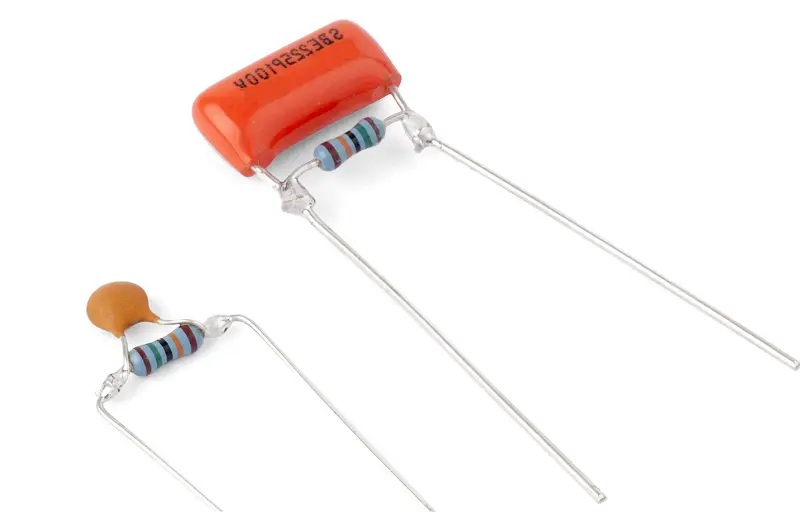
For most scenarios, the safer way to discharge a capacitor is to use a resistor with the correct resistance or one wattage.
Discharge Tool Quicklist
- Bleeder resistor(e.g., 10kΩ, 5-watt resistor for 400–600 volt capacitors)
- Well-insulated test leads or alligator clips
- Commercial capacitor discharge tools with voltage indicator (excellent for high voltage)
- Light bulb with a suitable rating(for medium capacitors as a visual discharge indicator)
- Multimeter to measure the voltage throughout the process
5. Connect the Discharge Tool Across the Capacitor Terminals
Step-by-step:
- Clip one end of the resistor to one terminal of the capacitor.
- Clip the other end of the resistor to the other terminal. If using a discharge tool or light bulb, carefully connect across the capacitor in the same time.
- It allow ourcapacitor to discharge for the calculated discharge rate time (see table below) or until the voltage measured falls safely below 1 volt. This step dissipates the energy stored in the capacitor.
Discharge Path Table (for typical values):
| Capacitance (μF) | Voltage (V) | Resistor (Ω/watt) | Time Constant (τ, seconds) | 99% Discharge Time (~5τ) |
| 10 | 450 | 45,000/2W | 0.45 | 2.25 sec |
| 2,200 | 300 | 10,000/5W | 22 | 110 sec |
| 47,000 | 50 | 1,000/5W | 47 | 235 sec |
Top Capacitor Discharge Methods Explained
a. Discharge Capacitor with Resistor
This is the safest and most controlled way to discharge capacitors.
- Choose a resistor: It’s a common values for most power supply filter capacitors, it is5kΩ–100kΩ, rated for a 5 watts.
- Attach one end of the resistor across the capacitor terminals using insulated leads or alligator clips.
- To wait the full calculated time (5xRC for 99% discharge) and then use your multimeter to confirm the capacitor is fully discharged.
- For very large capacitors (tens of thousands of microfarads), use several parallel resistors or increase the wattage to handle the higher discharge current.
b. Discharge with a Screwdriver
Only for low-voltage, low-capacitance caps (such as those in audio or signal circuits).
Procedure:
- We can use a screwdriver with an insulated handle.
- A short across the capacitor terminals firmly, it can creating a direct path for current to flow and discharge the cap.
- Be aware: Very large or high voltage capacitors discharged this way, it can also create a danger arc or maybe damage the screwdriver or circuit board.
Warning: Never use this method for high voltage capacitors (such as those in microwaves, old TVs, motors, or industrial gear). The energy will stored in a capacitor ,and also can vaporize the tool or cause serious injury.
c. Discharge Using a Light Bulb
A great visual way to discharge medium-value capacitors, especially in old radio or television circuits.
- It can connect a light bulb in series in a discharge resistor across the capacitor terminals.
- The bulb usually glow briefly, indicating energy is flowing, then dim as the stored energy dissipates.
- We can use the multimeter afterward to see if the capacitor is fully discharged.
d. Professional Capacitor Discharge Tools
For high-energy or high voltage capacitors, use a commercial discharge tool with an indicator for volt and remaining charge. These often contain a built-in resistor and LED or buzzer to show the discharge status.
- Attach as per instructions across the terminals.
- Wait for the signal indicating the capacitor is safe to handle.
- Use the multimeter after as a double-check.
Cases When You Must Fully Discharge Large Capacitors
Large capacitors (such as those in industrial motor drives, solar inverters, or old tube amplifiers) store significant electrical energy even at “safe” voltages:
- Any capacitor over 470 μF or with voltage ratings above 100 volts can deliver a potent shock or even cause electric burns.
- In high voltage applications, the stored energy can reach several hundred volts and cause arc flash or significant circuit damage.
- Large capacitors are often found in power supply banks. Always discharge each unit individually. Attempting to discharge only one can leave others in the bank charged.
How to Verify a Capacitor Is Fully Discharged
Even after we using a discharge tool or resistor across the capacitor terminals, it never assume the cap is safe.
Use the Multimeter to Confirm
- Set your multimeter to the appropriate voltage range.
- Touch the probes across the capacitor.
- A reading of under 1 volt is generally considered safe to handle.
- For very large or high-voltage caps, wait a minute, then measure the voltage again to ensure there is no “bounce back.”
- Repeat the discharge if there’s any measurable voltage.
Pro Safety Tips for Testing
- Always use insulated gloves and safety glasses when performing this test.
- For circuit board capacitors, make sure both sides are accessible and you’re not measuring across parallel components.
- Never to attempt the discharge or measure a capacitor with faulty or uncali brated tools, it without personal protective equipment.
Capacitor Safety Tips: Complete Discharge and Handling
- Never touch the terminals of the capacitor immediately after power-down.
- Always discharge capacitors safely, especially before attempting repairs or measuring voltage.
- Use insulated tools and PPE for every discharge.
- For large or old capacitors, always wait a few moments and recheck for voltage before pronouncing the capacitor fully discharged.
- Store discharged capacitors is separately from chargeds.
- Mark and isolate a capacitor, it cannot be safely discharged to prevent others from accidental contact.
Common Discharge Mistakes and How to Avoid Them
- Skipping the Multimeter Check: Failing to check capacitor voltage post discharge frequently leads to shocks and board damag.
- Using a Low-Wattage Resistor: Resistors may overheat, burn out, fail to fully discharge capacitors or spark fires.
- Shorting Large Capacitors: Creates powerful arcs, ruins tools and melts PCB traces.
- Not Using Insulated Tools: Raises shock hazards and triggers unintended shorts.
- Assuming All Capacitors Self-Discharge Quickly: Many capacitors retain charge for days or weeks in low-leakage circuits.
- Attempting to Discharge Without Safety Precautions: Tiny high-voltage capacitors can deliver fatal electric shocks.
Advanced Topics: Effects of Leakage, Dielectric Absorption, and Capacitance
Leakage in Capacitors
- Leakage is one of the small current, it flows through the dielectric material or across the terminals, also cause the capacitor to self-discharge over time.
- Over some years, high leakage can also reducecapacitor’s effectiveness&
- For circuit safety, always assume the worst—capacitors can retain a charge.
Dielectric Absorption
- Afterthe discharge, some capacitors “rebound” will develop a small voltage—this is dielectric absorption.
- It willmakes critical to verify voltage after several minutes, particularly in safety-critical or high-voltage circuits.
Capacitance and Discharge Rate
- A larger capacitance or lower resistance means,slower discharge, or maybe greater stored energy that must be handled carefully.
- Use the formula ( V(t) = V_0 e^{-t/RC} ) to model the voltage across the capacitor over time.
- The discharge rate should be calculated, in order to ensure safe dissipation of stored electrical energy.
Frequently Asked Questions About Discharging a Capacitor
1. What Is the Safest Way to Discharge a Capacitor?
Disconnect all power sources, then attach a suitable resistor across capacitor terminals. Allow adequate discharge time, then confirm zero residual voltage with a multimeter before handling the circuit.
2. Why Should You Discharge a Capacitor Before Testing or Replacing It?
Capacitors can hold dangerous voltage after power-off. Discharge prevents shocks, component damage, arcing and faulty readings.
3. What Tools Do You Need to Discharge a Capacitor Safely?
You normally need a matched discharge resistor or tool, insulated test leads, and a rated digital multimeter. High-voltage work additionally requires insulated tools and proper protective gear.
4. What Size Resistor Should You Use to Discharge a Capacitor?
The resistor size matches capacitor capacitance, voltage, discharge time and safe current. It must meet power, voltage and pulse energy ratings.
5. How Long Does It Take for a Capacitor to Fully Discharge?
The discharge time depends on circuit resistance and capacitance. After five RC time constants, residual voltage drops below 1% of the original level.
6. How Can You Tell Whether a Capacitor Is Fully Discharged?
To measure the voltage directly across the capacitor terminals with a properly rated multimeter. We need to check it again after a short delay, it is because some capacitors may recover a small amount of voltage due to dielectric absorption.
7. Can You Use a Multimeter to Discharge a Capacitor?
A standard multimeter are for voltage checking, not primary discharge. Discharge via proper resistors or dedicated tools, then confirm with the meter.
8. Is It Safe to Discharge a Capacitor with an Insulated Screwdriver?
Directly shorting a capacitor with screwdrivers. High current creates sparks, harms terminals and components, and causes injury, particularly for high-voltage, high-capacitance units.
9. How Do You Calculate a Capacitor’s Discharge Time?
The discharge time can be calculated using:
t = R × C × ln(V₀ ÷ Vₜ)
Here, R is resistance, C is capacitance, V₀ is the initial voltage, and Vₜ is the target voltage.
10. What Happens If You Do Not Discharge a Capacitor?
An undischarged capacitor trigger shocks, burns, arcs, device damage and false readings. Risks spike in power supplies, inverters, motor drives and other high-voltage gear.
Conclusion: Always Discharge for Safe and Reliable Electronics Work
Understanding how to safely discharge a capacitor is essential for all electronics workers and enthusiasts. Any capacitor on boards, power supplies or appliances stores latent energy; assume it carries hundreds of volts and discharge it properly:
- Use insulated gloves and safety glasses
- Use the right watt resistor or commercial discharge tools
- Verify with a multimeter—never assume
- Allow the capacitor to discharge fully
- Handle and dispose of all components responsibly
Brief caution during capacitor discharge avoids lasting harm. Respect all circuits and capacitors, strictly follow the guide’s procedures. Whether you’re working on a high voltage power supply, repairing a circuit board, or diagnosing industrial equipment, remember: even a small error in capacitor discharge can have major consequences for safety and equipment integrity.