

Introduction: The Green Circuit Board Mystery
Take apart any electronic device and you’ll likely find a familiar sight: a bright green PCB. This iconic appearance is so universal that “circuit board green” or “standard green” has entered everyday vocabulary, even outside technical circles. But why are circuit boards green? Is it the most functional color for PCBs, or simply traditional? Is a green PCBs better than black, red, white, or blue PCB?
This article unpacks the real reasons circuit boards are usually green, how to solder masks, and the color of a PCB can mean for inspecting, manufacturing, the performance of the board. We will explore the physics, chemistry, history, and best practices for PCB color choice—if you’re a hobbyist, designer, engineer, or project leader.
What is a Green Circuit Board?

The printed circuit board is the back bone of electronic system. A green circuit board, or green PCB, gets the color from the solder mask—the protective layer which can covers copper traces and prevents short circuits, corrosion, or oxidation. Today’s PCB industry recognizes green as the primary color and default choice for nearly every mass-produced board.
Structure of a Green PCB
| PCB Layer | Material/Process | Function |
| Silkscreen | Epoxy ink (white/black/yellow) | Reference marks for components and circuits |
| Solder Mask | Epoxy resin or acrylate + green pigment | Protection, insulation, the characteristic green color |
| Copper Traces | Pure copper | Electrical pathways, circuit traces, conductive function |
| Substrate | FR-4 glass epoxy, polyimide | Dielectric, mechanical backbone, insulation |
Fun Fact: The core material, or pcb substrate, is actually a glass epoxy laminate (FR-4) that’s naturally brownish. The green color only emerges after the solder mask is applied.
Why Do We Need a Solder Mask?
- Prevents solder bridges during wave soldering, then surface-mount processes.
- Shields copper traces from moisture, dust, flux, and contaminants.
- Supports the high-density layout of today’s pcb boards.
- Makes AOI (Automated Optical Inspection) and manual tests easier because of high optical contrast.
The History Behind Green PCBs: How Did Green Become the Standard?
The prevalence of the green circuit board isn’t accidental. In fact, it resulted from an interplay of chemistry, inspection ergonomics, cost efficiency, and advancing military standards.
How Green Became Synonymous with PCBs
- Origins: Early PCB solder masks were made from natural resins and glass epoxy binders. When pigment was added for better visibility in manufacturing, green was the most available and affordable option.
- Standardization: In the 1960s and 70s, the U.S. military and major aerospace companies began to specify green solder mask for supplied circuit boards, favoring its performance in inspection and all lighting conditions.
- Optimization: As a result, the whole PCB manufacturing process—from UV exposure to pattern imaging and curing—was streamlined for green solder masks. AOI machines, QA protocols, and global upstream material supply chains followed suit.
- Lock-in Effect: With green being the easiest color to work with, the industry found little reason to switch, especially as it yielded the best throughput, fastest assembly, and the lowest defect rates.
Why Are Circuit Boards Green? Decoding the Main Reasons

There are several compelling, practical reasons why PCBs are green and why the world has standardized on this board color for printed circuit boards.
1. Material Availability & Process Efficiency
- Epoxy resin is the foundational ingredient for solder mask coatings. Pure resin combined with specific green pigments forms a green epoxy mixture that’s chemically stable and production-friendly.
- Globally, green solder mask is produced at massive scale, making it cheaper and more readily available from any PCB manufacturer.
- Fact: Non-green options may require different pigmenting agents, adjustments in the PCB manufacturing process, and batch-specific inspection, all of which increase lead times and costs.
2. Manufacturing and Inspection Superiority
- Green is the easiest color for visual inspection, both for the human eye and machine vision systems. The contrast between copper traces, silkscreen, and the green of the solder mask is optimal.
- Manufacturing tolerances and AOI (Automated Optical Inspection) systems are set for the characteristic green mask, enabling higher throughput and fewer defects.
- Manual inspection of green boards is less prone to eye strain, fatigue, or oversight—even under bright assembly line lighting.
3. Military and Industrial Standards
- S. military and high-reliability industries historically required standard green for its multi-condition performance and clarity.
- Once green color became standard for circuit boards supplied to these sectors, commercial and consumer electronics quickly followed.
4. Environmental & Compliance Factors
- Green solder mask chemistry was first to comply with RoHS directives for lead-free and halogen-free electronics.
- Recycling: Green boards are easiest for global e-waste processors to sort and reclaim, as the chemistry is so well-known.
5. Practical Engineering Benefits
- Green makes rework, repair, and prototyping more reliable, thanks to clear visual separation of features on the PCB surface.
- With today’s dense surface-mount pcb layout, green boards help keep inspection—manual and AOI—fast and mistake-free.
The Chemistry and Science of Solder Masks

Understanding the color of a PCB is really about understanding solder masks. They’re not just colored paint; they’re an engineered, functional layer that protects and enhances board safety.
What is a Solder Mask?
A solder mask (sometimes called solder resist) is a thin polymer layer added during the pcb manufacturing process (after etching and before component soldering). Its job is to cover everything but the solder pads and vias—areas that should remain exposed for hot air solder leveling and assembly.
Components of a Green Solder Mask:
- Epoxy resin (provides thermal/chemical stability)
- Green pigment (standard for most pcbs)
- Fillers, photosensitizers, cross-linkers (tune viscosity, curing, and color stability)
- Solvents (evaporate during curing)
Solder Mask Application
- Solder mask is applied by spraying, screen-printing, or curtain coating.
- UV exposure through a photomask “images” the pcb board layout and hardens the desired pattern.
- Unhardened mask is washed away.
- Finished by thermal or further UV curing.
Some premium boards use liquid photoimageable solder mask (LPISM), which can achieve ultrafine patterning required for today’s microelectronics.
Green Epoxy for Reliability: Green epoxy-based masks are less prone to discoloration than other colors, making them perfect for long-term use in consumer, industrial, and military electronics. That’s why you’ll find a bright green or even a deep green colour on most supplied circuit boards, whether you’re sourcing from a global PCB manufacturer or a local prototyping shop.
Solder Mask Colors: The Full Spectrum
While green mask is the standard color for the industry, PCB manufacturing can deliver a variety of PCB colors as technology and customer demand have evolved. Today, it’s not unusual to find black PCBs, blue PCBs, red PCBs, white boards, yellow, and even purple in boutique or high-frequency designs. Each hue uses a slightly different set of pigments, and each interacts uniquely with the PCB manufacturing process.
| Solder Mask | Common Usage | Inspection Visibility | Thermal Impact | Branding Appeal |
| Green (Standard) | All/everyday | Excellent | Neutral | Familiar/trust |
| Red | Automotive/prototypes | Good | Neutral | Eye-catching |
| Blue | Medical/specialty | Good | Slightly warmer | Fresh/distinct |
| Black | High-end/gaming | Poor | Warmer/higher absorption | Premium |
| White | LED/lighting | Poor (shows dirt) | Very cool/reflective | Clean/modern |
| Yellow | Safety/alerts | Moderate | Slightly warm | Caution/safety |
| Purple | Boutique/RF | Moderate | Neutral | Stand-out/rare |
Green PCB in Modern Manufacturing: Assembly & Production Advantages
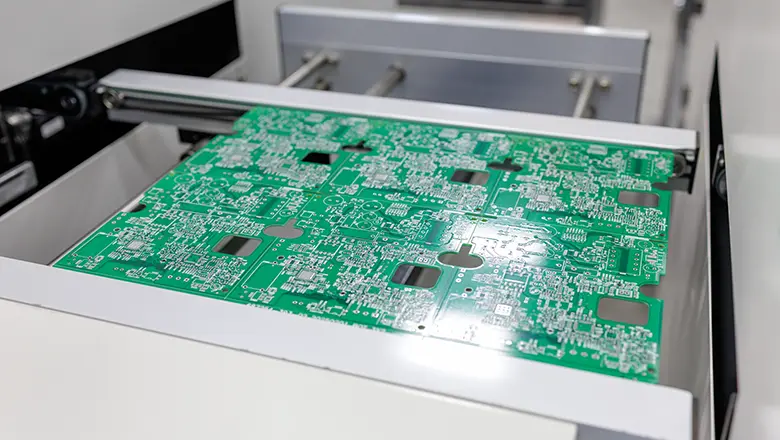
Why Is Green the Easiest Color?
Every PCB manufacturer optimizes their production lines for green PCBs. Using green boards is a guarantee of low cost, optimized quality, and fast output. The green colour is less likely to cause issues in the curing process. Due to their iconic green mask, these boards pass through AOI (automated optical inspection) and manual inspection with the highest error detection rates. That’s simply not true for black PCB or white PCB, for example, where silkscreen markings and copper traces are much less apparent to the human eye.
Short circuits are more easily spotted on green PCBs, even at the prototype stage. Green also hides flux residue and minor stains better than, say, black circuit or white boards, decreasing unnecessary rework.
Manufacturing Process for Green PCBs
- PCB layout is prepared from CAD files.
- Bare copper traces are etched onto the pcb substrate.
- The green solder mask is applied, either through screen printing or automated spray.
- Mask is UV-cured and developed, then “fired” in an oven.
- Hot air solder leveling is applied to ensure exposed solder pads are flat and free from oxidation.
- Silkscreen markings go on top, typically in white or black color for best contrast.
- The boards enter the final stages of PCB production, including automated testing and cutting.
This process is repeatable, and green is the “default” every step of the way—from small runs to millions of units.
Applications of Green PCBs Across Industries
Green PCBs dominate the PCB industry because they fit so many use cases:
- Consumer Electronics: Phones, tablets, toys, appliances.
- Industrial Controls: Robotics, sensors, automation PLCs.
- Automotive: Engine control modules, dashboards, infotainment, safety and warning boards are usually green or red/yellow for easy identification.
- Aerospace and Defense: Reliability and easy QA matter most; green PCBs are almost always green by specification.
- Medical Devices: Green PCBs are preferred due to their inspection reliability and proven long-term stability.
- Renewable Energy & Power: Power conversion, solar, wind, and battery management PCBs are green for supply chain efficiency and performance consistency.
Do PCBs Have to Be Green? PCB Color Options Explained
No, but for most users, using green is the best choice in terms of price, reliability, and manufacturability. PCB color options now extend far beyond green, allowing for custom branding, quick identification on the bench, or thermal/optical needs.
Alternative Choices:
- Black PCBs: Popular in premium consumer electronics and gaming, but inspection is trickier.
- Blue and Black: Used for branding, medical devices, or layer separation in stacked-board applications.
- Red: Sometimes denotes prototype or high-performance boards.
- White Boards: Key for LED lighting and optical hardware, where bright reflection is required.
Important: Switching away from green mask may impact lead time, cost, the performance of the board under AOI, and risk of missing short circuits or cold solder joints. Always consult your PCB manufacturer about the process demands of different colored solder masks.
Beyond Green: PCB Color Options and Their Uses
Why choose a different colored PCB?
- Brand differentiation: Make product internals truly your own.
- Visual identification: Color-coded boards are excellent for service/field work.
- Thermal management or optics: Black absorbs heat, white maximizes light reflectance.
- Aesthetic value: Gamers and hobbyists often love a sharp black PCB or blue PCB for extra “wow factor.”
| Color for Circuit Boards | Where Used | Why |
| Green (Standard) | All – default | Inspection, cost, reliability |
| Black (High-End) | Audio/PC/gaming | Premium look, sleek finish |
| Blue | Medical, specialty, branding | Unique, modern |
| Red | Automotive, alerts | Quick field ID |
| Yellow | Safety, power | Visual alerts |
| White | LEDs, electric lights | Light efficiency, hygiene |
Some users even specify a specific circuit board color for different product lines—for example, medical boards can be blue, while industrial controls may stay green.
Case Studies: PCB Color in the Real World
Consumer Icon (Green): Raspberry Pi
The world’s most famous single-board computer, Raspberry Pi, uses green for all its mainline boards. The color of a PCB here signals affordable mass production, fast yield, and no inspection problems.
Premium Brand (Black): Apple Mac Books
Apple often uses black PCB in MacBook Pro internals to complement the sleek visual impression—yet their supply chain must tune process, AOI, and rework to handle this harder-to-inspect color.
Lighting Innovator (White): LED Boards
White boards are chosen by companies making LED panels because the white solder mask improves overall light output—a critical performance factor for lighting.
Automotive Supplier (Red/Yellow): Safety
Some automotive and industrial suppliers use colored PCBs (red PCB/yellow PCB) for quick, unmistakable identification of safety and warning circuits.
Color and Inspection: How Green Makes Manufacturing Easier
Green PCB is not only the standard color from a manufacturing process viewpoint—it is best for the human eye. Humans detect detail and color contrast at peak efficiency in the green spectrum, which reduces eye strain for QA teams and service engineers. AOI systems also operate with the highest accuracy on green, as camera filters and lighting setups are tuned to this spectrum.
Board color impacts:
- Silkscreen visibility
- Error detection (solder bridges, lifted pads)
- Identification of misaligned or missing components
- Visual detection of contamination—white boards show residue, black PCB hides it entirely
If highest yields, process accuracy, and error-free repairs are your target, choosing green remains the industry’s gold standard.
PCB Color and Performance: What Really Matters?
Does the color of a PCB affect its electrical properties? For the vast majority of PCB applications, no. Solder mask thickness and dielectric constant may matter in high-frequency or RF boards, but for most users, this is negligible.
What does color affect?
- Thermal profile: Black PCBs get hotter, white PCBs stay cooler.
- Inspection: Human and AOI systems use color cues for defect detection.
- Cleanup/Rework: Green hides minor cosmetic flaws; white/black do not.
Industry Color Trends: Engineering Insights for the Future
The future may see an increase in different colored pcbs for branding and boutique applications. However, for industrial, automotive, and high-volume consumer sectors, the green pcb (and its related green soldermask) will continue to dominate, supported by an ecosystem of suppliers, automated inspection, and established manufacturing lines.
As more PCB manufacturers offer sophisticated color options and also customers become more design savvy, expect even more unique colors on visible PCBs—though the green part of the factory output will remain by far the largest.
Frequently Asked Questions About Green Circuit Boards
1. Why are so many PCBs green?
The majority of PCBs appear green as a result of the green solder mask covering their surfaces. Green emerged as the mainstream industry standard, thanks to strong visual contrast, consistent inspection performance, easy material access and comparatively affordable production costs.
2. Why is the solder mask green?
Green solder mask delivers clear contrast among copper tracks, solder pads, silkscreen prints and the PCB substrate. It helps operators and automated optical systems spot defects more readily during inspections.
3. What is the green layer on a PCB called?
This green covering is known as the solder mask, or solder resist. It shields copper circuits against oxidation, dirt, moisture, and unintended solder bridging that may occur throughout assembly.
4. What is a green circuit board called?
A green circuit board, we called it printed circuit board, or PCB. The green color comes from its solder mask, not represent a specific type of circuit board.
5. Are motherboards always green?
No. Motherboards we can use black, blue, red, white, purple, or other solder mask colors. Green is very simply a traditional and widely used manufacturing standard.
6. Does the color of a motherboard matter?
Motherboard color typically has no bearing on its electrical performance. Even so, solder mask hue affects defect detectability, automated inspection precision, manufacturing expenses and overall product aesthetics.
7. What is the difference between black and green PCBs?
The main difference in the pigments used within the solder mask. Green PCBs generally offer superior inspection contrast alongside cheaper production costs, whereas black PCBs are frequently chosen for visual appeal yet can obscure circuit tracks and surface flaws during inspection.
8. Does solder mask color affect PCB quality?
Solder mask color has no direct bearing on PCB quality. Circuit board reliability relies more on solder mask materials, curing procedures, coating thickness, adhesion strength and comprehensive production management.
9. What color solder mask can be used for a PCB?
Common solder mask hues cover green, black, blue, red, white, yellow and purple. The optimal choice hinges on inspection standards, brand styling, lighting environments, thermal demands and production expenses.
10. What is the difference between solder mask and solder paste?
Solder mask is a permanent protective coating applied to the PCB surface. Solder paste is a temporary mixture of solder powder and flux used to attach electronic components during the reflow soldering process.
Tips for Buyers & Designers: Selecting the Right PCB Color
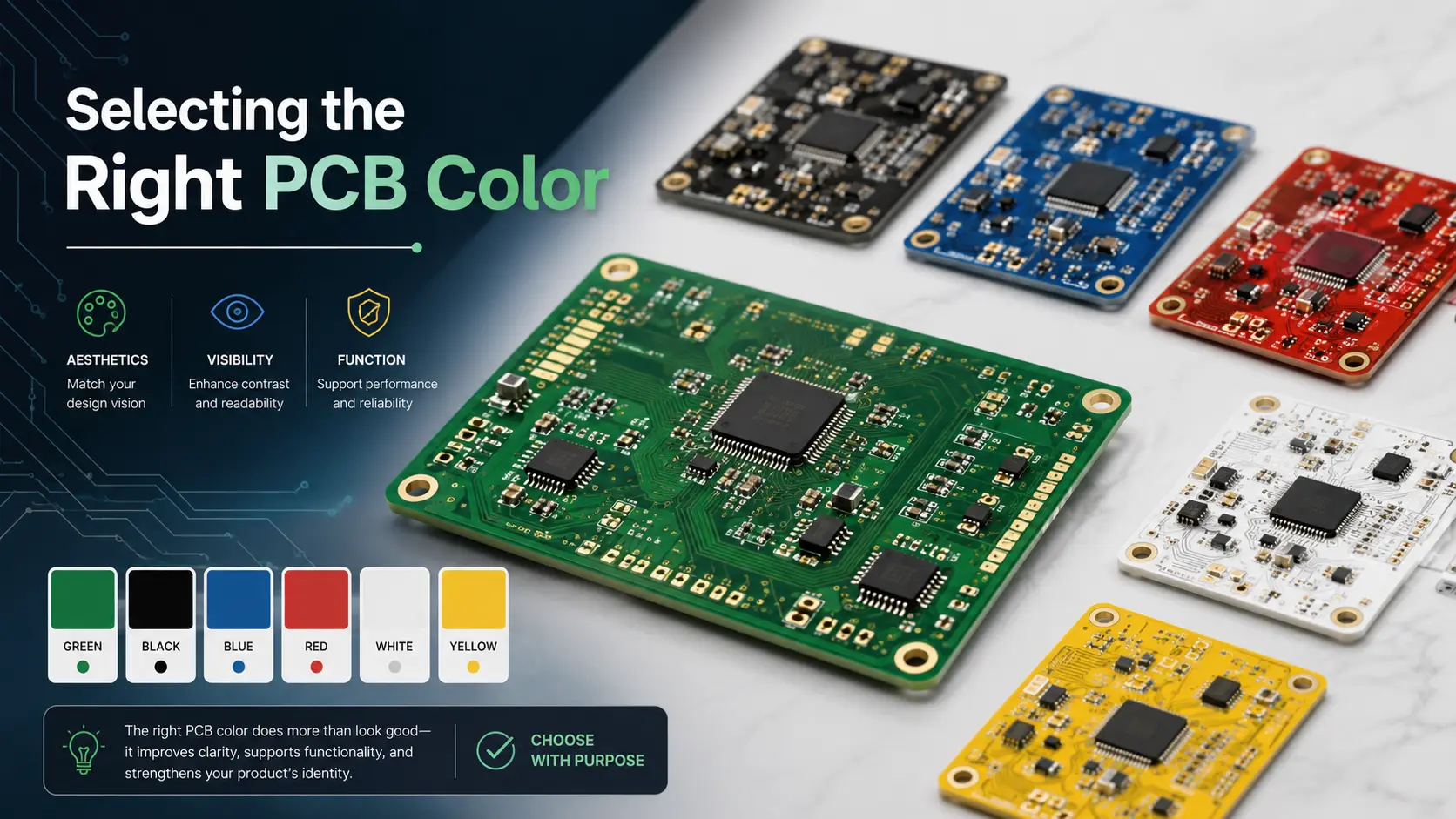
- Default to Green: If you want maximum manufacturing efficiency and lowest cost, go with standard green. Your pcb production will be faster, with fewer errors and best AOI compatibility.
- Use Color for Branding and Identification: Only specify a custom circuit board color (such as black PCB, blue, or white) if you have a clear reason—like product aesthetics, visible locations, rapid service ID, or thermal/optical needs.
- Test Before Scaling: Always request sample boards before a full run if you move away from the standard color for printed circuit boards. Some colors (especially black or white) require AOI recalibration, silkscreen contrast changes, and can introduce new inspection challenges.
- Consider Inspection & Rework: Remember that green color is universally easier to inspect. If your team or repair service relies on fast identification of cold solder or short circuits, green is the most practical board color.
- Communicate With Your PCB Manufacturer: Ask your fab house about their process for your color choice. They can inform you about special design rules, minimum order quantities, or if a unique solder mask is only available for specific PCB substrate types.
Summary/Conclusion: Why Green Still Rules
Green circuit boards are the result of both clever science and historical circumstance. The characteristic green of the solder mask is not just a manufacturing relic but a badge of trusted quality, cost-efficiency, and process reliability. The original green epoxy solder masks were naturally green and quickly became the industry’s standard color; today, this remains true due to the performance of the board, ease of inspection by the human eye, and mature global supply for green PCB substrates.
Yes, you can find a variety of PCB colors—black, blue, white, red, yellow, purple, and more—and each color’s pros and cons will influence your production costs, QA process, and serviceability. However, green remains “the easiest color” for everything from hi-tech printed circuit boards to educational kits.
Key Takeaways:
- Green boards are almost always green due to tradition, reliability, and efficiency.
- For most applications, choosing green is the safest, most cost-effective color for circuit boards.
- Color choice only slightly affects performance but can have a large impact on manufacturability, board inspection, and product branding.
- When in doubt—ask your PCB manufacturer which color is best for your needs or try green as your default, as it’s also the most environmentally proven option.
So, the next time you look at a green PCB, you’ll know there’s a reason for that bright green color—and it’s not just tradition. It’s the best choice for reliability, manufacturing, and seeing (and fixing) what matters!