
Introduction
In LHD TECH’s delivery record, over 82% of after-sales quality disputes stem not from the materials themselves, but from a mismatch between the selected base material and actual operating conditions. Therefore, we never recommend FR-4 or CEM-1 in isolation. Instead, we first work with customers to define the product’s electrical rating, thermal cycle count, and mechanical mounting method before issuing a “Substrate Matching Recommendation.”
In the future, as high-frequency, high-speed, and high-temperature resistant materials (such as PTFE and ceramic fillers) gradually penetrate the market, the traditional territory of FR-4 and CEM-1 will be squeezed. However, LHD TECH firmly believes that “using the right material” is more important than “using the most expensive material.” We will continue to use measured data as a benchmark and manufacturing yield as a mirror to help every PCB find its most appropriate material.
If you have specific stack-up requirements or cost targets, LHD TECH’s engineering team can provide free DFM material comparative analysis—we always believe that the best selection is based on real production conditions from the very first communication.
Understanding the World of PCB Materials
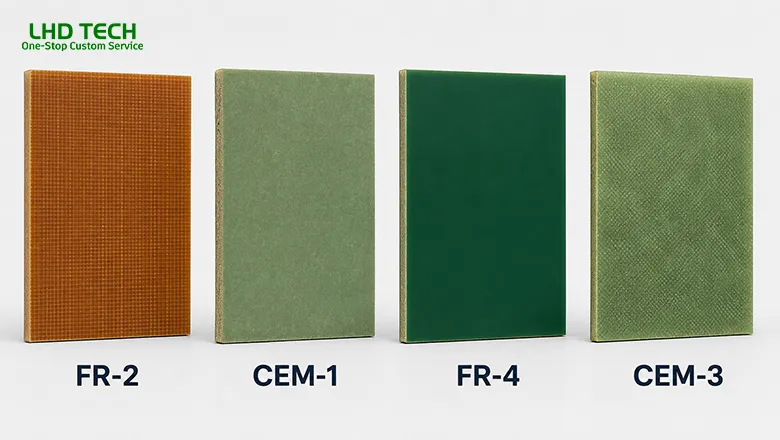
A common topic in PCB manufacturing is substrate selection. The substrate directly determines the PCB’s speed, heat resistance, and cost percentage. Common printed circuit board substrates on the market can be broadly categorized into four types based on their characteristics:
- FR-2: This is a representative of the “economical and practical” type: phenolic resin and paper base. It’s cheap, not flame-retardant, and has poor heat resistance. It’s a commonly used type for low-end fast-moving consumer goods.
- CEM-1: FR-2 is an “upgraded and simplified version.” It has a surface covered with fiberglass cloth and epoxy resin, but still has a paper core, making it slightly stronger and more heat-resistant than FR-2. It offers excellent value for money among single-sided boards and is commonly used in LED drivers and power adapters.
- FR-4: A mainstream player in the market, FR-4 uses epoxy resin-impregnated fiberglass cloth, resulting in excellent mechanical strength and thermal, and stable electrical performance after lamination. Whether it’s a four-layer industrial control board or an eight-layer communication board, FR-4 maintains stable performance; its main drawback is its higher price.
- CEM-3: It is very similar to FR-4, using non-woven glass mat instead of woven fiberglass cloth. Its electrical properties are very close to FR-4, but its mechanical strength is slightly lower. The drilling and edge treatment during processing will be slightly different. It will also be cheaper than FR-4.
Each of these four materials has its own advantages, and the best balance can be found between performance, reliability and budget.
Comparative Analysis: FR-4, CEM-1, CEM-3, and FR-2
A quick comparative analysis helps clarify the best choice for particular applications:
| Material | Resin System | Reinforcement | Thermal Stability | Electrical Properties | Board Types | Cost Difference |
| FR-2 | Phenolic | Paper | Low | Basic | Single-sided | Lowest |
| CEM-1 | Epoxy resin | Paper core + fiberglass | Moderate | Good | Single-sided | Cheaper than FR-4 |
| CEM-3 | Epoxy resin | Non-woven glass | High | Good | Double-sided | Cheaper than FR-4 |
| FR-4 | Epoxy resin | Woven glass fabric | Excellent | Excellent | Multilayer | Higher |
- High-speed multilayer, long lifespan, harsh environment requirements → Choose FR-4 and CEM-3without hesitation.
- Low-speed signal integrity is critical, short cycle time, high output requirements → Use CEM-1 and FR-2with confidence.
Composition: Woven Glass, Epoxy, and Paper in PCB Laminate
PCB laminate is not just a flat green sheet—it’s a carefully engineered composite material with two primary components: resin system and reinforcement.
Epoxy resin: It is responsible for “heat resistance, insulation, and flame retardancy,” while fiberglass cloth is responsible for “stability, durability, and non-deformation.” The combination of the two creates FR-4, an all-around board material. As for CEM-1 and CEM-3, their reinforcing materials are respectively mixed with paper base or non-woven felt. The resin determines the “character,” while the reinforcing material determines the “structure.”
Reinforcement:
- Woven glass fabric or woven fiberglass cloth is the “skeleton” of FR-4, much like the steel bars in concrete. It is what gives the sheet its mechanical strength, rigidity, and bending resistance.
- Paper core is used in FR-2 and CEM-1, lowering the cost and making sheets more punchable, but at the expense of thermal and moisture resistance.
- Non-woven glass in CEM-3 is a middle ground, offering some benefits similar to FR-4, but at lower cost and mechanical robustness.
FR-4 vs. CEM-1: Structure and Material Science
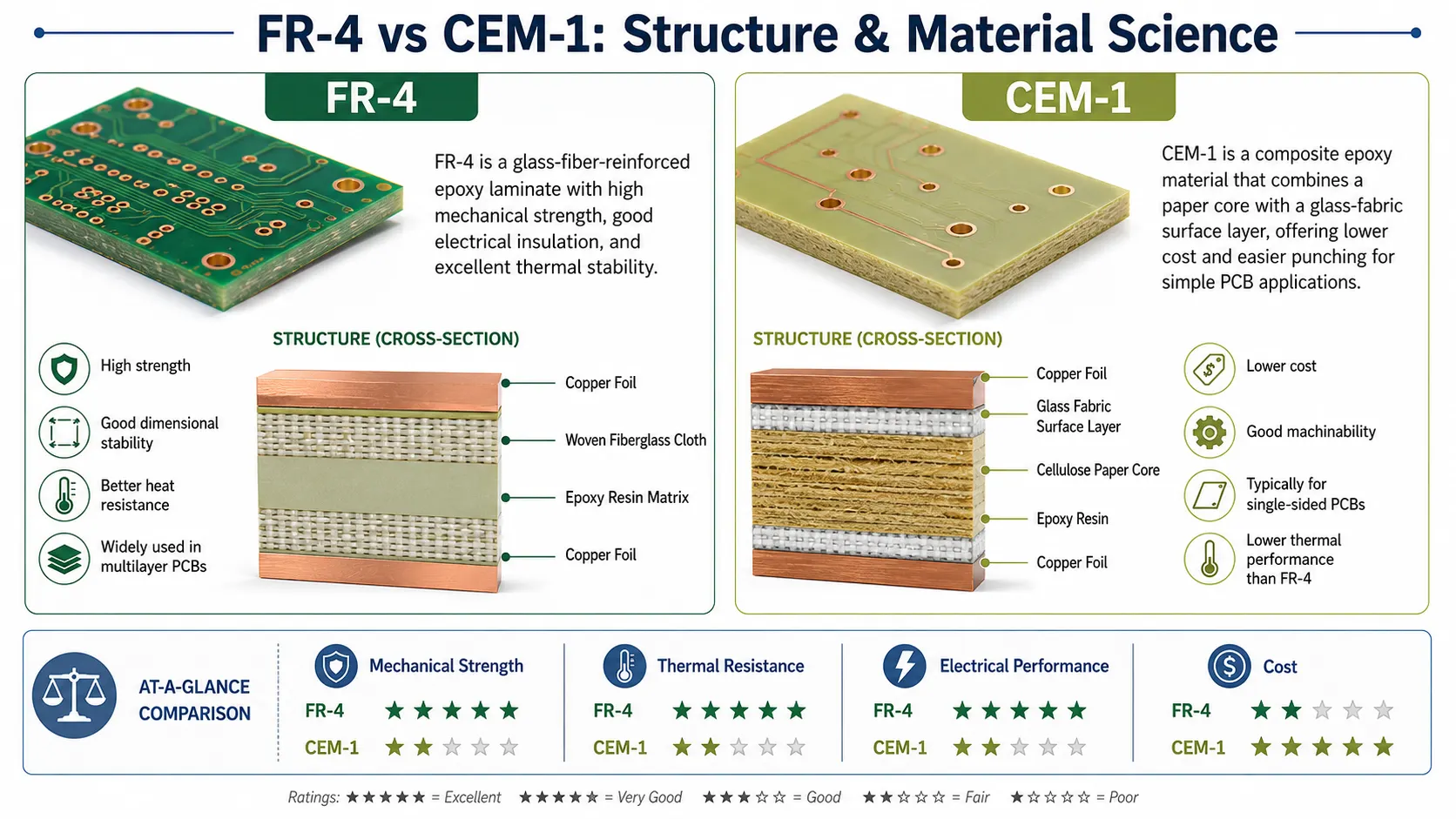
Understanding the physical structure of FR-4 and CEM-1 reveals why these materials behave so differently in real-world applications.
FR-4:
- It consists of layers of woven fiberglass cloth, thoroughly impregnated with epoxy resin and pressed together.
- It has extremely high adaptability, suitable for single-sided, double-sided, multilayer, and through-hole electroplating boards.
- It has excellent mechanical strength, a relatively stable dielectric constant, and a low loss factor, making it the preferred choice forhigh-frequency circuits.
CEM-1:
- The CEM-1 is paper core, with a layer of woven fiberglass cloth and epoxy resin.
- Limited to single-sided PCBs; copper foil can only be laid on one side of the board, and it does not support through-hole plating, only surface-mount traces with through-holes (non-metallized).
- While cheaper than FR-4,its disadvantages are poor heat resistance and weak mechanical strength. It is mainly used in high-volume, low-cost products where single-layer traces are sufficient.
CEM-3:
- The structure is non-woven glass mat + epoxy resin, the performance is similar to FR-4, but the body is slightly weaker and the price is slightly lower.
Mechanical Properties Comparison of FR-4, CEM-1, and CEM-3
The mechanical properties of a PCB are determined by three factors: flexural strength, rigidity, and impact resistance. These factors collectively determine the board’s lifespan and reliability during assembly, transportation, and long-term operation.
- FR-4 board’s excellent bending strength and overall mechanical strength, even on very thin boards. This makes it the material of choice for high-reliability, multi-layer, and complex designs.
- CEM-1 inexpensive and easy to process. For single-sided, cost-sensitive projects, CEM-1 is indeed a good choice, offering high production efficiency. However, its paper-based core material inherently lacks strength; under slightly higher temperatures or prolonged vibration, the sheet is prone to warping and deformation.
- CEM-3—being similar to FR-4—serves well for double-sided boards and offers a reasonable replacement for FR4 in non-demanding, cost-reduction scenarios.
Thermal and Electrical Properties in Demanding Applications
Electrical Performance
- The higher the dielectric strength, the more robust the board. FR-4 has a dielectric strength of ≥20 kV/mm, while CEM-1 is generally in the range of 15~20 kV/mm. In high-voltage power supplies or impact environments, the difference in dielectric strength directly translates to a significant difference in board lifespan and quality.
- Dissipation factor and dielectric constant is a core indicator of signal “fidelity,” especially in high-frequency and high-speed digital circuits. The higher the loss factor, the more severe the signal attenuation, and the faster the high-frequency components are lost.
- Signal integrity: Essentially, it’s the result of the combined effect of the electrical parameters mentioned above. Our engineering principle is: if signal integrity is required, directly select FR-4 or CEM-3.
Thermal Performance
| Feature | FR-4 | CEM-1 | CEM-3 |
| Glass Transition (Tg) | 130–180°C+ | 110–130°C | 120–145°C |
| Endurance at Elevated Temperatures | Outstanding | Modest | Good |
| Lead-Free Solder Survival | Reliable | Risk of delam./bubbling | Acceptable |
| Thermal Cycling | High Reliability | Fair—long-term warpage | Good |
| Moisture Absorption | <0.10% | 0.2–0.4% | 0.10–0.20% |
| Insulation | High | Good | Good |
- FR-4 exhibits significant advantages in thermal stability, with glass transition temperatures (Tg) generally above 130℃, and high-Tg versions reaching 170℃ or even higher. This high-temperature resistance prevents the board from easily softening, delaminating, or blistering during reflow and wave soldering.
- CEM-1 and CEM-3 perform well in low-power circuits at room temperature. However, during cyclic soldering or at high temperatures, the substrate has a relatively large coefficient of thermal expansion, making it prone to warping and delamination after heating.
Unique Advantages and Disadvantages: CEM-1 PCBs
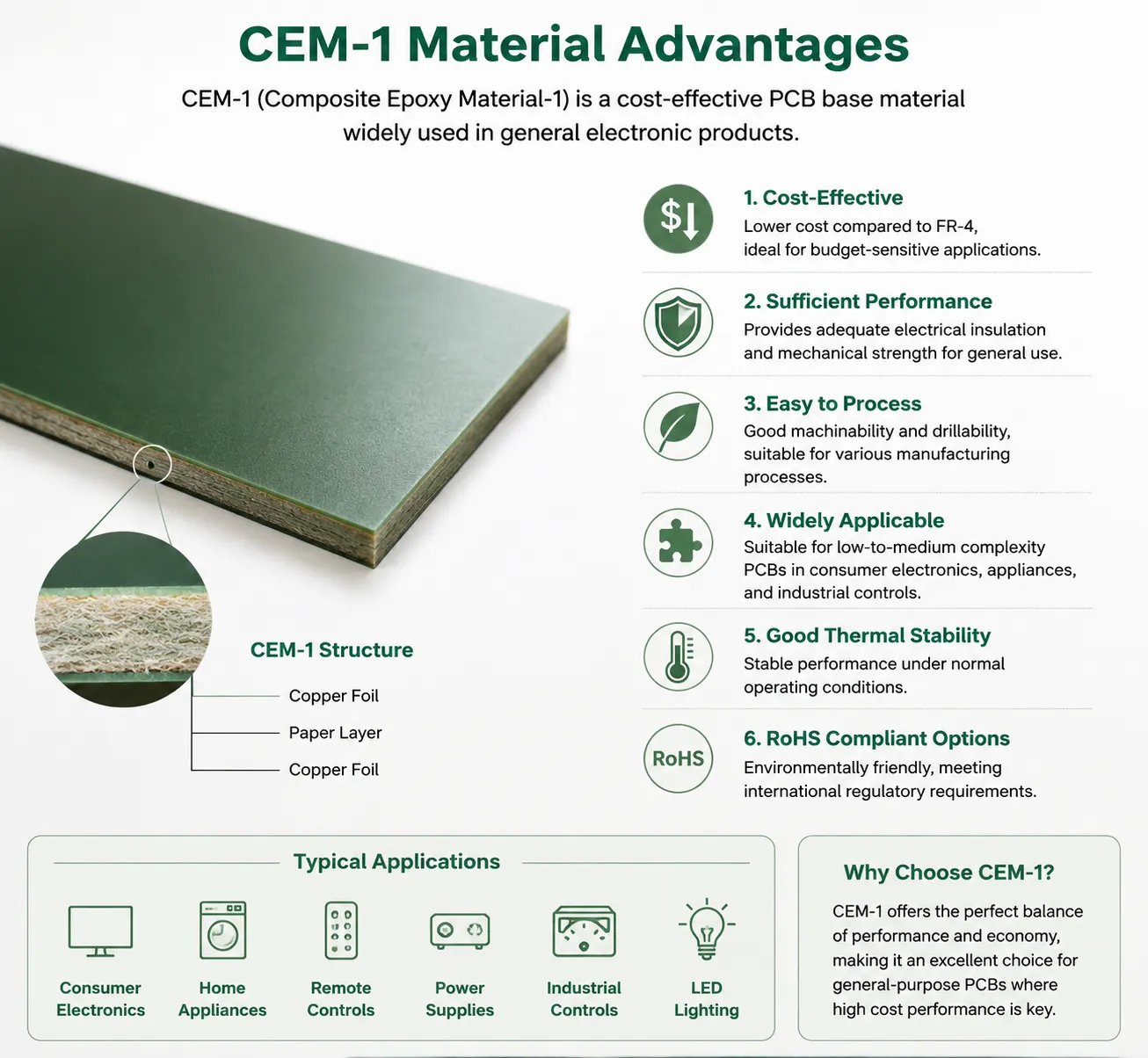
Advantages of CEM-1 PCB
- Highly cost-effective: Priced lower than FR-4, and made specifically for single-sided boards, CEM-1 is the top choice for products with high volume and simple circuitry.
- Easy machining and punching: Easy to process, high punching efficiency, suitable for large-scale rapid production。
- UL 94 V-0 flame retardancy: CEM-1 achieves UL 94 V-0 flame retardancy, meeting basic safety requirements.
- Used in low-cost consumer electronics: Low-cost consumer electronics are products with simple functions, rapid product updates, and extreme price sensitivity.
Disadvantages of CEM-1 PCB
- Limited to single-sided circuits—Inherently a “one-sided” design:** It can only perform single-sided wiring and cannot handle multi-layer electroplating designs.
- Lower mechanical strength and thermal performance: The paper-based core material is prone to warping when heated, cracking or delamination under stress, resulting in low insulation performance.
- Reduced moisture and environmental resistance: Once the paper-based core material absorbs moisture, the moisture expands when heated during reflow, easily leading to board bursting, blistering, or delamination.
- Not suitable for complex designs or applications where signal integrity is critical.
Where FR-4 Excels in Modern PCB Design
- Multilayer and High-Density Boards: FR-4 is the preferred material for high-end electronic products such as communication equipment and computer motherboards.
- Demanding Applications: The medical, automotive, and aerospace industries have high requirements for electrical performance and mechanical strength. Medical instruments need precision, automobiles need vibration and heat resistance, and aerospace requires extreme reliability.
- Superior Signal Integrity: Maintains high signal integrity—FR-4’s dielectric stability and low loss demonstrate its significant advantages.
- High-Reliability Industries: Used in all printed circuit board products where compliance with IPC-A-600 or IPC-6012 standards is mandated.
Cost Difference Analysis: When to Choose FR-4 or CEM-1
Choosing CEM-1 over FR-4 reduces the upfront cost but may result in higher lifecycle costs if reliability is compromised. Here is a practical comparative analysis for PCB manufacturing:
Cost Difference Table
| Attribute | CEM-1 | FR-4 |
| Raw Material Cost | Very Low | Moderate/High |
| Machining Cost | Minimal (punching) | Slightly higher |
| Fail Rate | Higher | Lower |
| Lifecycle Maintenance | More | Minimal |
| Is Cheaper Than FR-4? | Yes (initially) | No |
| Replacement for FR4? | Yes (for simplest designs, if cost is king) | Not Applicable |
When to choose:
- CEM-1: When board design is single-sided, simple, and field failures carry little financial or reputational cost; especially in cost-sensitive and disposable electronics.
- FR-4: Is the preferred substrate solution for scenarios such as double-sided and multi-layer PCBs, high signal integrity, harsh application environments, high reliability requirements, and global compliance standards.
Best Practices in Material Selection: Reliability vs. Cost-Effectiveness
- Prototype on FR-4 whenever possible (unless you know the design will never advance beyond single-sided, low-end applications).
- Factor in lifecycle cost and reputation: Reliability losses and field failures from CEM-1 can quickly erode any upfront savings.
- Consider CEM-3 as a cost reduction step between CEM-1 and FR-4—it’s suitable for double-sided boards and matches electrical performance needs for moderate-complexity designs.
- Never sacrifice reliability for upfront savings—especially where regulatory, warranty, or safety standards are in play.
Case Studies: CEM-1 and FR-4 Material Decisions in the Field
Case 1: Consumer Electronics Toy Project
A global toy supplier needed to mass-produce 5 million illuminated keychains to cope with the holiday peak season. The product design requirements were as follows: single-panel design, low power consumption, no high frequency, and a lifespan of 3 months. After comprehensive evaluation, the CEM-1 PCB was identified as the optimal cost-performance solution for the project, helping the client significantly reduce BOM costs while ensuring delivery.
Case 2: Automotive Dashboard Design
A Tier 1 automotive supplier’s PCB design initially targeted CEM-1 for cost savings in a steering wheel controller. However, rapid failure due to thermal cycling and vibration during crash tests prompted a switch to FR-4. The superior mechanical strength and thermal reliability of FR-4 ensured long-term product success, compliance, and customer safety—even though the raw laminate cost increased.
Case 3: LED Lighting Module
In the commercial LED lighting sector, continuous thermal management and long lifespan are core requirements for product design. For a lighting project with a double-sided PCB design, the R&D team conducted a systematic evaluation of CEM-3 and FR-4, ultimately deciding that FR-4 would be used for the high-end commercial lighting product line, while CEM-3 would be used for the standard lighting product line.
FAQs: PCB Performance, Material Choices, and Industry Standards
Q: Can you replace FR-4 with CEM-1 for budget projects?
A: Yes, but with strict prerequisites. CEM-1 can only replace FR-4 in cases of single-sided boards, simple circuitry, and low operating voltage. It is explicitly stated that CEM-1 does not support through-hole plating and cannot achieve multi-layer interconnection.
Q: When would CEM-3 be a better replacement for FR-4?
A: CEM-3 is suitable for double-sided boards where top-end FR-4 performance isn’t required but some reduction in cost is desired.
Q: What is “composite epoxy material” in PCB terms?
A:composite materials are a type of substrate system composed of epoxy resin and reinforcing fibers. FR-4 has the best strength and rigidity; CEM-1 is positioned as an economical single-sided board material; CEM-3 has performance similar to FR-4, but slightly lower mechanical strength.
Q: Why is thermal stability or a high glass transition temperature (Tg) so important?
A: Thermal stability directly determines the reliability and integrity of a printed circuit board under high-temperature conditions. When the board temperature approaches or exceeds Tg, the material expands significantly, its mechanical strength drops sharply, and its electrical performance deteriorates accordingly. High thermal stability provides three core guarantees: high soldering yield, long-term reliability, and environmental adaptability.
Common Mistakes to Avoid in PCB Material Selection
- Ignoring electrical and mechanical properties: Always match the base material to your application’s signal integrity, insulation, and flexural strength requirements.
- Assuming all FR-4 is the same: Specify Tg, glass content, and IPC/UL compliance for every
- Overlooking the effects of moisture absorption: n design and selection, the hygroscopic properties of materials are an easily underestimated yet crucial factor. CEM-1 and some CEM-3 grade materials absorb moisture from the air in humid environments, leading to dimensional expansion, insulation degradation, delamination, and blistering. This necessitates reflow soldering or scrapping.
- Selecting CEM-1 for demanding applications: CEM-1’s material positioning is very clear—an economical substrate for low-cost, low-complexity, single-sided applications. CEM-1 is strictly prohibited in applications involving frequent soldering, lead-free high-temperature processes, continuous vibration and impact, and multi-layer through-hole electroplated boards. The material should match the product positioning, not the other way around.
- Disregarding cost difference in rework and returns: While CEM-1 is much cheaper than FR-4 up front, high failure or warranty rates can quickly erode any initial savings through costly returns, repairs, and brand reputation loss.
Future Trends in PCB Materials and Composite Technologies
1. Toward Halogen-Free and Green Base Materials
With increasingly stringent global environmental regulations, halogen-free FR-4 is transitioning from an “optional” to a “standard requirement,” and some customers have already included halogen-free in their supplier qualification standards. Among high-end materials, polyimide boards and bio-based laminates are also gradually being used—they are resistant to ultra-high temperatures and can be bent, making them suitable for extreme applications such as aerospace and military. Bio-based boards, on the other hand, emphasize environmental friendliness, with raw materials derived from renewable resources, appealing to high-end consumer brands that value ESG image.
2. Advanced High-Tg and Low-loss Materials
The trend in electronic products is towards high-speed digital buses, high-power charging, and RF front-ends. Market demands for substrates are also focused on two directions: high Tg and high frequency. Both FR-4 and CEM-3 are undergoing formulation improvements, resulting in significantly enhanced thermal stability and dielectric properties compared to older versions. Power modules for electric vehicles, front-end boards for 5G base stations, and driver boards for high-end LED lighting urgently require higher-performance materials.
3. Integration of Thermal Conductive Fillers
Power electronics, LED lighting, and high-current circuits demand better heat dissipation. Special thermal filler-loaded epoxies and aluminum-backed laminates are now standard in the most demanding applications, supporting high reliability and extended service life.
4. Automated Traceability and Smart Manufacturing
New IPC and ISO standards drive the adoption of intelligent tracking of laminate batches and PCB materials throughout the supply chain, ensuring documented electrical and mechanical properties and coded compliance with standards like IPC-4101 and UL 94 V-0.
Summary and Conclusion
When choosing between FR-4 and CEM-1 laminate boards, always begin by defining your requirements for mechanical strength, thermal stability, electrical reliability, complexity, and cost.
- FR-4 is the gold standard for pcb manufacturing and pcb design—providing excellent mechanical and electrical properties, robust thermal performance, and support for multilayer and complex circuits. Its woven glass fabric impregnated with epoxy resin ensures reliable operation even under elevated temperatures, repeated solder cycles, and demanding electrical environments. FR-4 is the preferred choice for high-frequency, high-reliability, and performance needs.
- CEM-1, a true composite epoxy material, is ideal for single-sided, ultra-low-cost or disposable devices used in low-cost consumer electronics. It’s easy to punch, fast to process, and brings immediate cost-effectiveness, but is fundamentally limited in durability, insulation, and resistance to stress, moisture, and heat.
CEM-3 can serve as a compromise for some applications where double-sided boards are needed but ultimate performance is not—offering some mechanical properties similar to FR-4 for moderate savings.
In summary:
- Opt for FR-4 for double-sided or multi-layer PCB designs, advanced electronics, or anything that demands signal integrity and longevity. Consider CEM-3 if moderate performance is acceptable and cost is a concern.
- Choose CEM-1 PCB when your product is single-sided, cost-sensitive, and can tolerate potential field failures or short lifespans—never for industries where reliability is non-negotiable.