
Introduction

Printed circuit boards (PCBs) are at the heart of every electronic devices, from simple household gadget to high-power automotive and aerospace equipment. As electronics become faster, hotter, and more compact, the demand for high TG PCBs—circuit boards that withstand high temperature and high current—has surged. Ordinary PCB substrate materials often can’t meet today’s extreme operating temperature and power requirement. This evolving landscape forces engineer and manufacturer to move toward high-TG materials for better reliability, greater temperature resistance, and improved performance.
Why High TG and High-TG PCBs Matter
A standard PCB (also called an ordinary PCB) can only handle so much heat. When exposed to high heat, its polymer and base materials soften or deform once the temperature resistance of the material—known as the TG value—is exceeded. High TG PCBs (also known as high temperature PCBs) utilize specialize PCB material that resist much higher temperature before transitioning from a rigid, glassy state to a soft, rubbery state. This ability to withstand high operating temperatures is critical for PCB assembly in everything from automotive ECUs to industrial robotics, aerospace payload, and LED lighting.
What is High TG in PCB?
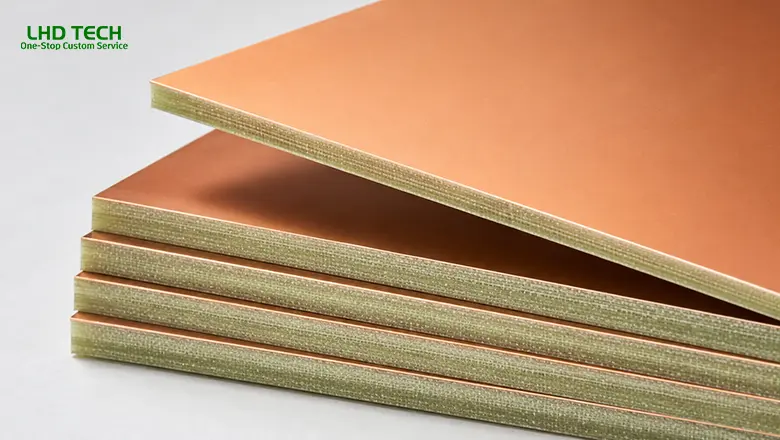
The term “High TG PCB” refer to a printed circuit board designed specifically to operate in high-heat environment. TG stands for “glass transition temperature,” the temperature at which the pcb material (often a polymer base like FR4 or polyimide) shift from being hard and glassy to soft and deformable.
Understanding Glass Transition in PCBs
- TG of a PCB substrate determines the temperature beyond which the board will lose vital mechanical and electrical properties.
- Ordinary PCB substrate materials usually have a TG value of 130°C or lower, called low TG.
- Standard and some medium TG FR4-based PCBs can reach up to 150–160°C.
- High-TG PCBs start at a TG value of 170°C and can go even higher with advanced resin systems (up to 200°C+ in some high-end applications).
| PCB Category | Typical TG Value | Application Example |
| Low TG (Standard FR4) | ≤130°C | Consumer electronics, basic PCBs |
| Medium TG | 150–160°C | Office equipment, mid-level PCBs |
| High TG PCB | ≥170°C (often 180°C+) | Automotive, industrial, aerospace, high-power |
Effects of Exceeding TG Value
When a PCB board exceeds its TG value, several risks appear:
- Loss of substrate rigidity (softening, deformation, warping)
- Increased coefficient of thermal expansion(CTE), risking cracked vias and open circuits
- Delamination between layers
- Reduced reliability of plated through holes (PTHs)
- Solder joint failures during high-temperature soldering
Key Properties and Benefits of High-TG PCBs
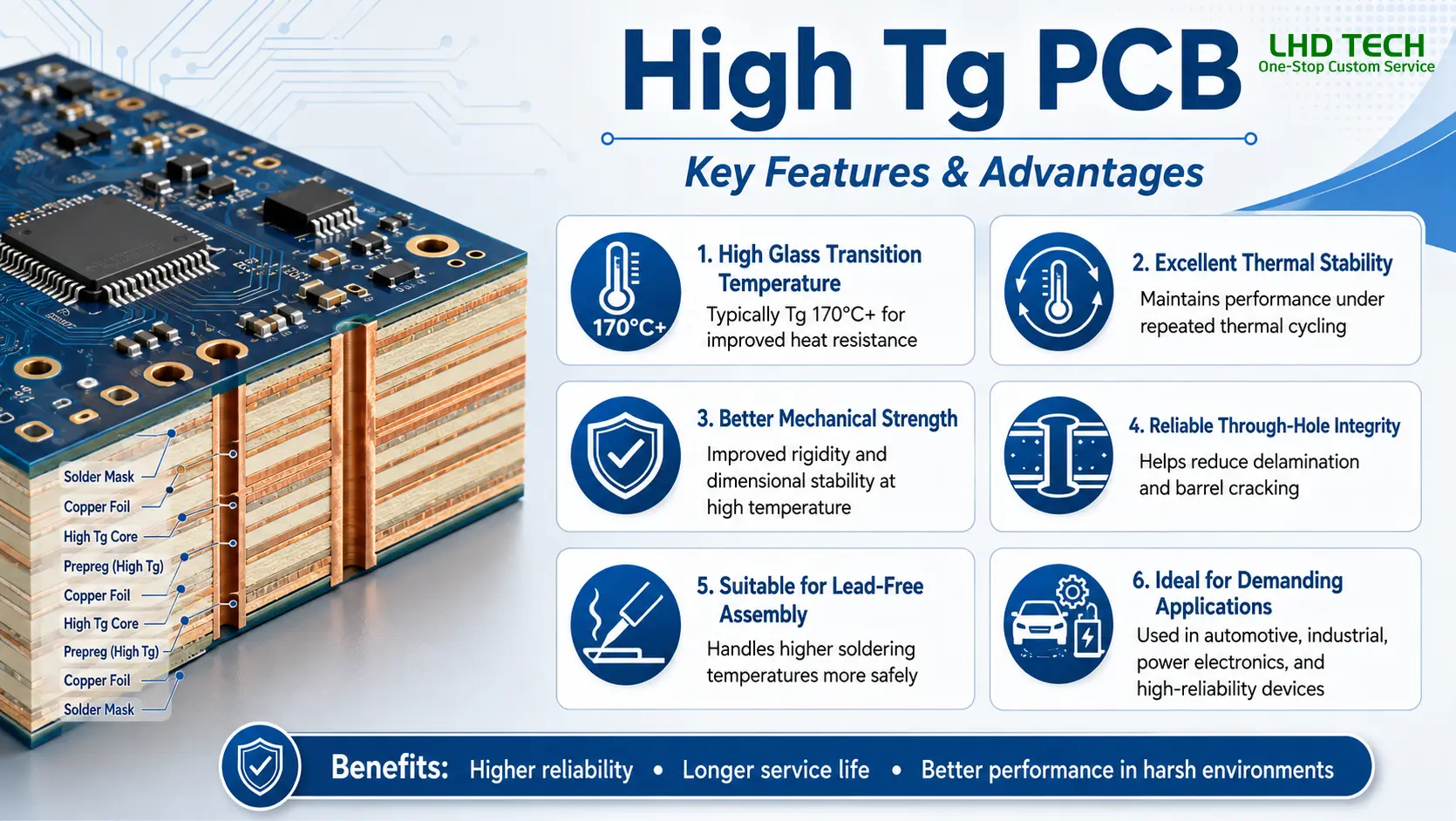
The advances in high-TG PCB material and PCB manufacturing processes offer a range of benefits not obtainable with normal PCB substrates.
Superior High Heat Resistance
High-TG PCBs are engineered for high heat. This enables them to:
- Survive sustained exposure to temperatures near but below TG.
- Withstand the temperature spikes of lead-free reflow processes which often reach >245°C.
- Outperform ordinary PCBs in both PCB assembly and field conditions.
Dimensional and Mechanical Stability
A high-TG circuit board resists deformation, warping, and flexing under thermal stress, thanks to a lower coefficient of thermal expansion. This is critical for:
- HDI PCBs and multilayer boards, where positional stability of via holes is paramount.
- Long-term mechanical loads in automotive and industrial applications.
Enhanced Electrical and Chemical Performance
- Electrical properties are retained at high temperature or after multiple soldering cycle.
- Resistance to environmental threat like humidity, chemical, and solvent is significantly increased, compared to normal PCB material or low TG PCBS.
Lead-Free and RoHS Assembly Compatibility
- High-TG PCBs are essential in lead-free (RoHS) manufacturing: their material withstand higher soldering temps and more thermal shock.
- They support both SMT (surface mount technology) and CMT (chip module technology) without compromising board quality.
Improved PTH Reliability and Solderability
- Through-hole plating (PTH reliability) is preserved due to strong resin/copper adhesion at higher temp.
- Solderability is enhanced for complex assemblies need multiple reflow or manual touch-up.
Extended Product Life and Reliability
- High-TG printed circuit boards reduce warranty claims, repair rates, and field failures.
- Ideal for products with long duty cycles (e.g., automotive ECUs, LED drivers, industrial automation).
High-TG PCB Applications in Electronics and Automotive
Automotive Electronics
Modern vehicles host dozens of microcontrollers, power circuits, and sensors in the engine compartment and passenger cabin. High-TG PCBs are vital for:
- Engine control modules: Constant exposure to under-hood thermal cycles, vibration, and solvents.
- Transmission and ABS modules: High current, high heat environments.
- In-car entertainment units: Long duty cycles, increased board density.
Communication and RF Technology
- Base station hardware demands high-frequency signal stability and low loss under high heat. Only high TG and PTFE or polyimide-based PCBs are recommended.
- RFID readers, antenna boards, and WiFi boosters require printed circuit boards that maintain impedance stability and low CTE.
Industrial Equipment
- Industrial controls, power inverters, embedded computer systems, robotics—all require extended reliability and must remain electrically stable for thousands of hours in high-heat, corrosive, or high-vibration environment.
LED Lighting and High Power Density Designs
- LED PCBs and aluminum PCBs (metal core, often paired with a high TG laminate) dissipate massive thermal load, making low CTE and high heat resistance indispensable.
- Power electronic, such as AC power supplies and high-power relay, benefit from high TG for safe, long-term performance.
Aerospace, Medical, and Military
- Boards in aircraft, satellites, medical imaging, implantables, sterilization system, and missile controls often specify high-TG or polyimide material to ensure thermal and mechanical safety.
Types of High TG PCB Material and Materials Used
In any PCB manufacturing process, the choice of base material fundamental dictate the board’s ability to resist high heat, mechanical stress, and environmental factor. Let’s look at common high TG PCB material used in today’s electronic, automotive, and industrial circuit.
FR-4 High TG PCB Material
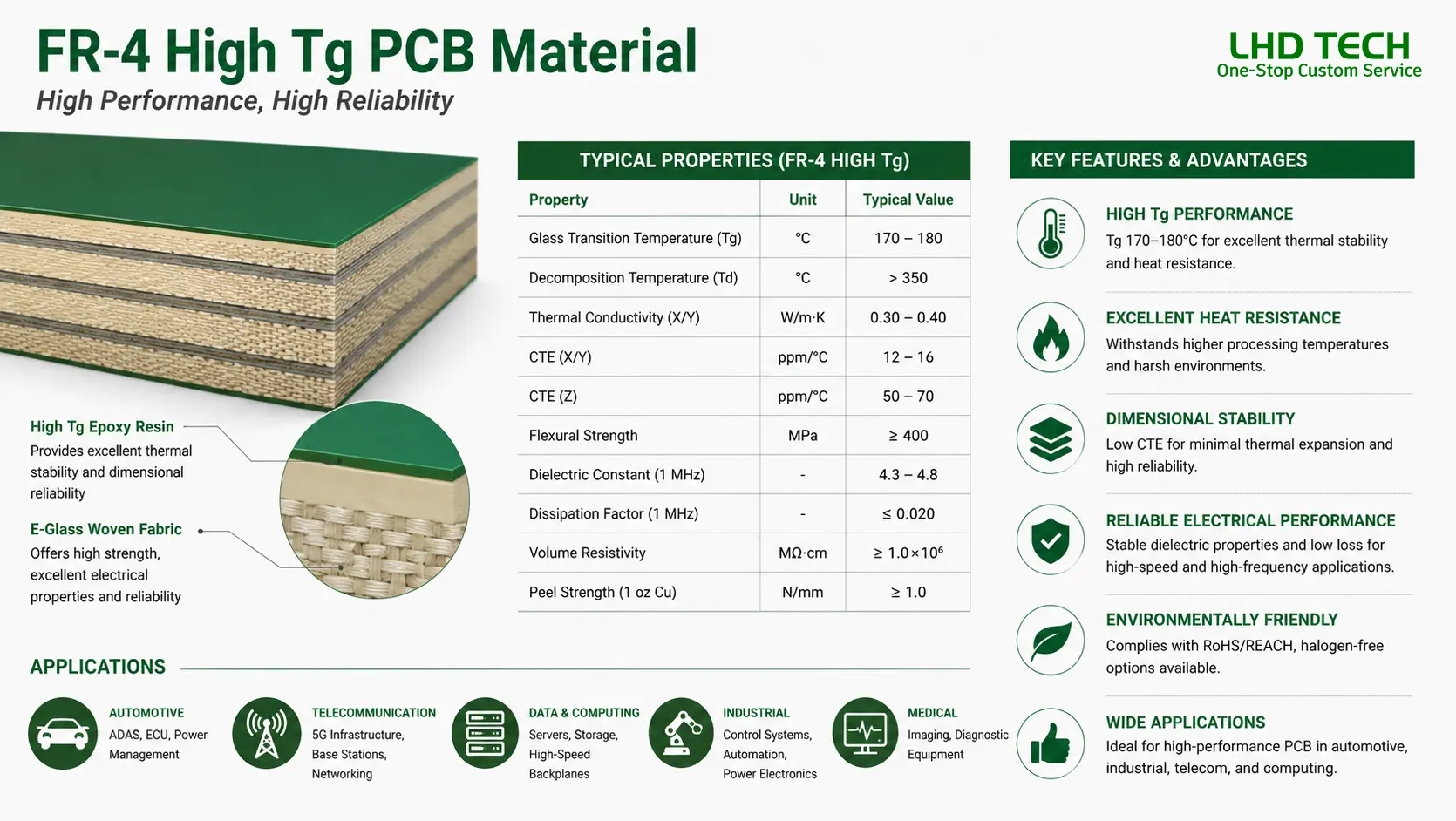
The most widely used material for both ordinary and high-TG PCBs is FR-4—a composite of woven glass fabric and epoxy resins. It’s loved for its balance of price, performance, and availability. While standard FR-4 provides a TG value of 130°C–140°C, high TG FR-4 is engineered for a TG starting at 170°C or higher.
Common High TG FR-4 Materials and their TG Values:
| Material | Supplier | TG Value (°C) | Typical Use |
| ISOLA 370HR | Isola | 180+ | HDI, medical, defense |
| NP-175TL | Panasonic | 175 | Automotive, industrial |
| ITEQ IT-180A | ITEQ | 180 | Communications, RF |
| Shengyi S1000-2 | Shengyi | 170+ | LED, power, industrial |
| S1170G/GB | Shengyi | 170+ | Consumer, multilayer |
Polyimide and Other High-TG Materials Used
When basic FR-4 reaches its thermal performance limit, polyimide and specialty materials step in. Polyimide base material is highly sought-after for high heat resistance (TG often above 200°C), ultra-low coefficient of thermal expansion, and excellent durability in harsh, flexible, or mission-critical environment.
Key Properties of Polyimide High-TG PCBs:
- TG values from 200°C to 260°C—even withstanding soldering and working temperature spikes.
- Greater resistance to chemicals, fire, and thermal shock than even the best FR-4.
- Favors use in aerospace, defense, medical, and advanced flexible PCB applications.
Other advanced materials include:
- PTFE-based laminates: For high-frequency, RF/microwave, and specialize communication hardware.
- Cyanate Ester and Polyurethane blends: Used where both thermal and dielectric need are extreme.
FR4, Polyimide, and the High TG PCB Material Spectrum
Comparing materials helps clarify where and why high-tg PCB boards are specified:
| PCB Base Material | Typical TG (°C) | Max. Continuous Operation | Key Use Cases |
| Standard FR-4 | 130–140 | <100°C | Consumer, office, low-cost PCBs |
| High-TG FR-4 | 170–180+ | 125–150°C | Automotive, LED, power, industrial, HDI |
| Polyimide | 200–260+ | 170–200°C | Defense, aerospace, flexible or flex-rigid |
| Rogers/PTFE | 160–240 | RF, microwave, radar | Comms, military, high speed/frequency |
| Metal Core/MCPCB | Varies (FR-4, Al) | Excellent, used in conjunction | High power LEDs, power electronics |
Understanding TG Value and its Role in PCB Assembly
What is TG Value?
The TG value represents the temperature at which a polymer or resin system (that forms the PCB base material) shifts from rigid/glassy (stable) to rubbery (unstable). Above this threshold:
- Material transition occur, risking delamination, trace lifting, or loss of PTH reliability.
- High heat and repeated heating/cooling cycles greatly accelerate board age.
Impact on PCB Assembly and Soldering
- Ordinary PCB: Standard reflow cycle can damage standard FR-4 if pushed too close to, or beyond, its TG value of 130°C–140°C.
- High-TG PCB: Special formulate to maintain mechanical and electrical properties at reflow temp 245°C and beyond (vital for QFN, BGA, and other advanced SMT packages).
- Lead-free assembly: Only high TG or polyimide PCBs withstand the temperature and duration of RoHS-compliant, high-temp reflow.
High-TG PCB Manufacturing and PCB Fabrication Process
Producing high-TG PCBs means more than swapping in a better base material—it’s a multi-step, specialize pcb manufacturing process.
Unique Steps in High-TG PCB Fabrication
- Material handling: Controlled storage to prevent moisture absorption.
- Layer registration: Advanced imaging for HDI PCBs and multilayers.
- Pressing/lamination: Optimized temperature cycles due to higher resin flow temps.
- Drilling: Diamond or specialize bit required for tough, high-tg laminates.
- Copper plating: Chemistry and timing adjustment for robust via and trace adhesion in high-tg system.
- Solder mask and finish: Heat-and-chemical-resistant options (e.g., lead-free HASL, immersion gold, OSP).
Advanced Design Considerations for High-TG PCB Boards
Designing a high-tg PCB requires careful planning to maximize the benefit of the higher-cost material and ensure system reliability.
Key Design Tips:
- Thermal management: Use thermal vias, thicker copper layer, and heavy copper plane for high current or high heat generation rate.
- Board stack-up: Optimize for minimal coefficient of thermal expansion (Z-axis), especially for large, multilayer, or high-density circuit.
- Component placement: Keep heat-sensitive components away from expected hot spots or add dedicated heat sinks/emissive thermal pads.
- Trace design: Wider traces for power, compact microvias for HDI, and ample annular rings on plated through holes for repeated temperature cycling.
Testing, Quality, and Reliability in High-TG PCB Manufacturing
Quality Assurance Testing
- Thermal cycling (TCT): Cycling from -40°C to 150°C repeated to check for delamination, cracked vias, or solder joint fatigue.
- IPC compliance: Boards certified to IPC-6012 class II (commercial) or class III (mission critical, medical, military).
- Cross-section analysis: For via integrity and layer registration.
- Moisture and chemical resistance testing: For automotive and medical electronic.
Common Issues, Troubleshooting, and Failure Prevention in High-TG PCBs
- Delamination: May still occur if moisture is present or processing temps exceed TG for too long.
- Via cracking: Usually due to poor CTE match between copper and resin; address by low-CTE, high-TG PCB material and correct stack-up.
- Solderability issues: Use proper surface finish, especial for lead-free/SMT processes.
Troubleshooting Tip: If you see sign of PTH failure, delamination, or trace lifting, check both fabrication and assembly record to see if the temperature resistance of the material was properly respect during soldering and reflow.
Trends in High-TG PCBs and Future Outlook in Electronics
The increasing demand for smart, connect, and high-powered device continue to drive innovation in high-tg PCB materials and pcb manufacturing. As electronics evolve, so do requirement for high heat resistance, reliability, and environmental sustainability.
Miniaturization and High Power Density
Device are shrinking but their power requirement are not. As circuit boards pack more transistor and function into tighter space, the need for high-tg materials that support high-density interconnects (hdi pcbs), microvias, and stacked layers rise sharply. This trend sees:
- More frequent use of high-tg pcbs in mobile devices, IoT products, wearables, and compact automotive modules.
- Adoption of advance stackup with high layer count, requiring robust pcb board quality and precise fabrication process control.
Higher Operating Temperatures
Automotive electronics, electric vehicle, and industrial control face hotter engine bay, rapid charging, and heavier current load. The expectation is that more ordinary pcb designs will give way to pcb with a tg of 170–200°C—and in some cases, switching from fr4 to polyimide or ceramics.
Green Manufacturing and Environmental Regulations
As RoHS, REACH, and global environmental standard tighten, pcb material suppliers invest in “greener” resin that deliver the same or better performance with less hazardous chemistry. Lead-free assembly and RoHS-compliant pcbs are now the default in many sector, advancing the case for high-tg pcb boards universally.
Improvements in Materials Used
Emerging polymer material—like high-TG, low-loss polyimide and advanced epoxy blends—offer both high frequency performance and temperature resistance. These development support future application in 5G infrastructure, edge computing, renewable energy, and space-grade electronic.
Digital Manufacturing and Quick Turn Prototyping
With online quick quote platforms and real-time DFM checks, sourcing a high-tg pcb for prototype or production is faster, more transparent, and easier to optimize for cost and lead time.
Conclusion: Selecting the Right High-TG PCB for Your Application
Choosing the right high-tg pcb is more critical now than ever before. Advancement in pcb manufacturing, pcb material, and design technique now allow engineer to push the boundaries of what printed circuit boards can do—enabling electronic that handle ever higher power, temperature, and complexity.
Key Takeaways
- Assess your working temperature: Always know the maximum operating temperature of the device and pick a pcb material with a tg value at least 20–25°C higher.
- Specify high-tg clearly: In design file, BOMs, and purchase order, always note the required high-tg resin or laminate and cite specific material used (e.g., Isola 370HR, NP-175TL, ITEQ IT-180A).
- Match material to need: Don’t overspend on ultra-high-tg if a medium-tg fr4 suffices, but never use standard low-tg fr4 in any assembly where high heat or high current is routine.
- Design for durability: Use ample thermal vias, beefy copper, and adequate creepage distances for high-tg pcb boards in power and automotive circuit.
- Work with proven partners: Trusted pcb suppliers like LHD TECH and top-tier foundries deliver documentation, traceability, and process support for demanding and regulated sector.
Frequently Asked Questions (FAQ)
What are High-TG PCBs?
High-tg pcbs are printed circuit boards built with base materials (often FR4, polyimide, or specialized resins) that provide a glass transition temperature (TG) of 170°C or higher, making them ideal for high heat, high-power, and RoHS-compliant application.
Can I use standard FR4 for my automotive PCB?
For low-power, protected environment, medium-tg FR4 may suffice, but any circuit board exposed to engine bay temperature, rapid thermal cycling, or frequent high current should use a high-tg fr4 or polyimide variant.
How do I know which PCB material to specify?
Assess the temperature and power requirements of your device, check the datasheet for candidate laminate, and consult your pcb supplier for stackup and manufacturability guidance. Always over-specify, not under-specify, for mission-critical electronics.
Does higher TG always mean higher cost?
Not always. While the highest-grade polyimide or PTFE high-tg materials are expensive, most high-tg fr4 solutions offer excellent value with only modest cost increases over standard pcbs.