
Introduction to 21700 and 18650 Battery Cells
At LHD TECH, we always keep up with the rechargeable lithium-ion batteries technology. With the relentless pursuit of “small space, big energy” by electronic devices, electric mobility, high-power vaping devices and high-performance flashlights, the core position of cylindrical lithium-ion cells has become increasingly prominent. Among the various battery cell specifications, 18650 and 21700 battery cells are undoubtedly the mainpillars of the current market.
If you are looking for the best battery for your device, you definitely cannot avoid the heated discussion of “which is better, 21700 vs 18650 batteries?” Both are cylindrical designs, but professional tests by LHD TECH show that the 21700 lithium battery is significantly larger in physical size than the 18650: its diameter is 21mm and the length is 70mm. The classic 18650 measures 18mm by 65mm. So, is “larger better”? The answer is not absolute – there are subtle differences among battery size, energy density, battery life, device compatibility and cost that determine the final choice. Whether you are choosing right battery cells for a powerful flashlight, e-cigarette or electric vehicle, these differences are of vital importance.
In this guide, LHD TECH will systematically break down the key parameters, practical performance, pros and cons of 21700 and 18650 batteries for you, and help you select the right battery cell based on your equipment requirements.
What Are 18650 and 21700 Batteries?
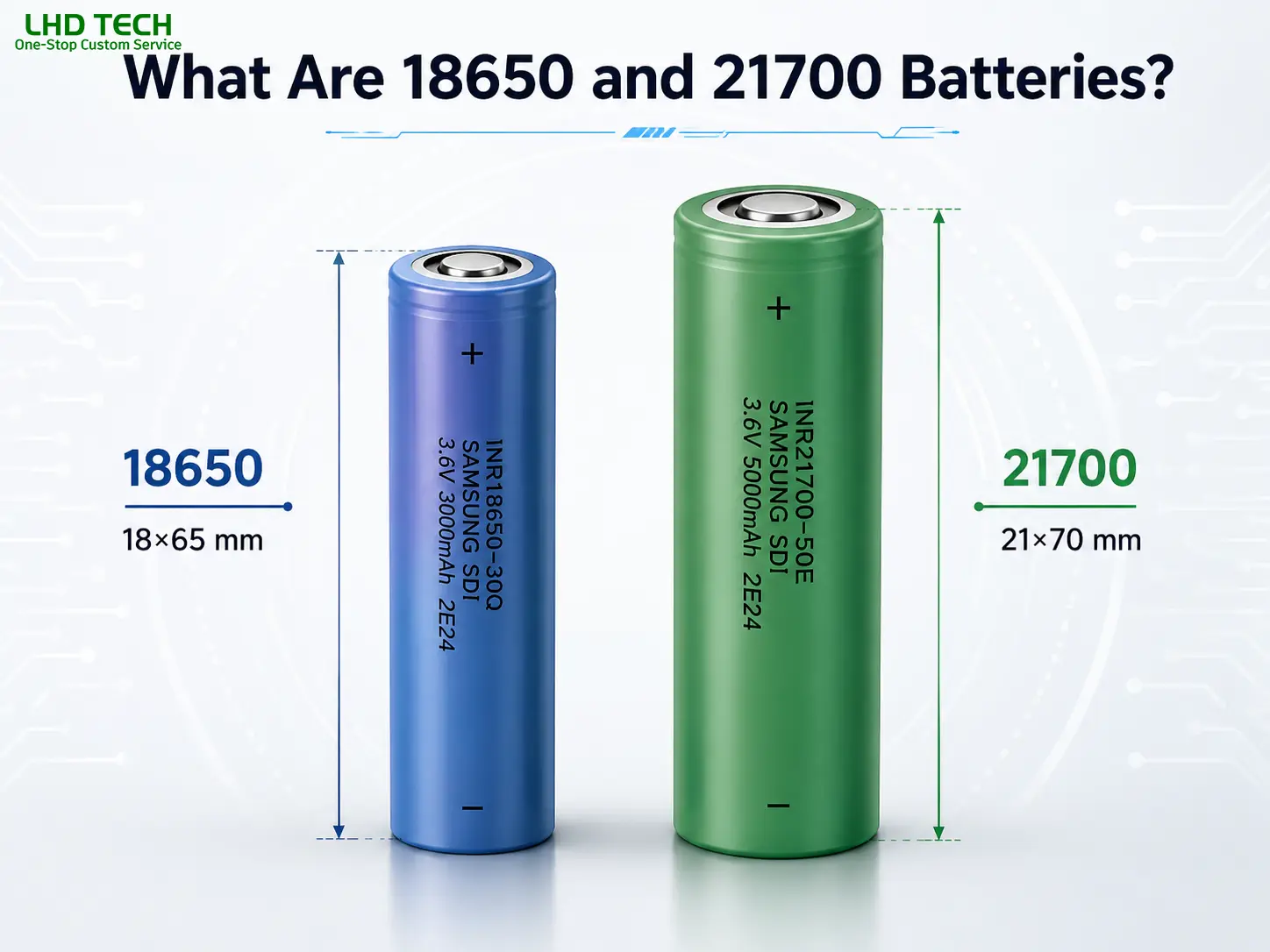
Both 18650 and 21700 batteries belong to the common rechargeable lithium-ion battery cells that we often see. Product names named battery sizes:
- 18650 battery: Diameter 18 millimeters, length 65 millimeters;
- 21700 battery cell: Diameter 21 millimeters, length 70 millimeters.
The Standard 18650 Battery Cell
The universal 18650 battery strikes a balance of power and size, being compact yet powerful. It is suitable for a wide range of devices: laptops, power banks, wireless tools, e-cigarettes, and flashlights. Some 18650 rechargeable batteries provide design ideas for some battery packs and portable devices, with various parameters:
- Nominal voltage: 6V or 3.7V, choose as appropriate.
- Capacity: It is commonly between 2000 mAh and 3500 mAh.
- Physical size: With a diameter of 18mm and a length of 65mm, it is the origin of the name “18650”.
- Common uses: Laptops, small flashlights, e-cigarettes, portable fans, and early electric vehicles.
- Chemistries: Common ones include lithium nickel cobalt manganese oxide (NMC), lithium cobalt oxide (LCO), and lithium iron phosphate (LiFePO₄), which vary depending on the material.
The 21700 Cell – The Larger Lithium-Ion Battery
The 21700 battery cell is a newer and larger battery that can meet the needs of electric vehicles and power-consuming electronic devices. It is 3 millimeters thicker and 5 millimeters longer than 18650, has a larger volume, more active materials and a greater storage capacity.
- Nominal voltage: 6V or 3.7V, similar to 18650.
- Capacity: From 4000 mAh to 5200 mAh, a 21700 battery has twice the battery life of 18650.
- Physical size: It has a diameter of 21mm, a length of 70mm, and a volume twice that of the 18650.
- Common uses: Tesla battery packs, high-performance electric vehicles, power tools, high-lumen flashlights, and high-power e-cigarettes.
- Chemistries: Common ones include NCA, NMC, LCO, and LiFePO₄. The selection depends on the specific application.
Key Differences Between 21700 and 18650 Batteries
Here are the key differences between 21700 and 18650 batteries across features relevant for real-life decisions.
| Feature | 18650 Battery | 21700 Battery |
| Physical Size | 18x65mm | 21x70mm (larger size) |
| Capacity (mAh) | 2000 – 3500 | 4000 – 5200 (higher) |
| Weight | 45 – 50g | 60 – 70g (heavier) |
| Discharge Rate | 5A – 30A | 10A – 35A (better for high-drain) |
| Nominal Voltage | 3.6 – 3.7V | 3.6 – 3.7V |
| Energy Density | ~220 Wh/kg | ~260 Wh/kg (higher) |
| Cycle Life | 300 – 700 cycles | 500 – 1200 cycles |
| Cost per Wh | $0.40 – $0.55 | $0.32 – $0.48 (often lower, per Wh) |
| Availability | Extremely common | Growing rapidly |
Physical Size and Larger Format
The 21700 is larger in volume (21mm in diameter and 70mm in length) and heavier than the 18650. This makes the space for loading active lithium materials larger, increasing the voltage and battery capacity.
Battery Capacity & Energy Density
The capacity and energy of 21700 are twice that of 18650. One charge, double battery life – suitable for both electric vehicles and flashlights, runtime per charge improving work efficiency.
Discharge Rate and Power Output
The 21700 is large in size, capable of withstanding higher continuous discharge currents and generating less heat. Electric-assisted bicycles, high-power e-cigarettes, professional-grade flashlights, 21700 is preferred.
Cycle Life and Lifespan
It is closely related to the brand, chemical system and usage habits. A qualified 21700 battery will have more charge and discharge cycles than an 18650 battery.
Key Features of 21700 Battery Cells
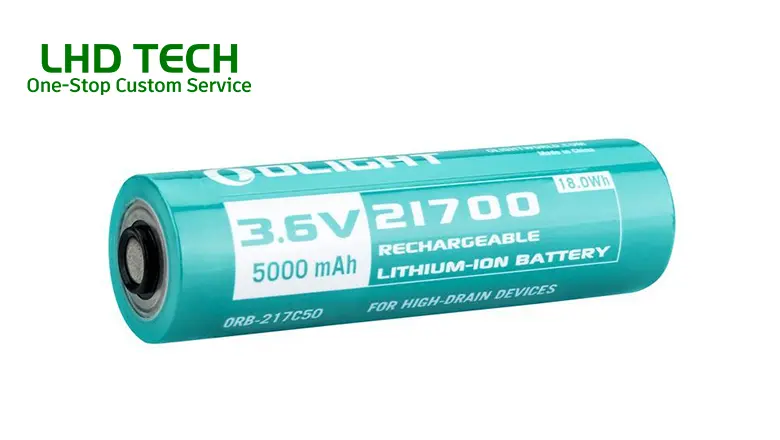
What makes 21700 cells so exciting for demanding users?
- High Capacity: Conventional 21700 battery cells can all achieve a capacity of 4000 to 5200 mAh, providing longer battery life and making them the preferred choice for products with less durable batteries.
- Higher Discharge Rate: The high-specification 21700 has a continuous discharge capacity of over 30A and is used in high-power distribution electric scooters, high-power electronic cigarettes, and battery packs for power tools.
- Improved Energy Density: The 21700 is larger in size than the 18650, but it has a greater capacity, demonstrating its size advantage.
- Thermal Management: It has a large volume and a large heat dissipation area. Under high load, the voltage drop is less, the performance is more stable, and it is less likely to generate heat.
- Newest Battery Chemistries: To enhance performance, the latest materials are preferred when manufacturing the 21700.
- Future-Proof Design: In line with market trends, flashlights, electric-assisted bikes and power tools have all been replaced with 21700 battery packs.
Pros and Cons of 21700 vs 18650 Batteries
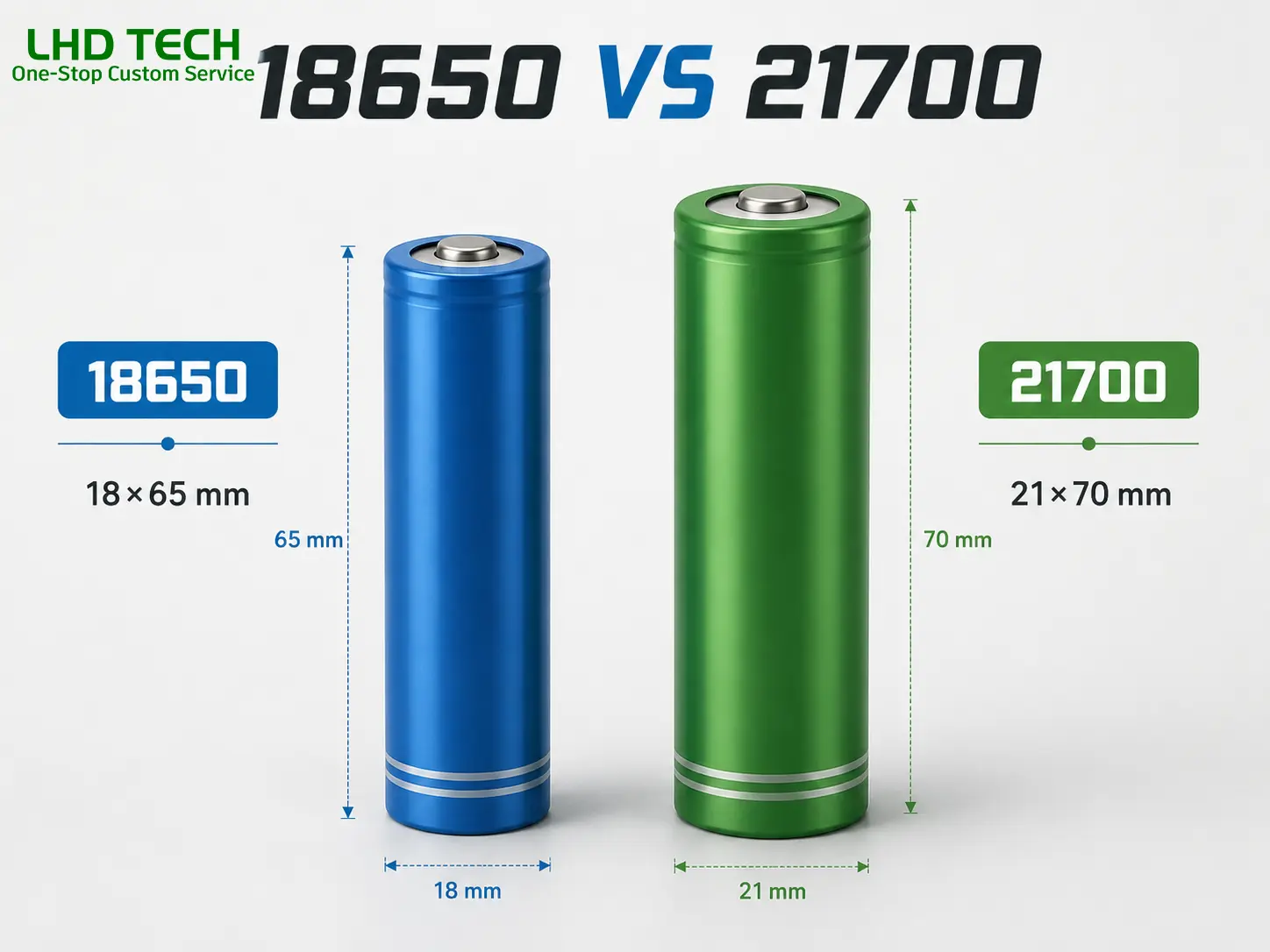
No single battery type is “best” for all uses—each has unique strengths. Here’s a thorough look at the pros and cons of 21700 vs 18650 batteries.
Pros of 21700 Battery Cells
- Longer Battery Life: With a large capacity and long battery life, the 21700 is the preferred choice for electric vehicles, high-end flashlights and electric-assisted bicycles.
- Better Power Output: With its large size, new material and strong discharge capacity, 21700 is the preferred choice for electronic cigarettes and power tools.
- Fewer Cells Needed: To assemble a battery pack of the same capacity, the number of cells in the 21700 is less than that in the 18650, making it easier to assemble and optimizing costs.
- Advanced Lithium-Ion Chemistries: At present, all the 21700s produced have adopted the latest NCA and NMC materials, and their performance, cycle life and safety have all been improved as a whole.
- Enhanced Thermal Management: The large-sized heat dissipation block is less likely to overheat and lose control.
- Future-Proof: Most high-power devices use 21700 battery cells, which is the future market demand direction.
Cons of 21700 Battery Cells
- Larger Size and Weight: 21700 is larger and heavier than 18650 and is not suitable for small devices.
- Not Backwards Compatible: If your battery compartment has a capacity of 18650, it cannot be replaced with 21700 as it is not large enough to be compatible.
- Higher Initial Cost: The high-end single 21700 is indeed more expensive than the 18650, but it offers better value for money in watt-hours.
- Less Universal (for now): The 21700 is applicable to an increasing number of devices, but it is not suitable for all products, and the procurement cycle is long.
Pros of 18650 Battery Cells
- Compact Size: The 18650 is compact in size and suitable for small-sized electronic devices.
- Wide Compatibility and Availability: 18650 is a globally universal battery cell with a wide range of models and extensive procurement channels.
- Lower Upfront Cost: If only one standard battery cell is needed, the 18650 offers better value for money.
- Lots of Accessories: From chargers and battery holders to DIY battery boxes, the peripheral accessories for 18650 are vast.
Cons of 18650 Battery Cells
- Lower Capacity: The milliampere capacity of the 18650 is higher than that of the 21700, but its battery life is shorter.
- Not as Good for High-Drain: In devices with high current consumption, the 18650 has a fast voltage loss and generates a lot of heat, and its battery life is not as long as that of the 21700.
- Potentially Obsolete for New Devices: The next generation of electric vehicles and heavy-duty power tools is shifting from the 18650 to the 21700.
21700 vs 18650 Batteries—Quick Comparison
| Aspect | 18650 Battery | 21700 Battery |
| Compact size | ✔️ | ❌ (larger, heavier) |
| Higher capacity | ❌ (~3500mAh max) | ✔️ (4000–5200mAh) |
| Fits old devices | ✔️ (legacy, universal) | ❌ (must check compatibility) |
| Best for new designs | ❌ | ✔️ (EV, e-bikes, new tools) |
| Cheaper per cell | ✔️ | ❌ |
| Cheaper per Wh | ❌ | ✔️ |
| Discharge rate | Good (up to 30A in best models) | Excellent (often 35A+ in premium models) |
| Battery life | Good | Better than 18650 |
Best Battery Applications: Where to Use 21700 or 18650 Batteries
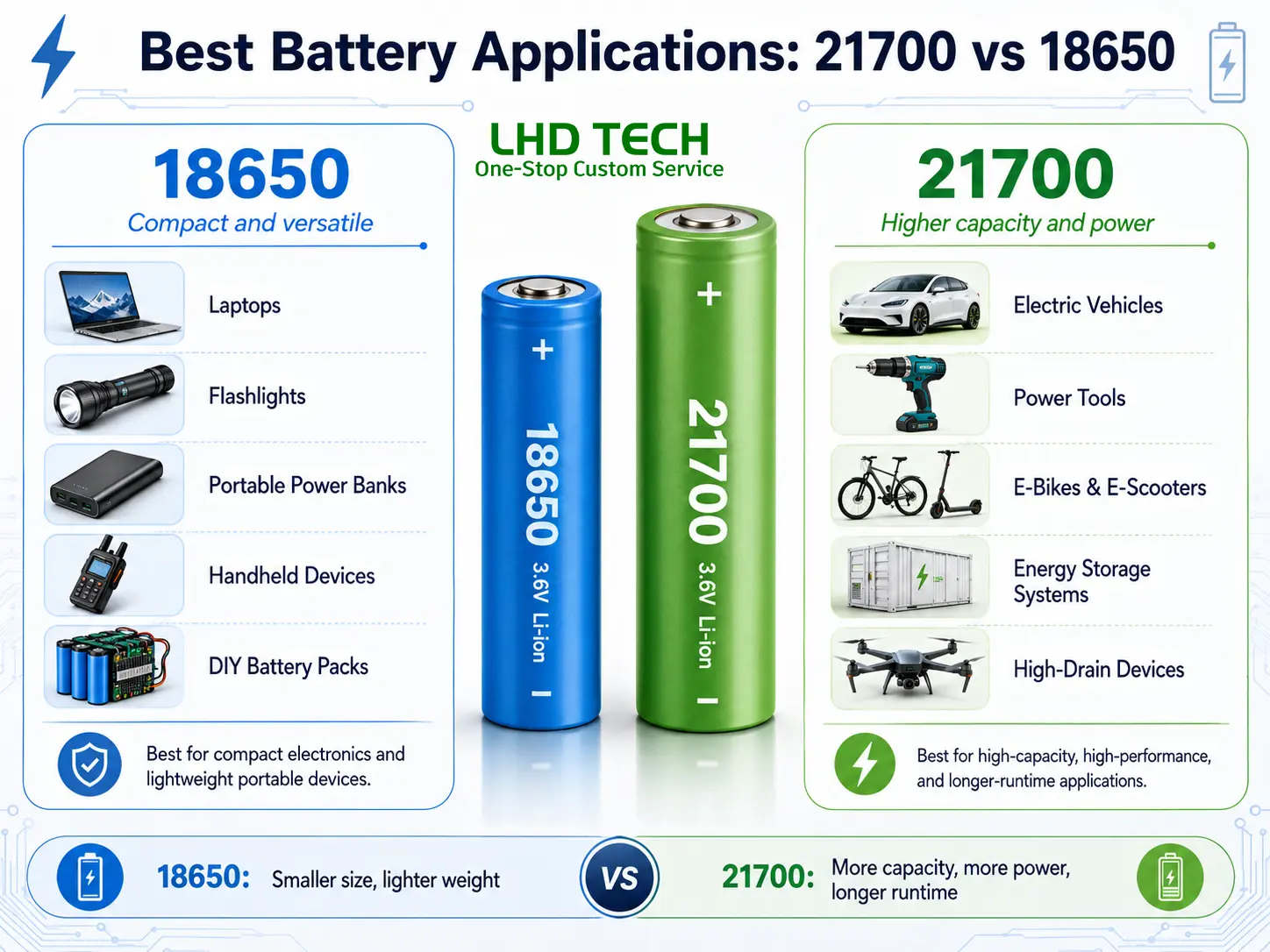
21700 vs 18650 batteries isn’t just a numbers game—use case makes all the difference! Here’s where each battery type excels.
When to Use 21700 Batteries
- Electric vehicles (EVs): New electric vehicles (including Tesla) are all using 21700 and 4680 battery cells, which offer longer range and stronger power.
- High-Lumen Flashlights: For search and rescue, camping and searchlight flashlights, the 21700 is the best choice.
- Power-Hungry Tools: For industrial-grade equipment like cordless drills and circular saws, a 21700 battery can last long enough for one charge.
- E-bikes and EScooters: With 21700 battery cells, under the same battery range, it has a longer mileage and is lighter in weight.
- High-Drain Vapes: For e-cigarette hosts with a current of over 20A, the 21700 offers the maximum continuous discharge capacity.
When to Use 18650 Batteries
- Compact Devices: For small-sized electronic devices such as laptops and mini LED flashlights, 18650 battery cells with a compact size are preferred.
- Legacy/Older Equipment: Some old-fashioned battery compartings are designed in 18650 size and are not compatible with 21700.
- DIY Battery Packs: For amateur projects that have high requirements for size and cost but low demands for battery life, the 18650 is the preferred choice.
- Widespread Replacement: 18650 is the preferred solution among global replacement cells.
Which Battery Type Should You Choose? Find the Right Battery Cell
Choosing the right battery depends on a few straightforward questions:
- Does your device support the battery size? The dimensions of 21700 and 18650 are different. When choosing a model, first confirm the size specification of the battery compartment.
- Do you need the longest runtime, highest output, or have high-drain needs? For high-lumen flashlights, professional e-cigarettes or electric-assisted bicycles, choose 21700 directly.
- Balance of Power and Size: For wearable devices, handheld devices and compact flashlights, choose smaller 18650 battery. If the battery pack capacity is large, choose 21700.
- Budget Considerations: 18650 is usually cheaper, but a large battery pack can hold a small amount of 21700, making it more cost-effective.
Battery Safety, Compatibility, and Handling Tips
No matter which battery type you choose, lithium-ion batteries require safe use:
- The battery size should be matched according to the size and model.
- The charger should also be a regular one that supports 21700 or 18650.
- In the same battery pack, do not mix new and old cells with those of different brands.
- Put the battery into the dedicated battery box.
- Stay away from high temperatures, compression and water; Lithium batteries are sensitive to heat, pressure and water.
- Choose big brands and find reliable channels. Purchase from regular dealers.
- Used lithium batteries should be sent to the electronic waste recycling point.
Adapter Tip and Real-World Troubleshooting
By adding a conversion sleeve or gasket inside a flashlights and vapes accept both 21700 and 18650 battery cells using a sleeve or spacer. To ensure battery life and lifespan, it is necessary to confirm the specification before modification.
Frequently Asked Questions: 21700 vs 18650 Batteries
Are 21700 and 18650 batteries interchangeable?
- The 21700 is one size larger than the 18650, and the battery compartment of the 18650 is too small. If the equipment is equipped with a conversion case, both specifications can be used.
Which battery lasts longer?
- Even with ternary or lithium cobalt oxide systems, the 21700 can generally run 40% to 70% more on battery capacity – both in terms of range and power.
Is bigger always better than 18650?
- Not necessarily. The 21700 is large in size and cannot be installed in compact devices or older 18650 models.
What is the right battery for vape mods?
- Most e-cigarettes support both. If you want to play with heavy smoke or turn on high power, please choose 21700. If you only need medium power, 18650 is more than enough.
What are the main differences between 21700 and 18650 batteries?
- Physical Size: The volume of 21700 compared to 18650 is 21mm in diameter and 70mm in length, while 18650 has a diameter of 18mm and a length of 65mm..”
- Capacity: The mAh of 21700 is higher, usually ranging from 4000 to 5200 mAh, while that of 18650 is generally between 2000 and 3500 mAh.
- Discharge Rate: The 21700 generally supports a larger continuous discharge current, so it is more suitable for those “power-consuming” devices, such as power tools, electric-assisted bikes, and high-performance e-cigarettes.
- Battery Life: Due to its larger capacity and better heat dissipation, the 21700 often has an edge over the 18650 in both the usage time per charge and the overall cycle life.
- Cost and Availability: Individually, 18650 is cheaper and easier to purchase. However, if you want to assemble a large-capacity battery pack, the cost per watt-hour calculated with 21700 cells might actually be lower.
Can I use a 21700 in a device designed for 18650 batteries?
- Usually not. Unless your device itself supports both specifications or comes with a dedicated conversion kit.
Are 21700 cells better than 18650 for battery packs?
- If you need high power and large capacity (such as for electric vehicles, power tools, or energy storage battery packs), 21700 battery cells provide clear advantages- fewer battery cells, higher total energy, and better heat dissipation and electrical performance. However, if it is an older model of equipment or a compact design, the 18650 is still a more suitable choice.
Is a 21700 battery safer?
- Both types of batteries adopt advanced lithium battery materials and are equipped with safety protection circuits. The 21700 battery is larger in size.
Conclusion: Should You Use 21700 or the Smaller 18650?
In LHD TECH’s view, to choose the right battery cell, whether it’s 21700 or 18650, the principle is to select based on your needs.
- Choose 21700 batteries If you need a large capacity (mAh), longer battery life, better heat dissipation performance, or if you are building a battery pack for an electric vehicle, a heavy-duty flashlight, or a high-power e-cigarette, choose the 21700 directly. It is large in size and suitable for users who want to upgrade to the latest power tools, high-end flashlights and electric vehicles.
- Choose 18650 batteries If your device is an older model and you have high requirements for size and cost, the 18650 is still a safe choice. It is compact size and lightweight, making it highly suitable for laptops, traditional flashlights, and replacement cells that are readily available worldwide.
Remember:
- 21700 is physically larger than the 18650; always check battery compatibility.
- For most new high-end devices, 21700 generally outperforms the older standard 18650, especially in capacity, discharge rate, and battery life.
- When building or upgrading a battery pack, consider your size and weight constraints, the device’s runtime requirements, and your budget.