
Introduction: What is an Integrated Circuit Board?

In LHD TECH’s view, the integrated circuit board (IC board), or printed circuit board (PCB) housing integrated circuits (ICs), is the physical foundation of modern electronics. It is not only a substrate that carries and mounts electronic components, but more importantly, it enables electrical interconnection between components through copper traces on the PCB. This intricate interconnect design is one of the core driving forces behind the continuous miniaturization and performance improvement of electronic devices.
A typical IC board usually integrates semiconductor integrated circuits, resistors, capacitors, and various other discrete components. These components together build a fully functional electronic system—from the simplest calculator to AI-driven smart terminals to high-speed data centers. IC boards, depending on their function, structure, or manufacturing process, can be categorized in various ways, but regardless of type, they all rely on a PCB to communicate with external circuits.
IC chips are manufactured based on semiconductor materials (most commonly silicon wafers), integrating billions of transistors, resistors, and capacitors on an extremely small area to form extremely compact electronic circuits. These highly precise ICs need to be mounted onto PCBs using surface mounting and soldering processes. This assembly process not only determines the product’s performance but also places extremely high demands on manufacturing precision and reliability.
For this reason, IC boards serve as the cornerstone of modern electronics. Whether in consumer electronics, communication equipment, industrial control, automotive electronics, medical instruments, or artificial intelligence, almost all functions rely on them. Advanced integrated circuits and meticulously designed PCBs complement each other, jointly building stable and reliable electronic systems while effectively reducing power consumption and extending overall lifespan. For LHD TECH, a deep understanding and continuous optimization of this combination is fundamental to serving our customers and driving innovation.
What Do Integrated Circuits Do?
An integrated circuit (IC) is an electronic circuit built on a single piece of semiconductor material (usually silicon). A single IC chip can integrate billions of transistors, performing core tasks such as logic operations, signal processing, and control. These highly integrated chips have become the fundamental building blocks of all modern electronic devices—from consumer devices to industrial systems, all rely on their computing and control capabilities.
Core Functions of Integrated Circuits
Logic and Processing:
Logic gates, flip-flops, and microprocessors constitute the “brain” of the digital world.
Dedicated inference chips (such as NPU and TPU) and GPUs are widely deployed in AI servers.
Analog and Mixed-Signal Processing:
Analog ICs such as amplifiers, filters, and oscillators are responsible for processing continuously changing physical signals—such as audio from a microphone, radio frequency from an antenna, and voltage values from a sensor.
The real world is analog; digital processors only recognize 0s and 1s. An ADC quantizes continuous analog voltage samples into a digital bitstream, while a DAC reconstructs the analog waveform; together, they form a converter.
Control and Sensing:
Microcontrollers for device management and automation.
Sensor ICs for input from the environment—accelerometers, temperature sensors, and more.
Memory and Storage:
Memory ICs for data storage (RAM, ROM, Flash).
Power Management:
Power management ICs and voltage regulators for efficient, stable operation.
Integrated Circuit Types and Functions
| IC Type | Main Function | Example |
| Digital Integrated Circuits | Logic, processing, computing | Microprocessors, FPGAs, logic gates |
| Analog Integrated Circuits | Signal amplification, filtering | Operational amplifiers, audio amplifiers |
| Mixed-Signal Integrated Circuits | Converting analog to digital and vice versa | ADC, DAC, sensor/readout ICs |
| Sensor IC | Sense specific physical quantities | Accelerometer, gyroscope, photodetector |
| Application-Specific Integrated Circuit (ASIC) | Custom product features | AI chips, Bitcoin miners, automotive safety ICs |
| Microcontroller | Embedded control, automation | Arduino-compatible chips, STM32 family |
| Voltage Regulators | Stable power supply | LM7805, LDO regulators |
In the field of AI and machine learning, advanced integrated circuits (such as NPU neural network processing units and various dedicated acceleration chips) are redefining the performance boundaries of electronic systems.
History and Evolution of Integrated Circuits and IC Boards
The development of integrated circuits (IC) was one of the most disruptive turning points in the history of electronics. In the late 1950s, Jack Kilby and Robert Noyce independently invented the first IC, integrating a complete electronic circuit onto a single semiconductor chip, enabling miniaturization and mass production. From then on, bulky vacuum tubes and discrete component circuits were gradually replaced, allowing computers, calculators, and communication systems to move towards miniaturization and high reliability. Subsequently, ICs evolved through SSI, MSI, LSI to VLSI, with each generation increasing integration density and functionality, ultimately becoming the core pillar of modern electronic systems. At LHD TECH, we understand that each leap in integration presents new challenges to PCB design and manufacturing—and this is precisely the driving force behind our continuous improvement.
Key Milestones:
- SSI (Small-Scale Integration): Logic gates and basic functions (<100 transistors)
- MSI (Medium-Scale Integration): It integrates hundreds of logic gates and flip-flops, and supports timing modules such as registers.
- LSI (Large-Scale Integration): Thousands of gates, early microprocessor ICs
- VLSI (Very Large-Scale Integration): The number of transistors has increased to millions to billions, forming the hardware foundation of modern CPUs, GPUs, and AI chips.
- AI-specific accelerator chips and photonic integrated circuits are gradually emerging, opening up new technological dimensions for advanced electronic systems.
Today, photonic integrated circuits and AI ICs are pushing into new frontiers, enabling high-speed communication, deep learning, and mass production of computational power never before imagined.
Understanding Integrated Circuit Boards
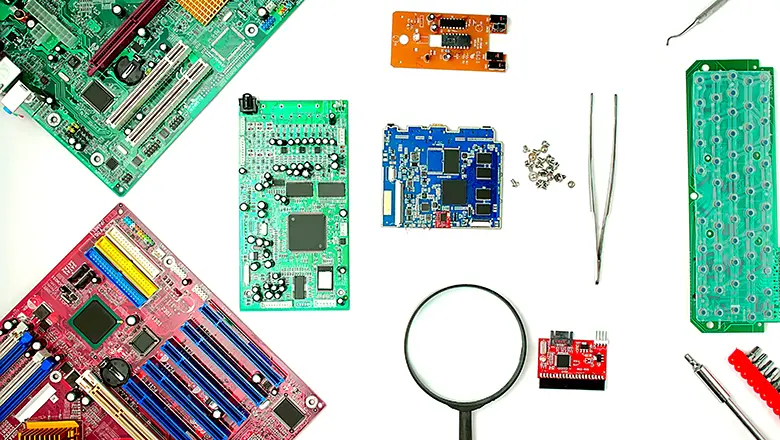
An integrated circuit board is a structural component that has been precisely engineered—usually presented in the form of a printed circuit board (PCB). Its design must take into account the realization of circuit functions, long-term reliability, manufacturability for mass production, and, in some high-speed or high-frequency application scenarios, must also meet stringent signal integrity requirements.
What Makes Up an IC Board?
- Semiconductors/ICs/Chips: The core of the system’s computation, including microprocessors, application-specific integrated circuits (ASICs), and AI accelerators, responsible for logic decision-making and data processing.
- Passive Components: Includes capacitors, resistors, and inductors, used for filtering, current limiting, energy storage, and impedance matching.
- Connectors and Sockets: Provide electrical connection interfaces between modules within the board or with external devices.
- Traces on the PCB: Copper paths for interconnect and signal routing.
- Substrate: The physical support, often FR-4 or ceramic.
Key Design Points:
- Circuit layout is optimized with CAD tools for minimal trace length (signal speed) and maximal reliability.
- Heat dissipation is carefully engineered, especially in AI, GPU, and power IC boards.
Types and Classifications of Integrated Circuits
Types of integrated circuits include digital, analog, and mixed-signal. These types of ICs can be further classified by size, function, or method of manufacturing.
| Scale | ICs Example | Application |
| SSI | Simple logic gate ICs | Traffic lights, calculators |
| MSI | Multiplexer, counter ICs | LED drivers, basic digital clocks |
| LSI | Microprocessor, SRAM | Personal computers, early mobile phones |
| VLSI | AI chips, modern CPUs | Smartphones, AI servers, advanced robotics |
| ULSI | Billions of components | AI cloud infrastructure, supercomputers |
IC Classification by Construction and Function
- Monolithic ICs: Manufactured on a single silicon wafer, suitable for high-volume production of microprocessors, memory chips, and logic ICs.
- Hybrid Integrated Circuits: Integrate multiple chips or heterogeneous semiconductor materials onto a single substrate, primarily used in high-frequency modules and power amplifiers.
- Analog: Process continuous signals; typical applications include audio amplifiers, sensor conditioning circuits, and voltage regulators.
- Digital Integrated Circuits: Encompass logic chips, MCUs, and MPUs, forming the logic hub of AI computing and digital systems.
- Mixed-Signal Integrated Circuits: Support both digital computation and analog signal processing, particularly critical in sensor readout circuits and communication transceivers.
ICs can be classified in many different ways, covering every use case from a logic gate to a complete AI-optimized SoC.
Essential Types of ICs
| Type | Description |
| Analog ICs | For signal conditioning, amplifier, regulation |
| Digital Integrated Circuits | For computation, AI logic, data processing |
| Mixed-Signal Integrated Circuits | Convert between analog and digital worlds |
| Application-Specific Integrated | Custom chips for unique requirements (ASICs) |
| Microcontroller | Embedded processor & peripherals (sensors, I/O) |
| Sensor IC | Temperature, pressure, light, motion detection |
| Power Management IC | Voltage regulation, power optimization |
Integrated Circuit Board vs. Printed Circuit Board (PCB)
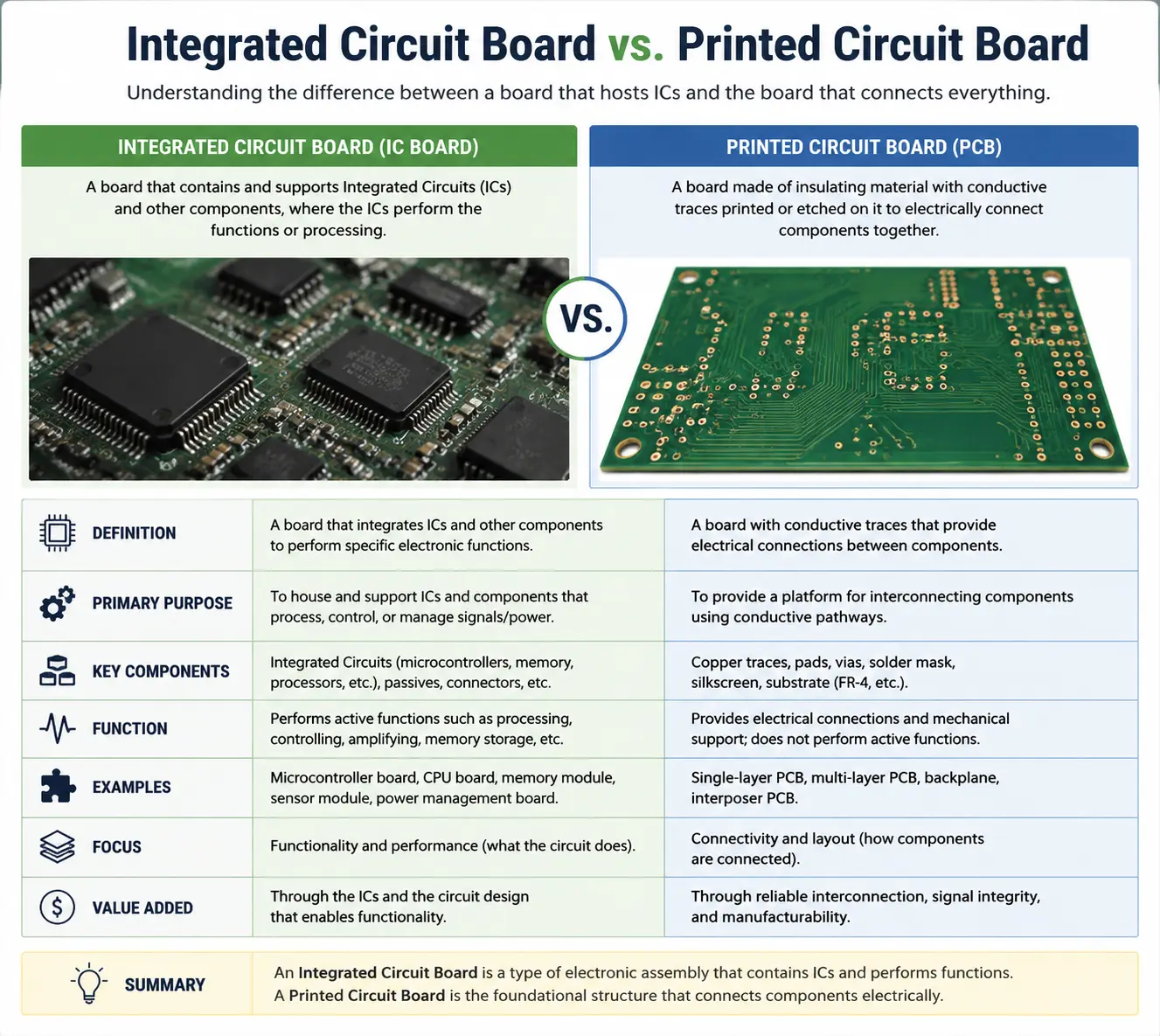
People often ask what the difference is between PCB design and integrated circuit design. Simply put, a printed circuit board (PCB) is a physical substrate on which copper wires interconnect all components—including ICs, resistors, capacitors, and connectors—to form a complete system. An integrated circuit (IC), on the other hand, is a miniature electronic circuit manufactured on a semiconductor wafer; it is one of the many components on a PCB.
Major Differences
- PCB: Composed of an insulating substrate and conductive traces, it can simultaneously mount multiple ICs as well as other components such as resistors and capacitors.
- IC: Semiconductor device, typically a single chip or package, with a specific circuit function.
- PCB and Integrated Circuit Boards: When an IC is mounted on a PCB, it forms a working electronic system called a PCBA (Printed Circuit Board Assembly).
Comparison Table: PCB vs Integrated Circuit
| Feature | PCB | Integrated Circuit (IC) |
| Material | FR-4, ceramic, polyimide substrate | Silicon wafer, sometimes GaAs or SiGe |
| Function | Hosts, connects electronic components | Encapsulates electronic circuitry |
| Contains | Traces, pads, vias, IC packages, passives | Billions of transistors, diodes, resistors in compact form |
| Role | System-level interconnection | Functional building block |
| Packaging | Usually provides a slot for IC packages | Encapsulated as DIP, QFP, BGA, CSP, etc. |
When designing for AI, you might have multiple VLSI chips (neural processors) installed on advanced multilayer PCBs, tightly routed for low power consumption and maximum speed.
Types of IC Boards
IC boards are classified by their assembly technology, chip density, substrate type, and use case.
- Through-hole Board: With through-hole soldering, the robust structure is suitable for highly reliable, repairable and maintainable electronic equipment.
- Surface-mount Board: Most modern boards use SMD ICs—enables miniaturization, multilayer routing, and increased speed for AI and high-frequency signals.
- Hybrid Board: Through-hole and surface mount technology are used in combination to balance electrical performance and mechanical strength, and are often used in automotive and industrial control systems.
- HDI (High-Density Interconnect): Characterized by micro-blind vias and fine lines, it meets the extremely high I/O density requirements of advanced ICs and is the mainstream choice for smart terminal devices.
BGA (Ball Grid Array) offers superior signal integrity and heat dissipation efficiency, making it the mainstream packaging choice for high-computing applications such as AI chips. The array of solder balls on its bottom not only shortens electrical paths and reduces parasitic effects, but also creates excellent heat conduction channels with the PCB through large solder joints.
Common IC Packaging Types
IC packages come in many forms, each optimized for size, pin count, heat dissipation, or high-frequency application.
- DIP (Dual In-line Package): Through-hole package, simple structure, suitable for cost-sensitive or legacy designs requiring manual soldering.
- SOIC, QFP, TSSOP: Surface mount, exposed leads, compatible with high-speed SMT production lines, the mainstream package for general-purpose digital and analog ICs.
- Ball Grid Array (BGA): Bottom ball array, supports extremely high I/O density and excellent heat dissipation, designed for high-performance chips such as AI processors and FPGAs.
- CSP (Chip-Scale Package): Package area close to bare die, providing an extreme miniaturization solution for space-constrained scenarios such as wearable devices and high-end smartphones.
| Package Type | Pros | Typical Application |
| DIP | Easy to solder | Prototypes, education |
| QFP | High pin count | Microcontrollers, ASICs |
| BGA | Best for density & thermal | AI, GPUs, Networking |
| CSP/WLCSP | Smallest size | Mobile, wearables |
Key Components of an Integrated Circuit Board
An IC board is nothing without robust supporting electronic components and a reliable substrate.
- IC Packages: The main chips (digital, analog, mixed-signal, AI, and sensor ICs).
- Resistor: Controls current flow.
- Capacitor: Smooths voltage, stores charge.
- Voltage Regulator: Ensures stable voltage supply.
- Connector: Links board to the outside system.
- Substrate: Forms the core physical support, and in advanced designs, helps with heat dissipation.
Traces on the printed circuit / PCB: Provide all interconnections between the IC, passive components, and I/O.
How Integrated Circuit Boards are Constructed
PCB Design and Manufacturing
- Schematic & Circuit Design: Complete the selection and matching of ICs and peripheral components, perform electrical simulation and layout optimization using CAD tools, and define circuit behavior from the top level.
- PCB Layout: Coordinate routing strategies in multi-layer boards, balancing interconnect efficiency, noise suppression, and impedance control. In digital-intensive applications such as AI and high-speed networks, signal integrity analysis is a critical step in ensuring stable system operation.
- PCB Fabrication: Layers are created on the substrate, with copper etching to form traces. Via holes are created for through-hole or multilayer interconnection.
- Component Assembly:
- Solder paste is applied, and ICs, resistors, and capacitors are picked and placed.
- Through-hole or SMD IC packages are fixed using automated or manual soldering.
- AOI/inspection ensures no short circuits or improper joints.
Heat dissipation is planned throughout, especially for AI accelerators or chips used in mass production, which can generate significant heat.
Integrated Circuit Design: Analog vs. Digital
Analog Circuit Design
- For processing continuous physical signals such as amplification and filtering, PCB layout must strictly control noise interference; analog ICs are widely used in signal conditioning, sensor readout, and voltage stabilization circuits.
Digital IC Design
- Composed of logic gate arrays, they perform binary operations and support microprocessors, FPGAs, and AI-specific chips; the transistor integration scale of a single digital IC has now reached billions.
Mixed-signal integrated circuits combine both approaches, vital in AI, audio, sensor interfaces, and more.
How to Install Integrated Circuits onto Boards
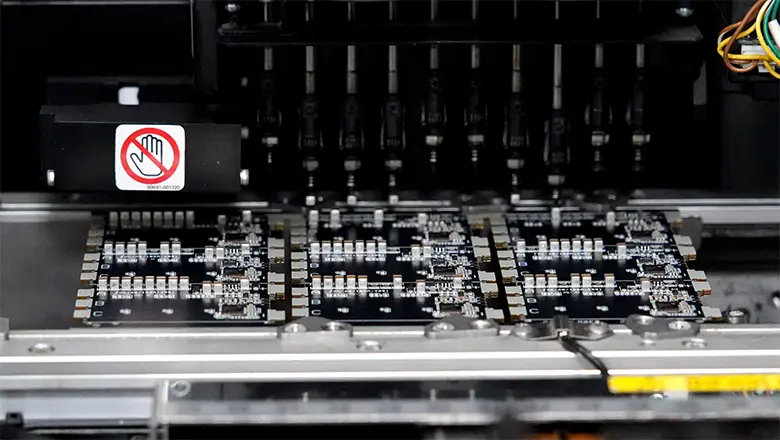
Soldering is the main method of fastening ICs onto the PCB, creating both a mechanical and electrical connection.
Step-by-Step
- Prepare the board: Ensure pads are clean and pre-tinned.
- Apply solder paste (for SMD) or insert leads (for through-hole).
- Place ICs and passives: Accurate placement ensures no misalignment.
- Reflow soldering or wave soldering: For advanced SMD packages or mass production boards.
- Inspection: AOI, functional, and X-ray inspection for BGA and CSP IC packages.
Applications of Integrated Circuit Boards
IC boards power every sector in the AI age:
- AI hardware: PCBs hosting AI ASICs, neural network processors, and high-density memory for datacenter training and edge inference.
- Consumer electronics: Smartphones, wearables, and TVs use mass-produced, miniaturized IC boards.
- Medical devices: Miniaturized ICs and advanced sensor ICs enable portable diagnostics.
- Industrial and automotive: Rugged boards withstand vibration, temperature extremes, and require robust reliability, with through-hole and hybrid integrated circuit boards commonly used in automotive control units, industrial automation, and robotics. These environments demand ICs and substrates that can survive shock, temperature swings, and humidity—often featured in automotive ECUs, robotic controllers, and industrial sensor interfaces.
Specific Use Cases
- Consumer Electronics: Modern smartphones use at least one SoC (a single chip integrating billions of transistors for computing, graphics, and communications), memory ICs, voltage regulators, and multiple sensor ICs—all placed on a densely packed multilayer PCB. Wearables and smartwatches drive further miniaturization.
- AI and Data Centers: AI hardware leverages advanced integrated circuits, AI accelerators, application-specific integrated circuits, and high-density memory modules, all placed on PCBs with careful circuit design to support low power consumption and efficient heat dissipation.
- Automotive & Industrial: Engine control units, ABS modules, and industrial automation controllers utilize hybrid integrated circuits, robust PCB substrates, and soldered through-hole or surface-mount ICs for long-term reliability and vibration resistance. These devices require precision circuit layout for sensor readings, power management, and safe system shutdown in case of short circuits.
- Medical Devices and Robotics: Everything from portable ECG monitors to robotic arms depends on mixed-signal ICs, sensor ICs, and low-voltage amplifiers. Medical and industrial PCBs must meet strict reliability and traceability regulations.
Common IC Board Damage and Failure Modes
Even the best circuit designers face the challenge of IC board failure. Proactive understanding and mitigation are essential for reliability:
- ESD Damage: Semiconductor integrated circuits are often destroyed by electrostatic discharge during handling. Use ESD-safe protocols.
- Thermal Stress: Inadequate heat dissipation or poor solder joints under ball grid array ICs can cause failure—use thermal vias and quality inspection techniques.
- Short Circuit: Excess solder or manufacturing debris can bridge traces on the PCB, leading to functional failure.
- Corrosion and Contamination: Moisture or harsh environments can cause open circuits or degrade interconnect points, especially on exposed traces.
Prevention:
- Conformal coating, robust enclosure, and pre-delivery burn-in testing.
- Choosing the right substrate and board finish to prevent moisture ingress.
- Employing AOI or X-ray for ball grid array and high-density ICs.
How to Choose the Right Integrated Circuit Board
When selecting an IC board, consider:
- Electrical Requirements: What voltage, current, and power consumption does your device need? AI applications often require high-current tracks, low-impedance voltage regulators, and special PCB substrates for heat management.
- Environmental Conditions: Will the ICs face high temperatures, moisture, vibration, or dust? Industrial and automotive PCBs use hybrid integrated circuits and ceramic or exotic substrates.
- Functionality Needs: Do you require analog circuits, mixed-signal data conversion, AI inferencing, or high-speed logic? This determines which types of ICs and package types (e.g., QFP, BGA, CSP) you’ll select.
- Manufacturing Scale: For mass production, design and manufacturing must emphasize automated PCB assembly services, testability, and sourcing stable, available ICs.
The Four Key Steps of IC Board Manufacturing
- Design & Simulation: Circuit design, IC selection, and PCB layout with DFM/DFT in mind. AI chips and advanced integrated circuits require thermal simulation and impedance analysis.
- PCB Fabrication: Manufacturing the printed circuit with high-precision etching, layer stacking, and via formation.
- Assembly & Testing: Soldering of IC packages, passive components, post-assembly AOI, and functional validation.
- Quality Control & Packaging: Burn-in testing, inspection, conformal coating, and ESD-safe packaging—especially vital for sensitive AI and sensor ICs.
Future Trends in Integrated Circuit Board Technology
- AI-centric Designs: Expect exponential growth in IC boards designed for artificial intelligence, hosting AI-optimized chips, and supporting photonic integrated circuits for future high-speed optical data processing.
- Miniaturization & Advanced Substrates: Flexible, stretchable boards, ceramic substrates, and 3D packaging will drive further miniaturization and reliability increases.
- Green Manufacturing: Low-toxicity materials, lead-free solder, and recycling-ready PCB assemblies.
Frequently Asked Questions
Q:What is an integrated circuit board?
A:Explain that it usually refers to a printed circuit board that carries integrated circuits and other electronic components to perform specific functions.
Q:What is the difference between a circuit board and an integrated circuit board?
A:Clarify that a circuit board is the physical platform, while an integrated circuit board usually includes IC chips mounted on the board.
Q:Are ICs still used today?
A:Yes. ICs are essential in almost all modern electronics, including industrial control, automotive electronics, communication devices, and IoT products.
Q:What are three types of integrated circuits?
A:Common types include analog ICs, digital ICs, and mixed-signal ICs.
Q:What is the most common integrated circuit?
A:Microcontrollers, logic ICs, power management ICs, and memory ICs are among the most common ICs used on circuit boards.
Q:What is the lifespan of an IC chip?
A:The lifespan depends on temperature, voltage, operating environment, workload, and board-level reliability.
Q:How to know if an IC is faulty?
A:Signs may include overheating, unstable output, no response, abnormal voltage, burning marks, or failure during functional testing.
Q:How to check an IC using a multimeter?
A:A multimeter can help check power pins, short circuits, continuity, and abnormal resistance, but full IC diagnosis usually requires circuit-level testing.
Q:What is the main cause of IC failure?
A:Common causes include overheating, electrostatic discharge, overvoltage, moisture, poor soldering, and PCB design or assembly defects.
Q:Can a damaged IC be repaired?
A:In most cases, the IC itself cannot be repaired; it is usually replaced. The board can often be repaired if the damage is limited.
Conclusion
The integrated circuit board is the linchpin of the AI era and the broader world of modern electronics. Bringing together billions of transistors, advanced microcontroller and microprocessor designs, and custom AI logic gates in one compact package, the IC board enables innovation at unprecedented scales—from mass-produced consumer electronics and medical devices to industrial automation and cloud data centers.
ICs and PCBs are the result of decades of progress in semiconductor integrated circuit technology, soldering advances, and the science of miniaturized interconnects and substrates. Whether you’re a designer, builder, or buyer, understanding how IC boards are designed and manufactured—and why reliability and assembly best practices matter—is your roadmap to success in today’s ultra-connected world.
Remember, the future belongs to those who embrace constant learning, especially as we enter an era defined by AI, photonic ICs, miniaturized electronic circuits, and sustainable electronic systems for tomorrow’s challenges.
Thank you for reading our expert guide to integrated circuit and PCB assembly—your gateway to mastering the future of electronics!