
What is IPC 6012?
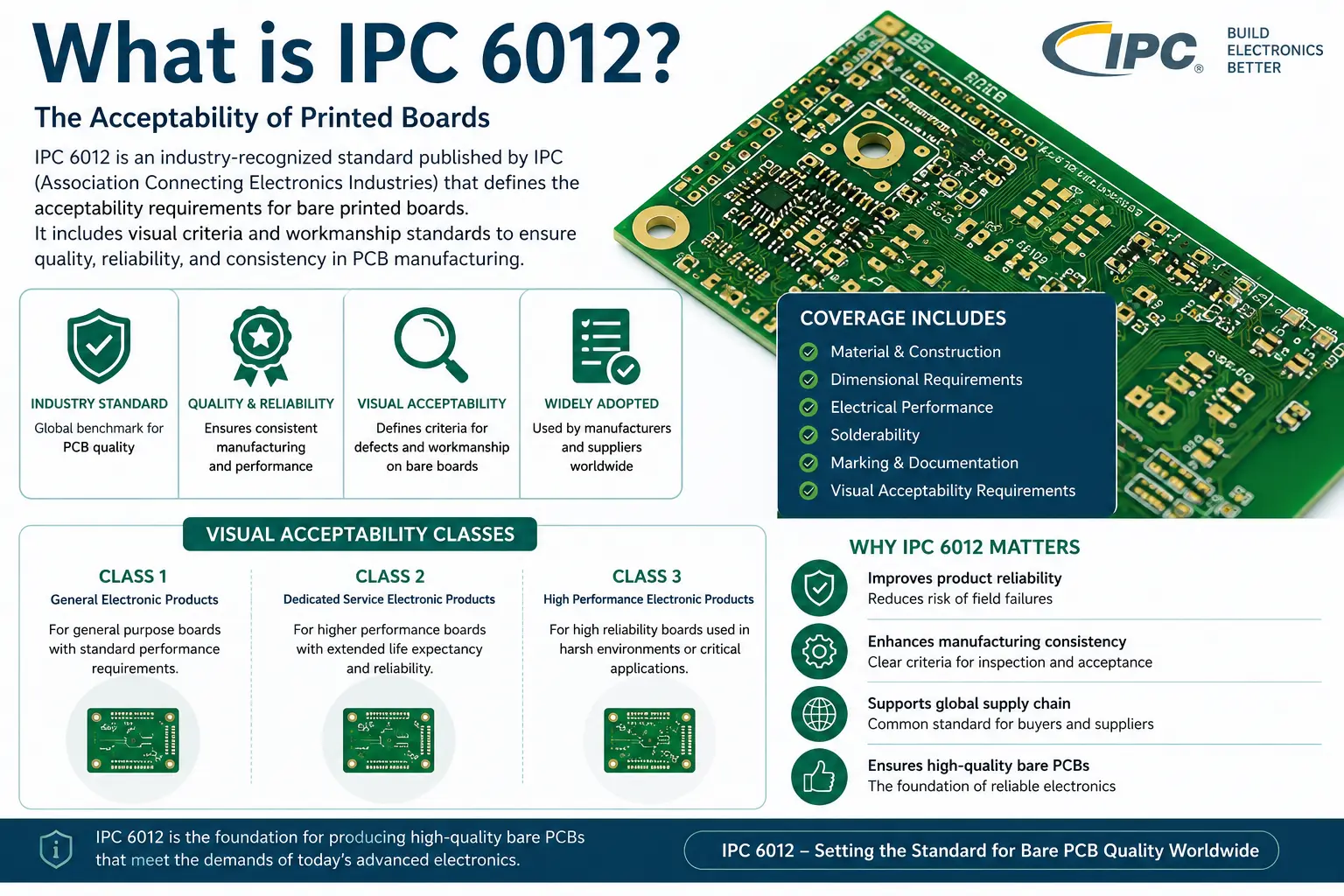
IPC 6012 is a widely recognized standard, it establishes the qualification also performance requirements for rigid printed circuit boards (PCBs). For the one who involved in PCB design, production, assembly—no matter in consumer electronics, medical, automotive, or aerospace industries—IPC-6012 is the performance and qualification specification we can master.
The IPC-6012 standard is one of the broader IPC standards family, and established by IPC (Association Connecting Electronics Industries). It sets criteria for printed circuit board quality, reliability, and manufacturability. Then released in multiple revisions, IPC-6012 can help pcb factory produce reliable and consistent products, through defining key requirements for rigid boards.
Importance of IPC Standards in Electronics
With electronics permeating in life, rigid printed circuit boards can serve as the vital foundation of all digital technology. High reliability is very critical for mission-critical and safety-related applications—it making IPC standards indispensable across the supply chain.
Why are IPC standards crucial?
- They unify performance specification for rigid printed boards globally.
- They enable PCB designers, manufacturers can communicate requirements with precision.
- They set acceptance criteria and inspection benchmarks, to reduce ambiguity and defects.
- They empower companies to deliver high-quality, consistent, and safe electronics.
Companies can comply with IPC-6012 often see fewer field failures, improved customer trust, and smoother audits by regulatory bodies.
The Scope and Purpose of the IPC 6012 Standard
IPC 6012 is a standard that applies specifically to rigid printed circuit boards, setting the foundation for what makes a board compliant in terms of materials, mechanical strength, electrical performance, and solderability. This standard also clarifies what inspection and qualification and performance requirements must be met during PCB fabrication.
Types of Boards Covered:
- Single-sided and double-sided rigid PCBs (with or without plated-through holes or PTH)
- Multilayer rigid PCBs (HDI included)
- Rigid boards with embedded passive/active components
- Metal-core boards for high power/thermal applications
Per IPC-6012, these boards are classified into three key performance classes, which we’ll soon explore.
IPC-6012 Standard – Revisions and History
IPC-6012 has evolved significantly from the years. Each revision brings new requirements reflecting advances in electronics and the need for heightened reliability.
Key Milestones:
| Revision | Year | What Changed and Why It Matters |
| A–C | 1999–2010 | Established baseline for performance requirements, plating, solder mask, and via reliability |
| D/E | 2014+ | Segmented requirements for rigid, HDI, and boards with embedded components |
| F (6012F)** | 2023/2026 | Added standards for back-drill depth, microvia quality, cavity types, and automotive/medical addenda |
Note: Each revision of IPC-6012 builds on user feedback, emerging failure modes, and technology shifts. The latest IPC-6012 Revision F is highly relevant for high-speed, high-density applications (5G, automotive, aerospace).
Changes included in this revision:
- Stricter rules for microvia structures
- Enhanced controls for thermal and mechanical stress
- Clearer definitions on plating, annular ring, and solder mask
- Automotive (IPC-6012FA), space/military (6012FS), and medical (6012EM) addenda
To following the IPC 6012 standard can ensures us in step with the latest industry best practices and reliability requirements.
What Does IPC-6012 Cover?
IPC-6012 defines a comprehensive suite of performance, inspection, and process requirements for rigid PCBs. Areas covered include:
Materials and Laminate Quality:
- Requirements for copper foil, prepregs, and laminate classes based on dielectric performance.
Mechanical and Dimensional Checks:
- Specification for board thickness, registration, and dimensional accuracy.
- Rules for plate and layer alignment.
Via and PTH Quality:
- Controls for via wall plating thickness: Class 3 requires ≥25 μm per IPC-6012 class 3 criteria.
- Void-free and crack-free plating is mandatory.
Annular Ring Integrity:
- Class 2 allows minor breakout if connectivity is preserved, while Class 3 requires no breakout—vital for lifetime reliability.
Solder Mask and Surface Finishes:
- Minimum coverage, registration, curing, and zero tolerance for bridging in Class 3 products.
- Acceptable finishes: ENIG, OSP, HASL, LF-HASL.
Thermal and Environmental Tests:
- Boards are subjected to thermal cycling, humidity, vibration, and mechanical flex tests.
- Evaluates both solder and plating durability.
Electrical and Reliability Tests:
- High voltage breakdown tests, continuity checks, and insulation resistance.
- Failure analysis (cross-section or microsection) for rigid PCB lots failing inspection.
Keep in Mind:
- Acceptable inspection methods include AOI, X-ray, and microsection analysis.
- Cleanliness and ionic contamination thresholds are strict—especially for Class 3 PCBs.
IPC-6012 Classes: Class 1, Class 2, Class 3
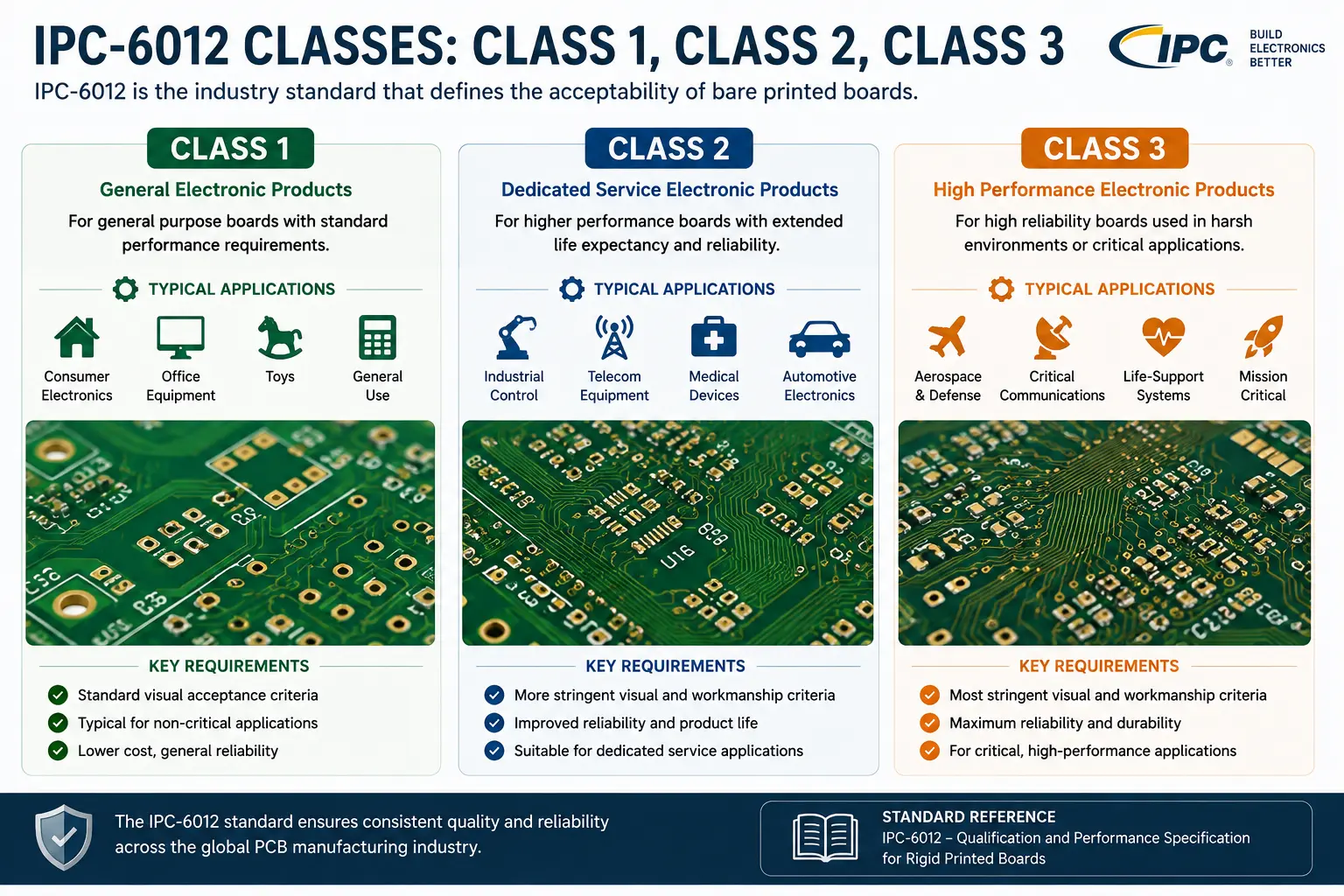
IPC-6012 divides all rigid printed circuit boards into three performance classes, each tailored to the reliability needs of the application:
Class 1 – General Electronic Products
Low-risk, consumer or hobbyist goods.
- Example: Low cost toys, remote controls, simple gadgets.
- Performance and acceptability requirements are most lenient.
Class 2 – Dedicated Service Electronics
Products where continued function and extended life are desired, but total failure is not catastrophic.
- Example: Computers, industrial controllers, telecommunications, majority of automotive non-safety electronics.
- Minor process or cosmetic defects may be allowed if performance is intact.
Class 3 – High Performance/Electronics
Mission-critical, safety, or life-support where reliability is everything!
- Example: Medical implants, aerospace controls, automotive crash sensors, military devices.
- Class 3 requirements: 0-tolerance for most defects, highest standards for plate thickness, annular ring, solder mask, and cleanliness.
Comparison of Classes
| Feature | Class 1 | Class 2 | Class 3 |
| Application Risk | Minimal | Moderate | Mission-critical |
| Annular Ring | Breakout allowed | Minor breakout | No breakout |
| Plate Thickness (PTH) | ≥20 μm | ≥20 μm | ≥25 μm |
| Solder Mask Defects | Permitted | Minor okay | Zero-tolerance |
| Testing | Functional | Functional | Thermal, cross-section, AOI/X-ray |
| Inspection | Visual sample | Per batch | 100% or statistically significant |
| Documentation | Basic | Enhanced | Traceable, comprehensive |
Class 3 products demand the highest board quality, and Class 2 and Class 3 are by far the most commonly specified in leading-edge electronics and critical applications.
Detailed Review of IPC-6012 Requirements
The requirements for rigid PCBs established in IPC-6012 section by section create a framework that touches every aspect of PCB fabrication and assembly. The performance specification for rigid printed boards ensures that every process— from copper plate to solder mask to final inspection—meets world-class expectations.
Major IPC-6012 Class 3 Requirements
1. Copper Plate Thickness
- For Class 3 PCB and especially for any PCB manufacturing in aerospace, medical, or automotive, a minimum plate thickness of ≥25μm is required for all plated through-holes (PTH).
- This plate specification is crucial for both thermal performance and mechanical reliability, as Class 3 criteria are designed to ensure performance in demanding environments.
2. Annular Ring Quality
- The annular ring is critical for ensuring stable electrical and mechanical connections.
- Class 3 requires that there is no break-out or drill wander, while for Class 2 minor break-out is tolerated if connectivity remains.
3. Inspection, Testing, and Process Controls
- To Inspect all boards, touse both automated optical inspection (AOI) and manual/visual inspection per IPC-A-600 and IPC-6012 protocols.
- Every batch must undergo cross-section (microsection) analysis, especially to check thermal cycling reliability along PTHs.
- Electrical testing is performed to guarantee continuity and the absence of shorts.
4. Solder Mask and Surface Finish Control
- Surface finish must meet the correct performance and cosmetic standards (ENIG, OSP, HASL, etc.) to ensure high solderability and board reliability.
- Rigorous registration alignment of the solder mask prevents shorts or defects, it’s also essential in class 3 PCB manufacturing.
5. Cleanliness Standards
- Strict ionic contamination and particulate cleanliness levels are enforced, the residues can cause corrosion and electrical failure.
Sample Inspection and Acceptance Criteria Per IPC-6012
| Parameter | Class 1 | Class 2 | Class 3 |
| Minimum Plate Thickness | ≥20 μm | ≥20 μm | ≥25 μm |
| Annular Ring | Breakout allowed | Slight breakout allowed | None allowed |
| Acceptable Solder Mask Pinholes | Yes | Yes, minor tolerance | None allowed |
| Cleanliness | Functional | Pass/Fail Batch | All boards |
| Microsection Required | Not always | Yes (spot check) | Yes (routine) |
IPC-6012 vs IPC-A-600: Understanding the Difference
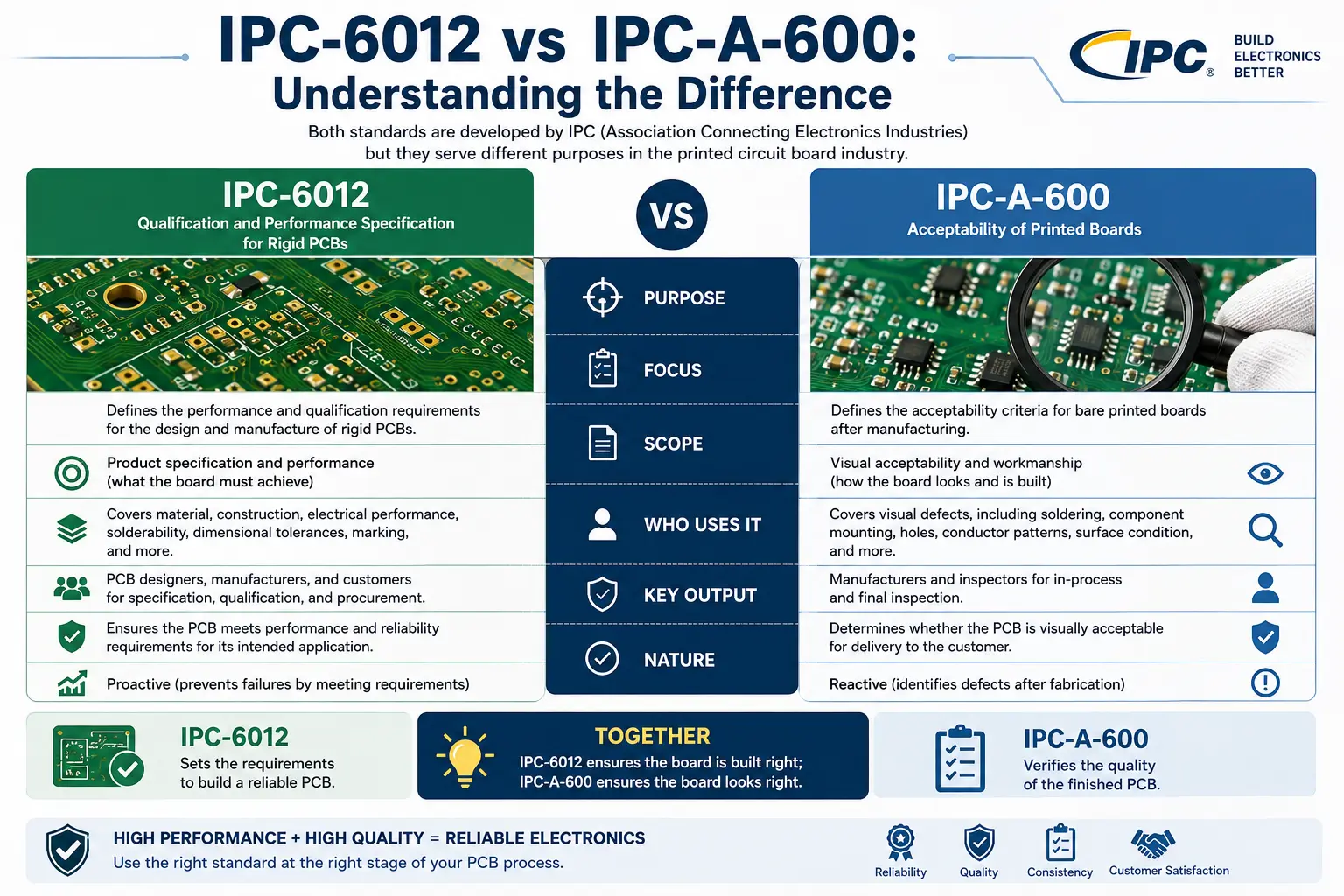
A frequent point of confusion is the difference between IPC-6012 and IPC-A-600. Both are key IPC standards, but they serve distinct roles:
- IPC-6012 is the performance and qualification standard—defining how boards should be made and the performance requirements for rigid printed boards.
- IPC-A-600 will provides the detailed visual acceptance criteria for printed boards, listing what’s visually acceptable, defective, or process-indicative.
IPC-6012 or IPC-A-600? Use Both!
For comprehensive control:
- Specify IPC-6012 for production and qualification and performance specification.
- Specify IPC-A-600 for end-item visual inspection, especially in PCB assembly and quality assurance.
Best Practice Table:
| Purpose | Use IPC-6012 | Use IPC-A-600 |
| Manufacturing Process | Yes | |
| Board Qualification | Yes | |
| Inspection/Acceptance | Sometimes | Yes |
| Visual Reference | Yes |
Compliance and Quality Assurance Under IPC-6012
Compliance with IPC standards, for example IPC-6012 is both a competitive necessity and a smart risk-management strategy in PCB produciton. Without standardized performance specifications, inspection, and documentation, it will become almost impossible to ensure quality and reliability in complex electronic assembliy.
Steps to Comply With IPC-6012 Class:
- To Use the Latest IPC-6012 Revision F: It always cite the newest revision to capture the customer’s requirements for rigid PCBs, include automotive, medical, and aerospace addenda .
- Set the Right Class (1/2/3) in Documentation: A clearly specify the required IPC-6012 class on all design, fab, and PO file.
- Incorporate Required Tests: A manufacturing process maybe include AOI, micro section, X-ray, and solder ability tests as appropriate for client’s application and class level.
- Documentation and Traceability: To maintain detailed records of every batch and lot, also include test reports, certification, images supporting acceptance criteria.
- Routine Training: To regularly train a team on both IPC-6012 and IPC-A-600 it can ensure everyone understands the standards for rigid board quality.
Practical Tips for PCB Designers and Manufacturers
- Early Engagement: Engage our PCB manufacturer early in the PCB design process to identify any risk areas and optimize for IPC-6012 compliance.
- PCB Layout Best Practices: To optimize annular ring size, avoid dense via-in-pad structures unless designed for HDI, we can always specify copper plate thickness unambiguously.
- Proactive Documentation: To keep all deviation requests in writing and clarify any acceptance criteria specific to every
- Use DFM Tools: Many PCB manufacturers can provide free DFM analysis to check design compliance with IPC-6012 and related standards.
- Regular QA Audits: Periodically audit our PCB assembly partners, to ensure ongoing adherence to process controls and standards.
Industry Examples and Case Studies
Medical Device Manufacturer (Class 3 PCB)
Since medical implants need meet strict qualification and performance requirements, one manufacturer switched to full IPC-6012 class 3 compliance. Through implementing stricter plate thickness and using consistent AOI/X-ray inspection, they reported field failure rate dropped by 70%.
Automotive Supplier (Class 2 vs Class 3)
A firm supplying ECUs to an automotive OEM used to specify Class 2 for most products. After thermal cycling and vibration failures in the field, they upgraded to class 3 PCB manufacturing per IPC-6012 revision F and saw warranty claims drop dramatically. Automotive applications require the IPC-6012FA addendum for further robustness.
Consumer Electronics Start-Up (Class 2 Board Quality)
For a new wearable, a start-up initially tried to save costs with Class 1, but after board quality complaints, they moved up to Class 2 in their rigid PCB supply. With better inspection and performance requirements for rigid, field defects vanished and reviews improved.
Frequently Asked Questions: IPC 6012 and PCB Quality
-
What is the IPC-6012 standard?
IPC-6012 means qualification and performance requirements for rigid pcb, it covers fabrication quality, materials, structural integrity, testing, then acceptance criteria.
-
What is the latest revision of IPC-6012?
The current revision is IPC-6012F,toreleased in September 2023. It supersedes IPC-6012E and updates requirements for rigid board qualification and performance.
-
What is the difference between IPC-6011 and IPC-6012?
IPC-6011 provides normal performance requirements applicable to every boards, however IPC-6012 provides specific qualification and performance requirements for rigid PCBs.
-
What is the difference between IPC-6012 and IPC-6013?
IPC-6012 applies primarily to rigid printed boards, while IPC-6013 specifies qualification and performance requirements for flexible and rigid-flex printed boards.
-
What are the key differences between IPC Class 2 and Class 3 PCBs?
Class 2 is intended for dedicated-service electronic products, it’scontinued performance are needed. Class 3 applies to high-performance products where equipment cannot be tolerated and stricter manufacturing criteria are required.
-
Are IPC-6012 requirements mandatory for PCB manufacturing?
IPC-6012 is not automatically mandatory for every PCB. It becomes a contractual requirement when specified by the customer, drawing, purchase order, or applicable industry requirement.
-
What types of PCBs does IPC-6012 cover?
IPC-6012 covers rigid PCBs including single-sided, double-sided, multilayer, plated-through-hole, blind/buried via, microvia, embedded circuitry, and certain metal-core constructions.
-
What PCB testing is covered by IPC-6012?
IPC-6012 includes requirements related to dimensional inspection, electrical testing, structural integrity, plating quality, thermal stress, and other qualification or acceptance tests for rigid PCBs.
-
What are the main IPC standards for PCB manufacturing?
A common PCB standard not only include IPC-6011 for general printed-board performance, IPC-6012 for rigid PCBs, IPC-6013 for flexible and rigid-flex boards, but also related design and acceptance standards.
-
What does IPC stand for in PCB manufacturing?
IPC refers to the electronics-industry standards organization responsible for developing, it is widely used requirements in a PCB design, fabrication, assembly, inspection, and quality control.
Conclusion: Why Following the IPC-6012 Standard Matters
IPC-6012 is the backbone of printed board reliability and quality for rigid PCBs in the electronics industry. No matter you’re manufacturing high volume consumer gadgets or safety-critical aerospace controls, we can comply with IPC-6012 (and its revision F or special addenda) for both industry standard and a mark of professionalism.
Key Takeaways:
- Always align with the latest IPC-6012 revision—such as Revision F—for your PCB manufacturing and documentation. Keep an eye out for future updates as IPC recently released additional automotive, medical, and military addenda, each with specialized performance and reliability requirements for rigid printed boards in those sectors.
- To choose the correct class (Class 1, Class 2, Class 3)it is based on customers product’s risk and real For the highest quality and critical applications, only Class 3 fulfills the strictest requirements for rigid PCB reliability and field performance.
- To understand the difference between IPC-6012 and IPC-A-600:We can Use IPC-6012 for setting fabrication, qualification and performance specification, then IPC-A-600 for practical inspection, also visual acceptance criteria.
- Document every detail: From specifying plate thickness, annular ring tolerances, and solder mask coverage to defining acceptance criteria for PCB inspection, it is very clear specs mini the production risk.
- Invest in quality assurance and continuous improvement: Proper process control, staff training in IPC standards, robust inspection, and diligent tracking of defects make the difference in long-term field reliability and customer satisfaction.
- Leverage your PCB manufacturer’s expertise: Ask help with PCB layout optimize, DFM checks, for guidance on the right IPC standards for customer’s It prove manufacturers not just comply with IPC-6012—they will help us to exceed it.
Why compliance with IPC-6012 matters: Following the IPC 6012 standard can improves the reliability of one PCB, increase global market acceptance, and demonstrates a commitment to rigid board quality. Complying with IPC can help us to gain access regulated markets and reduces some risk of costly recalls or product failures.
Final Thoughts and Call to Action
In summary: IPC-6012 is the industry standard, international language, and performance specification for rigid boards, it used in every sector of the electronics marketplace. It not only guards client’s products against common defects, but also ensures the manufacturing process, which stays ahead of reliability, regulatory, and challenges.
Through working with qualified and experienced PCB manufacturers, to set up our products—and also business—for success in an intensely competitive field.
Are you ready to take your rigid PCB reliability and quality to the next level?
- Consult with IPC-6012 experts to review your design and manufacturing process.
- Request a full DFM and IPC-6012 compliance analysis for your next printed board project.
- Download your free IPC-6012 and IPC-A-600 checklist to strengthen your acceptance criteria and ensure you’re fully prepared for any inspection or audit.
Build smarter. Build safer. Build to the highest global standard—build with IPC-6012.