

Introduction: The Evolution of Power in RC Models
Traditionally, powering radio-controlled (RC) models typically required a main motor battery, plus additional batteries to power the receiver and servos. This reliance on separate batteries not only increased the weight and complexity of the project but also directly reduced operational efficiency and flight time. As RC models become increasingly sophisticated—integrating FPV cameras, digital servos, and intelligent receivers—the need for stable power supply and stable DC voltage distribution has become increasingly urgent.
It is against this backdrop that LHD TECH focused on the research and optimization of Battery Elimination Circuits (BECs), bringing a professional and practical revolution to the RC model field. BEC circuits provide precisely matched voltages to all onboard electronics in a simple, safe, and reliable manner, completely eliminating the need for additional batteries. Today, thanks to continuous innovation in BEC technology, this solution is widely used in various RC devices, from small quadcopters to large electric aircraft, and even electric motorcycles and e-bikes, becoming an ideal power supply choice in the industry.
What is a Battery Eliminator Circuit?

A battery elimination circuit (BEC) is essentially a voltage regulator. Its working principle is to reduce the high voltage of the main battery (such as a lithium polymer battery) to a suitable low voltage to power low-voltage devices like receivers and servos in an RC model. The BEC draws DC power from the high-voltage main battery and converts it into a constant, regulated voltage (usually 5V or 6V) safe for electronic devices.
Why Is a BEC Essential?
- Eliminates the need for separate batteries for receivers and servos.
- The entire power supply system has a simple structure and is lighter in weight.
- All devices can be adapted to the appropriate voltage.
- Whether it’s fixed-wing aircraft, vehicles, ships, drones, or robots, wiring becomes simpler, safer, and more reliable.
How Does a Battery Eliminator Circuit Work?

The core of a BEC (Brain Regulator) is a voltage regulator, either a linear regulator or a switching regulator. Both types can step down the high DC voltage from the main battery to the low voltage required by the receiver and servo motor, but their operating methods differ.
Linear BECs
Linear regulators dissipate excess voltage as heat. If you connect a 12V battery to a 5V linear BEC (Bridge Regulator), with a load current of 1A, it must dissipate (12V-5V)×1A = 7W of energy as heat. While this method is simple, clean, and produces little electromagnetic interference, all the energy into heat. Therefore, linear BECs are only suitable for applications with low current and minimal voltage drop.
Switching BECs
A switching regulator (also called SBEC or UBEC) uses high-frequency electronic switching (PWM) components, an inductor, and smoothing capacitors to efficiently convert even very high input voltages to the required stable DC voltage. Switching BECs can achieve 80–95% efficiency, making them ideal for high-power applications and reducing the heat dissipation problem.
Diagram: Basic Switching BEC Circuit Flow
- Main power from LiPo battery → Switching PCB (controller & inductor) → Output terminals (5V or 6V, regulated)
Key Components in a BEC:
- Voltage regulator IC (linear or switching)
- Inductor (for SBEC/UBEC)
- Capacitor(s) for input/output smoothing
- Heat sink (for high power linear types)
- Connector plugs (servo/RX/Futaba, JST, etc.)
Types of Battery Eliminator Circuits
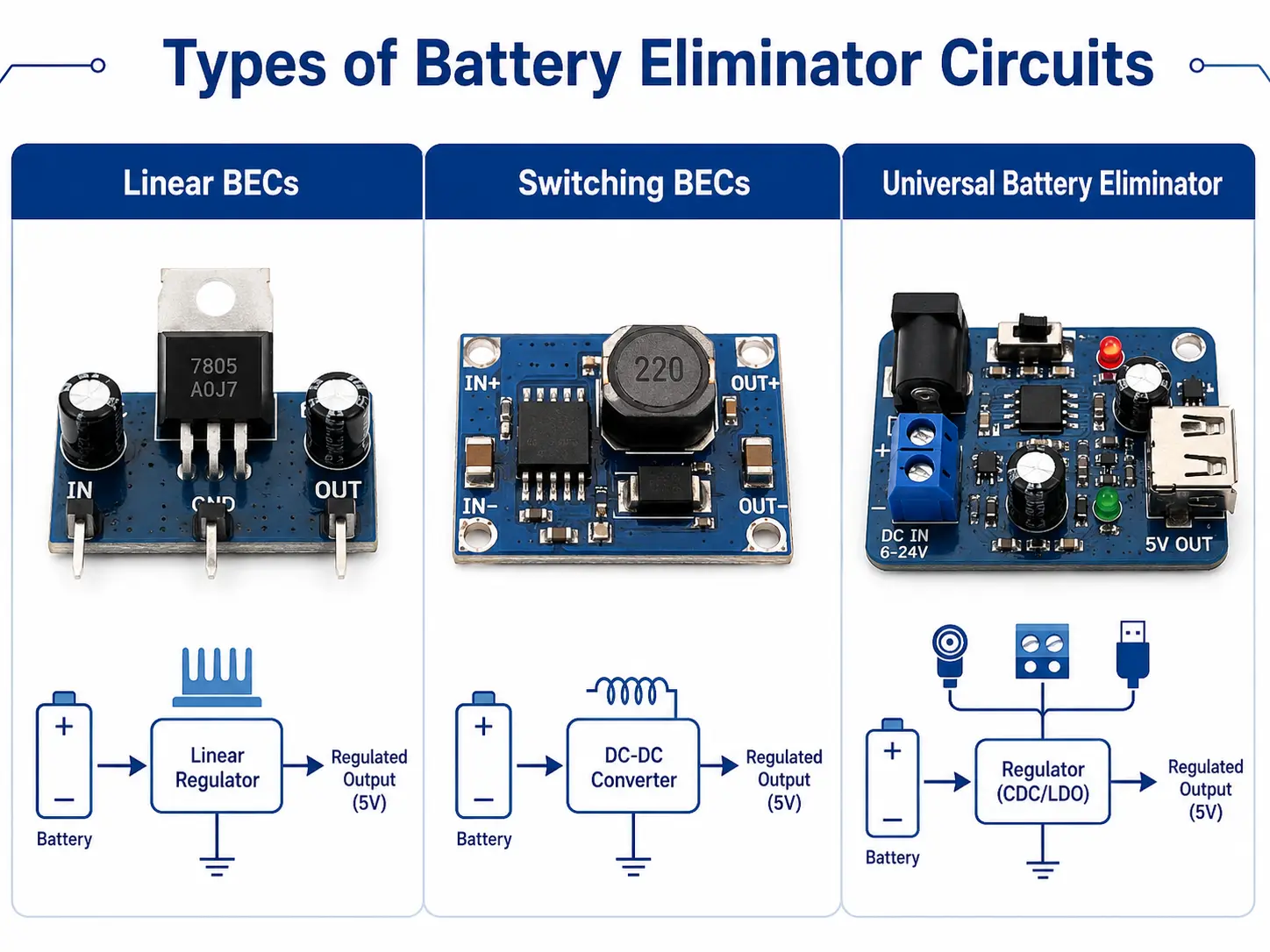
There are several types of battery eliminators available for RC models, each with different requirements and scenarios:
Linear BECs
- Ideal for: Small RC model for batteries with low voltage (e.g., ≤3S lithium batteries) and low current requirements.
- Pros: Simple circuit, interference-free, small PCB board size.
- Cons: Higher voltage results in reduced efficiency and significant heat generation.
Switching BECs (SBEC, Switching UBEC)
- Ideal for: High-power, large-scale RC airplanes, multi-rotor car models, and multi-servo model boats.
- Pros: High efficiency, low heat generation, and capable of supporting high-voltage batteries—up to 8S (around 32V).
- Cons: Complex circuit board design, slight electromagnetic interference (this problem can be eliminated if capacitors and wiring are handled properly).
Universal Battery Eliminator Circuit (UBEC)
- Often used interchangeably with SBEC
- Pros: It offers sufficient output power and selectable voltage (e.g., 5V or 6V), supporting a wide range of device types.
- Cons: However, it is expensive. If the environment has severe electromagnetic interference, careful attention must be paid to the installation location and wiring.
Table: Types of BECs at a Glance
| Type | Max Input Volt | Efficiency | Output Voltage Options | Typical Use |
| Linear BEC | 12V | 40–60% | 5V, 6V (fixed) | Small RC, single servo |
| SBEC/UBEC | 32V+ | 80–95% | 5V, 6V, 7.4V | Large RC, many servos |
Key Functions of a BEC
The functions of a BEC are vital for any modern RC model or electronic device:
- Voltage Regulation: Unaffected by the main battery voltage, it outputs a stable voltage (typically 5V or 6V), ensuring stable power supply to the device.
- Power Distribution: It provides a stable and safe voltage to the receiver and servo motors.
- Noise Filtering: The built-in capacitors and filtering circuits effectively suppress high-frequency interference and voltage spikes generated by the brushless motor and ESC.
- Brownout Protection: It prevents dangerous low-voltage drops during high-current servo motor operation.
- Thermal Management: Reliable BECs have built-in over-temperature protection and short-circuit detection functions.
Why Use a BEC Instead of Power Supplies or Separate Batteries?
- Reduces weight and complexity by eliminating extra batteries.
- Increases run time because all energy comes from the main battery.
- Ensures consistent operation by providing stable DC power under varying loads and battery voltages.
Choosing and Sizing a BEC for Your RC Model
To ensure equipment runs smoothly and without safety issues, the key is to choose the rightBEC (Best Electronic Control System).
Sizing Steps:
- List all electronic devices that will draw current from the BEC, such as receiver, all servos, gyro, FPV camera, telemetry, and any added actuators.
- Check each device’s voltage and current rating.For servos, always use the stall (maximum) current value. For digital servos, this can be 2A or more each.
- Add up the peak current draw of all devices. Add a safety margin of at least 25–50% above your calculated peak.
- Choose a BEC (or UBEC/SBEC) with a continuous current rating higher than your margin.
- Ensure the BEC supports your input battery voltage(e.g., 2S–6S LiPo). Using a BEC outside its rated input and output will lead to poor regulation or damage.
Installing and Wiring BECs in RC Power Systems
To ensure stable voltage and system safety, the installation method is crucial. There are two main common wiring methods: one is to use the BEC built into the ESC, and the other is to use a separate BEC module.
Integrated BEC (in ESCs)
Modern electronic speed controllers (ESCs) integrate a small built-in circuit control (BEC) on their boards. For some simple RC models (small airplanes, cars, boats), the built-in BEC is usually sufficient. The ESC’s signal cable is then plugged into a receiver to power the servos and other small components.
Stand-alone BECs
High-power RC models, or those using more than one ESC, heavy servos, or digital accessories, often demand an external UBEC/SBEC:
- Connect the BEC input wires to the main battery or power distribution PCB.
- Connect the BEC output wire to the receiver’s battery input or servo power bus.
- For backup, you can use two BECs along with a Schottky diode.
Important: If you have multiple BEC (Best-Chip) ESCs, only connect the red power wire from one ESC to the receiver; disconnect or remove the red wires from the other ESCs. Otherwise, the multiple regulators will conflict with each other, causing malfunctions.
BECs in Practice: Tips, Examples, and Case Studies
Wiring Example Table:
| Component | Power Source | Wiring Notes |
| Receiver | BEC output (5V/6V) | Via battery port or CH2 |
| Servo(s) | BEC output via RX | Heavy-duty wire for high-power |
| ESC | Lipo main battery | Powers motor, BEC piggybacks |
| FPV Camera | BEC or separate reg | Separate bus for less noise |
| LEDs | BEC if small, UBEC for high current | Fuse if >1A |
| Capacitor | Across BEC output | Reduces ripple, stabilizes voltage |
| Telemetry | BEC or dedicated reg | Use OSD to monitor voltage |
Advantages & Disadvantages of BECs
Advantages:
- Reduce the weight and eliminate extra batteries.
- Deliver stable voltage to the receiver and servos, improving reliability.
- Wiring is simpler, eliminating the need for separate batteries for electronic devices.
- The main battery allows for longer flight or operating time and improves energy efficiency.
- It is safer and has fewer points of failure compared to using separate battery packs and switches.
Disadvantages:
- Linear BECs are unsuitable for high-current, high-voltage applications, as they are prone to overheating and power outages.
- The BEC integrated into the ESC (Electronic Speed Controller) lacks sufficient power.
- Inexpensive BECs have poor filtering, resulting in electromagnetic noise that can cause remote control signal interruptions.
- The selection and installation of the BEC determine the reliability of the system.
UBECs, SBECs, and BECs: A Comparison
Universal Battery Eliminator Circuit (UBEC):
- Choosing a switching type BEC offers high efficiency and low heat generation.
- It can be directly connected to high-voltage batteries, supporting up to 8S lithium batteries and even higher.
- The output voltage is selectable or programmable, commonly available in 5V, 6V, and 7.4V, allowing for flexible matching with different devices.
- This type of BEC is particularly widely used in FPV, large aircraft, robots, and model cars and ships.
Switching BEC (SBEC):
- A switching regulator BEC
- Similar to UBEC, but may have fixed output or fewer options
- Good choice for efficient conversion from powerful batteries
Regular BEC:
- Often refers to linear or simple switching type
- Fixed voltage, less suitable for high-power, high-voltage systems
Table: UBEC vs. SBEC vs. Linear BEC
| Feature | Linear BEC | SBEC | UBEC |
| Efficiency | Low | High | Highest |
| Input Voltage | ≤12V | Up to 26V+ | Up to 32V+ |
| Output Voltage | 5V, 6V | 5V, 6V (fixed or selectable) | 5V, 6V, 7.4V |
| Use Case | Small models | High power | Universal (any RC) |
| Weight/Size | Light | Compact | Compact |
Advanced Applications and Future Trends
More and more RC models are integrating telemetry, multi-channel receivers, digital servos, and FPV, and the design of the power supply controller (BEC) is constantly evolving:
- Smart BECs: It can transmit current, voltage, and temperature data back to the remote controller.
- Dual-output BECs: It can provide two independent voltage channels (5V or 6V) to the servo motor and receiver respectively, without interference.
- Waterproof/potted BECs: It is specifically designed for model boats, off-road vehicles, or all-weather flight environments.
- PCB-integrated BECs: It is commonly found on high-end flight control boards used in drones and multi-rotor aircraft, and is directly integrated into the PCB.
FAQs about Battery Eliminator Circuits
Q: Can I run my receiver and servos without a BEC using just a step-down transformer or rectifier?
A: No, that’s unsafe and inefficient. Only truly reliable voltage regulators can provide electronic devices with the stable voltage and current they need.
Q: Why can’t I use a power supply instead of a BEC in my RC airplane?
A: Power supplies are for AC to DC conversion. BEC battery eliminator circuits are for DC to lower DC voltages, directly from your LiPo or main battery, on board your RC model.
Q: Can a single BEC power several digital servos and an FPV setup?
A: Yes, you can choose a high-current UBEC, first add up the current of all devices to calculate the total, then wire the circuit properly and add capacitors for filtering to stabilize the voltage.
Q: Do UBECs output “exactly” 5 volts or 6 volts?
A:A good UBEC output voltage can generally be stable within ±0.1V. Especially under load, you can actually measure it at the output terminal with a multimeter.
Conclusion: Is a BEC Right for Your Project?
If you want your RC model to have a modern and reliable power system—eliminating the need for a separate battery, reducing weight, and providing stable power to the receiver and all servos—choosing the right Battery Elimination Circuit (BEC) is crucial. LHD TECH has always excelled in BEC solutions: whether you’re using a linear BEC on a small glider, a high-power UBEC on a large RC aircraft with numerous servos, or integrating a switching BEC into a drone’s flight control board, you’ll experience higher efficiency, better safety, and complete peace of mind.
Our BEC solution ensures that every servo, receiver, and sensor in your RC model or robotics project receives the voltage it needs—whether you’re using an ESC with a built-in BEC or a separate general-purpose BEC. As RC and electronic devices become increasingly complex, choosing a reliable BEC is no longer just a “bonus,” but a key factor in ensuring stable power supply and optimal performance. In this regard, LHD TECH remains a trustworthy choice.