

Introduction to the BC547 Transistor in Electronics
The bc547 transistor is a basic building block in modern electronics, it offering both amplification and switching in a variety of circuits. As one of the most popular npn bipolar junction transistors (BJTs), the bc547 transistor stay within the broader 547 transistor family—it’s a group renowned for versatility and reliability. No matter you’re starting out in electronics or want to design a complex circuits, you need to know how the bc547 transistor operates is important.
If you’re working with sensors, amplifiers, or logic interfaces, you’ll need a reliable switch for low-power loads, the bc547 transistor should be the first one in the component list.
Transistor Types and the 547 Transistor Family
There are two basic transistor types: NPN and PNP. The 547 transistor family will includes NPN transistors (like the bc547 transistor),although complementary PNP types like the bc557 exist.
547 Transistor Types Table
| Name | Type | hFE Gain Range | Package | Common Applications |
| BC547A | NPN | 110–220 | TO-92 | Switching, low gain amps |
| BC547B | NPN | 200–450 | TO-92 | General purpose, sensors |
| BC547C | NPN | 420–800 | TO-92 | High-gain, weak signal amps |
| BC557 | PNP | 110–800 | TO-92 | Power inverters, audio |
| Other 547 | NPN | 100–800 | TO-92 | Similar roles |
The types of 547 transistors is different primarily in the current gain (hFE). This variation can allow a designer choose the perfect transistor for a circuit application.
What is a BC547 Transistor?
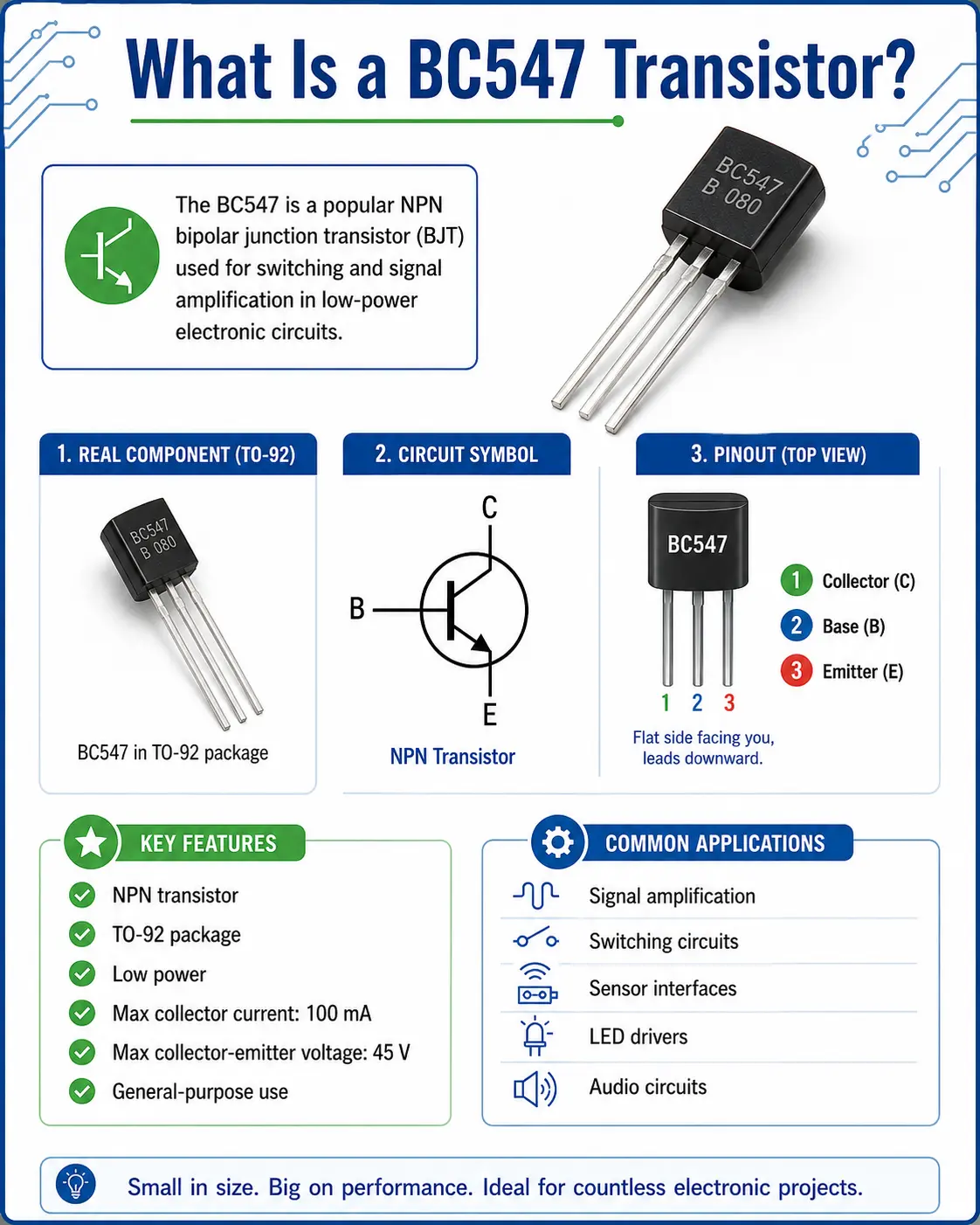
The bc547 transistor is an NPN bipolar junction transistor, it commonly used in linear and digital circuits. It’s part of the 547 transistor family, it also offers a range of gain levels and excellent performance at low power. As an NPN BJT, the bc547 receives a signal at its base, it controls the flow from collector to emitter.
Key Points
- The bc547 transistor operates in both an amplifier and a switch.
- It is good in electronics because of the high gain, low noise, it works steady performance in small current and voltage ranges.
- The bc547 transistor comes in a TO-92 plastic package, with a straight forward pin out.
Parameters of BC547 Transistor: Datasheet and Features
If you’re designing or repairing electronics, to knowing the parameters of bc547 transistor from its data sheet can help us ensure reliable performance:
BC547 Transistor Features Table
| Feature | Value/Range | Unit | Notes |
| Collector-Emitter Voltage (Vce) | 45 | V | Maximum voltage collector to emitter |
| Collector-Base Voltage (Vcb) | 50 | V | Maximum between collector & base |
| Emitter-Base Voltage (Veb) | 6 | V | Maximum base-emitter voltage |
| Collector Current (Ic max) | 100 | mA | Maximum continuous current |
| Total Power Dissipation | 500 | mW | Keep the transistor within safe temp |
| DC Current Gain (hFE) | 110 to 800 | — | Depends on gain group (A/B/C) |
| Transition Frequency (ft) | Up to 300 | MHz | High enough for RF and audio |
| Operating Temperature | -65 to 150 | °C | Safe junction temperature range |
| Package | TO-92 | — | Compact, standard, easy to use |
What Makes the BC547 Ideal?
- Low-power usage means less heat and increased longevity.
- The range from 110 to 800 hFE allows selection for weak signal or higher current needs.
- RoHS compliant, making it safe for the environment.
- High input impedance ensures the circuit does not load input sources.
BC547 Transistor Pinout and Package
Pin configuration is essential for using the bc547 transistor in any circuit.
The TO-92 Package:
When looking at the flat side of the transistor, pins down:
- Pin 1: Collector (C)
- Pin 2: Base (B)
- Pin 3: Emitter (E)
- Collector terminal of transistor Q3: Typically connected to supply via a load resistor.
- Base of transistor Q3: Receives input signal through a resistor.
- Emitter terminal: Usually grounded.
This simple arrangement makes the bc547 very easy from prototype to a breadboards and PCBs.
How the BC547 Transistor Works
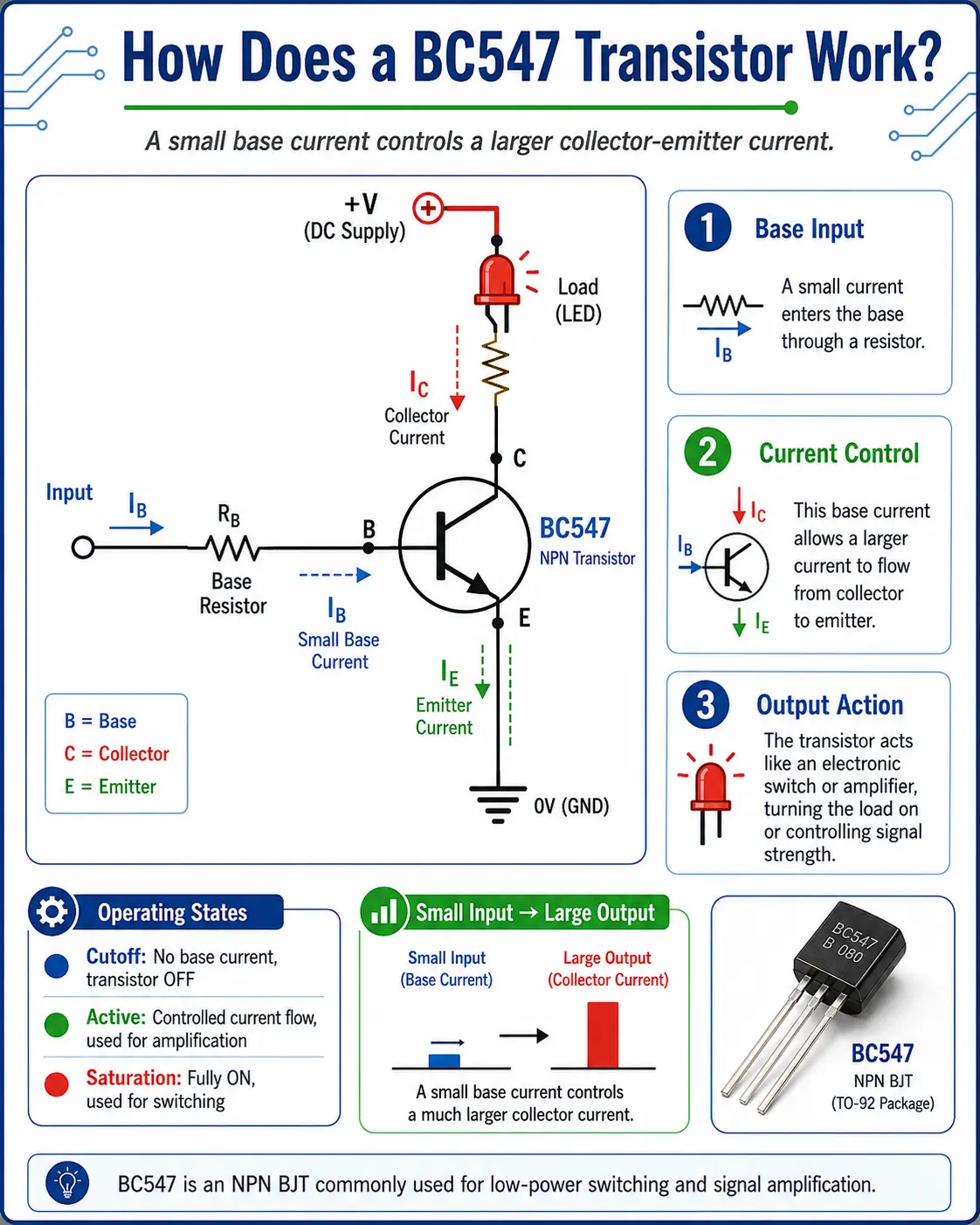
The bc547 transistor works as a NPN bipolar junction transistor. A tiny feed current into the BC547’s base lets substantially bigger current pass between collector and emitter. With no base input current, this transistor stays off similar to an open switch; once base gets drive current, it conducts like a closed switch to complete collector-emitter current flow.
Step-by-Step Operation
- No Current at Base: The transistor acts as an open switch, blocking all current across collector and emitter terminals.
- Input Signal Applied to Base: A small base current turns the component into active mode, enabling current passage from collector toward emitter.
- Transistor Saturation: Sufficient base drive fully switches the transistor on, leaving only a minimal near-zero voltage drop between collector and emitter.
Using the BC547 Transistor in Electronics Circuits
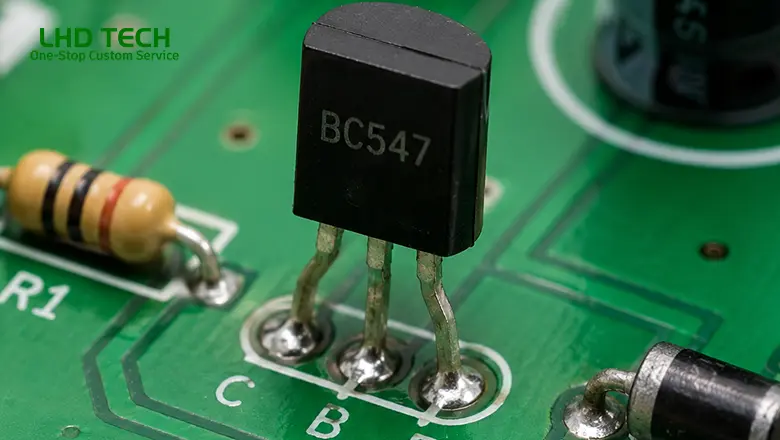
Using the bc547 transistor across a range of electronics circuits is straightforward.
How to Use BC547 Transistor
Select the Right hFE (Gain Group): For switching tasks, a lower gain (110–220, e.g., BC547A) is often sufficient and stable. For amplification of weak signals, we can use a higher gain group (up to 800 for BC547C). its flexibility can makes the BC547 transistor ideal, then across many electronics projects in the 547 transistor familis.
Properly Bias the Transistor: Always use a base resistor to limit the current and protect the transistor. The size is the base resistor, it depends on your intended collector current (Ic) and expected current design.
Configure the Circuit for Your Application:
- In switching circuits, connect the load between collector and power, with emitter to ground.
- In amplification circuits, it can connect input signal (with a coupling capacitor) to the base, bias with resistors,then will take output via collector.
Key Considerations
- The bc547 transistor offers stable performance, also can handle signal currents up to 100mA—it’s perfect for sensors, audio, and digital electronics.
- Since the transistor operates efficiently at voltages below 45V, which is designed as a low-power device, it’s rarely a thermal hazard used properly.
- Substitute the BC547 only with similar NPN transistors (e.g., BC337 if you need higher collector current).
BC547 Transistor as an Amplifier
One of the chief transistor functions of the BC547 is amplification. The bc547 transistor amplifies small input signals, making it invaluable as an audio pre-amplifier or sensor signal conditioner.
Example: Audio Pre-Amplifier Using BC547 Transistor
- Input Signal is applied to the base via a coupling capacitor and series resistor.
- The base-emitter voltage (Vbe) forward-biases the junction, it usually causing current to flow from collector to emitter.
- A load resistor on the collector not only allow the amplified output but also be taken as a voltage drop across the resistor.
- HFE (Gain) values for the BC547 range from 110 to 800, ensuring enough amplification for even weak signals from microphones or piezo sensors.
Typical Values in Audio Circuits:
| Component | Typical Value |
| Base Resistor | 22kΩ – 56kΩ |
| Collector Load Resistor | 1kΩ – 10kΩ |
| Emitter Resistor | 470Ω – 1kΩ |
| Coupling Capacitor | 10μF |
BC547 Transistor as a Switch
A vital use case for the bc547 transistor in electronics is switching.
Example: LED Driver or Relay Circuit
- Input (e.g., from Arduino or sensor) applied to the base of transistor Q3 through a resistor.
- When the base of transistor Q3 is pulled high, the transistor conducts, and current flows from the collector terminal of transistor Q3 through the LED or relay coil, down to emitter and ground.
- Without input (base pulled low), the transistor acts as an open switch—no collector current flows.
Key Tips for Switching Circuits:
- Always place a fly back diode across relay coils to protect against voltage spikes.
- Use a BC547 for loads up to 100mA; for higher, opt for another NPN transistor (like 2N2222).
What Makes the BC547 Ideal for This Role?
- Its fast response and low input current requirements are perfect for microcontroller outputs.
- The bc547 is widely used for turning on LEDs, alarms, or relays in logic and sensor circuits.
- Its low saturation voltage ensures minimal voltage and current waste when ON.
Checking and Testing the BC547 Transistor
Reliability in electronics depends on knowing your parts are good. Check BC547 transistor health with a multimeter or tester.
Multimeter Diode Test (Basic method)
- Test Base-Emitter Junction: Put red probe on base, black on emitter – should read 0.6–0.7V.
- Test Base-Collector Junction: Red on base, black on collector – similar 0.6–0.7V.
- Reversed probes: Both should show open.
- Collector-Emitter: Both directions, should show open (high resistance) unless damaged.
Using hFE Mode
- Place pins in hFE socket on a digital multimeter.
- Compare measured gain to datasheet for your gain group (110–800).
BC547 Transistor vs 2N2222 and Other NPN RJTs
The bc547 transistor vs 2n2222 comparison is common:
| Feature | BC547 Transistor | 2N2222 Transistor |
| Max Collector Current | 100mA | 600mA |
| Max Vce | 45V | 40V |
| Gain (hFE) | 110–800 | 35–300 |
| Common Use | Signal, audio, weak signal | Power, relay drivers |
| Package | TO-92 | TO-92/TO-18 |
- BC547 is best for low-power, high-gain applications.
- We can choose 2N2222 if customer’s need higher collector current or drive power.
If customer need a drop-in alternative, we can choose another NPN transistor with similar pin out and ratings.
Common Circuits Using the BC547 Transistor
Here are some basic electronic circuits which we can build using the BC547 transistor:
- Touch Switch: Controls an LED or buzzer—sense minimal touch current.
- Light-activated Relay: Uses a photo resistor and BC547 to drive a relay based on ambient light.
- Water-level Alarm: Probes detect water; signal triggers BC547 to sound a buzzer.
- Audio preamp: Amplifies microphone signals for ADCs or speakers.
- PWM Motor Controller: We can use the BC547 to drive small motors or fan speed via pulse-width modulation.
- Crystal Oscillator: BC547 as part of an oscillator for clock circuits.
Characteristics of the BC547: What Makes the BC547 Ideal?
The characteristics of the bc547 that make it a popular choice include:
- High current gain (hFE range from 110 to 800) for signal amplification even of weak signal sources.
- Low-power operation for efficient circuit design in sensor networks, audio gear, and digital logic.
- Fast switching—bc547 switches in less than 1μs, making it useful in oscillators and digital pulse circuits.
- TO-92 package: Reliable, easy to mount, and excellent for breadboarding and prototyping.
- Longevity of the bc547: Rugged and tolerant if properly biased and within ratings.
- High input impedance: Does not load previous circuit stage.
Why Rely on the BC547? It’s incredibly versatile, readily available, and rarely fails under proper use.
Frequently Asked Questions About 547 Transistors
Q: What is the maximum collector current the BC547 transistor can handle?
A: 100mA max continuous; which never exceed data sheet rate.
Q: Can I use the bc547 transistor as a direct switch for a 12V relay?
A: Only for low -current relays (<100mA coil). For higher currents, we can use a 2N2222 or BC337.
Q: Why does my BC547 heat up?
A: Overloaded collector current or a high power dissipation. We always use base and collector resistors per calculated max.
Q: What’s the difference between the types of 547 and bc547 transistor vs bc557?
A: BC547 is NPN, BC557 is PNP (complementary). In order to choose NPN or PNP, it depending on whether you need switching on high or low logic.
Q: How do I check a bc547 transistor on a breadboard?
A: To apply a base resistor and try driving an LED or small output. If the current flow results in output, our transistor is good.
Expert Tips for Working with the BC547 Transistor
- Keep the transistor cool: BC547 is a low-power NPN transistor, and laying out extra copper pad around its footprint on PCB helps dissipate working heat and prolong service life. Avoid dense grouping of these parts for high duty-cycle applications without proper natural airflow.
- Proper lead dress: When amplifying tiny input signals, shorten base and emitter wiring wherever possible to mini stray noise on sensitive circuitry. Run all input signal lines with shielded wire to improve signal-to-noise ratio, an essential design point for audio and sensor circuits.
- Reinforce reliability with good biasing: Work out base resistance and collector load values manually or through circuit simulation to match BC547’s electrical specs. Too little bias causes unstable amplification or imperfect switching; excess bias will overheat the transistor in service.
- Parallel operation and Darlington pairs: Wire two BC547 devices into a Darlington pair to boost gain or output current. This configuration handles ultra-weak input signals perfectly and fits the front-end of low-signal sensor circuits.
- Protect sensitive bases: For BC547 input stages connected to microcontroller digital circuits, solder a 100Ω~1kΩ resistor in series with the base pin. The resistor clamps sudden voltage spikes and shields the base from accidental electrostatic discharge damage.
- Common emitter amplifier stabilization: Mount a 100nF to 1μF decoupling capacitor between one collector power supply and grounded. The capacitor will supply ripple and stable amplifier output, its very important for audio amplifier builds.
- Replacing or substituting the BC547: In order to switch to NPN types like BC337 or 2N2222 when higher operating current is required. It always cross-check pin assignments first, TO-92 packaged transistors will have inconsistent pin layouts. The BC547 is highly adaptable for general use, but proper design always accounts for its rated operating boundaries.
Conclusion: Why the BC547 Transistor is Widely Used in Modern Electronics
The BC547 transistor is a champion of flexible, robustness, also ease of use. Thanks to its wide range, efficiency at low power, then suitability in both signal and switching applications, it remains a best-seller in the 547 transistor field.
When we use the BC547 transistor in a projects, you know you are working with a device, for electronics professionals have trusted for decades. The parameters are steady, its performance is predictable, and the role—no matter amplification or switching—it remains important even as technology advances.
Key takeaways:
- The BC547 transistor operates not only an amplifier of weak signals but also as a reliable, fast-acting switch in countless electronics boards.
- Properly bias the transistor, we can keep the transistor cool, select the correct gain group, always tailor resistor values to people’s specific application to optimize longevity and performance.
- Its TO-92 package and high input impedance not only make circuit assembly straightforward, while its RoHS compliance and global standardization ensure safety and availability.
- When experimenting—for example a circuits involving the collector and emitter, or multi-stage amplifiers—we always check BC547 transistor parameters, to use the transistor within its rated specification, and confirm correct pin out assignment.
- Whether you using the BC547 transistor in a breadboard prototype or regarding part of a mass-produced device, it will
In summary: The BC547 transistor is one of electronics’ greatest “unsung heroes,” faithfully amplifying, switching, enabling inventions both simple and sophisticated. It is a good choice for beginners to learn about transistor types, also can experienced engineers executing production designs, everyone in between a values reliability in their recipes for innovation.