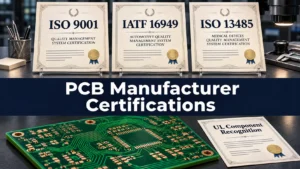

Every PCB supplier shows a row of logos. Few buyers know what each one covers and who issued it. There is also a need to know whether it applies to the factory that will build their boards.
PCB manufacturer certifications fall into two groups. The first is quality management certificates, which audit how a site operates. The second is product recognition, which evaluates the board itself.
This guide explains which PCB manufacturer certifications to ask for based on your application and how to check that they cover your supplier’s factory or your specific board design.
Why Certifications Shouldn’t Be Ignored
A certificate is the quickest way to see whether an outside auditor has examined a supplier’s processes. Auditors return on a schedule. For example, an IATF 16949 certificate runs on a three-year cycle with surveillance audits at least once a year. That gives you a record of ongoing checks, which a supplier’s own description of its quality system cannot match.
Your market may also require PCB supplier certifications. Most automotive OEMs and Tier 1 suppliers expect IATF 16949 from their PCB suppliers. The FDA’s Quality Management System Regulation, effective since 2 February 2026, incorporates ISO 13485 by reference. Many end-product standards also call for UL Recognized boards, so the board’s UL file can decide whether your finished product passes certification.
Skipping the check can cost more than the check itself. A supplier that lacks the certification your program needs can force costly re-qualification in the middle of a project, which means new audits and new samples, followed by a lost schedule.
PCB manufacturer certifications also give your quality team a common starting point for supplier audits, though each one still needs a scope check. The verification steps later in this guide show how to do that quickly.
Two Kinds of Certificates
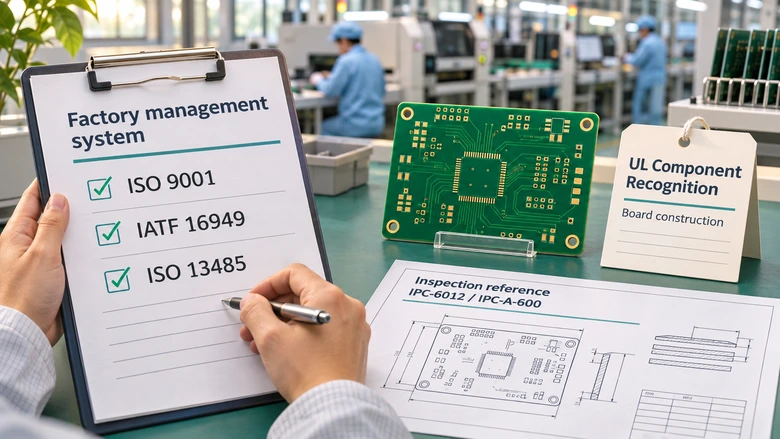
Most PCB certifications tell you about the factory’s management system. ISO 9001 covers general quality management, while IATF 16949 and ISO 13485 address automotive and medical requirements. An independent certification body audits the operations listed in the certificate’s scope.
UL Component Recognition works in a different way. It applies to a particular board construction from an identified manufacturer under specified conditions.
You still need to specify what makes a board acceptable. IPC-6012 defines qualification and performance requirements for rigid PCBs. IPC-A-600 helps inspectors assess conditions they can see on the board surface or examine in a cross-section. State the required class on the fabrication drawing so the supplier knows what to quote and your receiving team knows what to accept. Our guide to IPC-6012 and IPC-A-600 explains how the two standards work together.
ISO 9001 for General PCB Manufacturing
ISO 9001 PCB certification is usually the first certificate to request for commercial and industrial electronics. It is the general quality management standard. This certificate shows that an independent auditor found documented processes, internal audits, and corrective action routines in place. It says nothing about how tight a supplier’s tolerances are or which IPC class it builds to.
ISO published ISO 9001:2026 on 16 September 2026. The transition period runs through 30 September 2029, so a supplier may still present a valid ISO 9001:2015 certificate. The 2015 certificate is no red flag today. Certification bodies must first obtain accreditation for the new edition before they can issue 2026 certificates, so ask a supplier when it plans to transition.
IATF 16949 for Automotive PCB Suppliers
IATF 16949 incorporates ISO 9001 requirements and adds stricter quality controls for automotive manufacturing. It covers automotive core tools and requires manufacturers to follow applicable customer-specific requirements. This certification is relevant for PCBs used in engine control systems or battery management electronics, where manufacturing defects can have serious consequences.
IATF 16949 certification applies to individual manufacturing sites and must be issued by an IATF-recognized certification body. Certificates are valid for three years, with annual surveillance audits required to maintain certification. Buyers should verify that the certificate covers the actual production site and that its scope includes the relevant PCB manufacturing activities.
ISO 13485 for The Medical PCB Assembly
ISO 13485 is the international quality management standard for medical device organizations. It places greater emphasis on traceability and risk management throughout medical PCB production, with stricter documentation requirements than ISO 9001. The standard also reaches the US market because the FDA Quality Management System Regulation became effective on 2 February 2026 and incorporates ISO 13485:2016 by reference.
A supplier certificate has limits. QMSR compliance belongs to the device maker, and a supplier certificate does not replace it. Scope is the second catch. A certificate scoped to contract manufacture of electronic assemblies is not interchangeable with one scoped to soldering of circuit boards, and neither automatically covers a sister plant. Some suppliers hold ISO 13485 at the assembly PCB factory while the fabrication plant holds only IATF 16949 and ISO 9001.
UL Recognition for the Board Construction
UL evaluates the board as a component. UL 796 covers standard rigid, metal-based and HDI boards, and UL 796F covers flexible and flex-rigid constructions. Rigid boards sit under category ZPMV2 and flexible ones under ZPXK2.
The recognition belongs to the fabricator and not to your design, and the E-file number ties to specific factories/materials and constructions. A UL-recognized laminate does not make the finished board recognized, because materials and boards are separate categories. Each file lists the rated flame class and maximum operating temperature, along with solder limits for its constructions.
Verify the file in UL Product iQ, and confirm that your layer count and materials fall inside its scope. The board marking should show the fabricator’s identifier, file number, and type designation. Never place a UL logo or E-number in your own silkscreen, because that is another company’s file.
Other Credentials You May See
- ISO 14001 — Environmental Management: Your purchasing policy may require evidence that the PCB factory manages its environmental impact. ISO 14001 covers the site’s environmental management system. Check that the certificate includes the plant responsible for etching and plating.
- AS9100 — Aerospace Quality Management: An aerospace customer may require AS9100 before approving a PCB supplier. The certificate covers the quality management system for the sites and activities listed in its scope. Check the manufacturer’s record in the IAQG OASIS database, especially if your order includes both fabrication and assembly.
- RoHS — Restricted Substances in Electronics: If your finished product falls under EU RoHS rules, you will need evidence that the board meets the applicable substance limits. RoHS restricts certain substances in electrical and electronic equipment. Ask for a declaration that identifies the supplied PCB or complete assembly and lists any exemptions the supplier relies on.
- REACH — Substance Disclosure: A REACH declaration helps you determine what substance information you need to pass on to customers. Suppliers must disclose Candidate List substances present above 0.1% by weight in an article. That threshold applies to individual articles within an assembly, so ask for a dated declaration naming the product and the Candidate List version used.
- IPC-A-610 and J-STD-001 — PCB Assembly Workmanship: These PCB supplier certifications give your supplier and receiving team a common basis for accepting assembled boards. IPC-A-610 defines assembly acceptance criteria. J-STD-001 sets requirements for soldered assemblies. State the required class on your purchase order and clarify whether an IPC credential covers personnel training or facility qualification.
After knowing which PCB manufacturer certifications your project requires, you can use them to narrow your search. Our guide to the top 10 PCB manufacturers can help you build a shortlist. Before choosing a supplier, ask for current documents showing which factory is covered and how the proposed board meets your requirements.
How to Verify a PCB Manufacturer’s Certificate
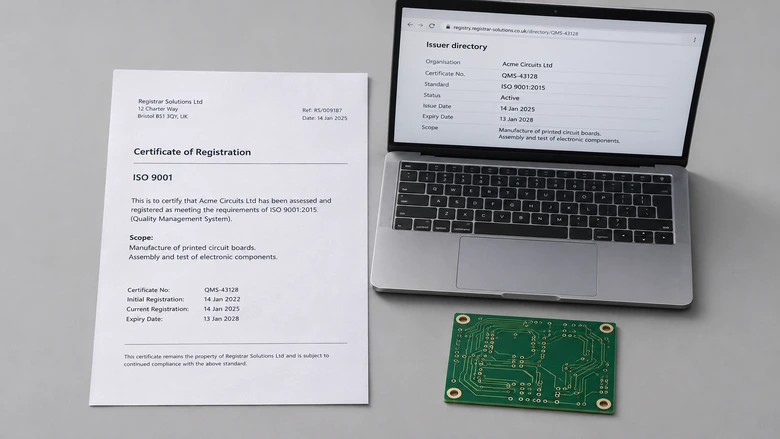
- Match the site: Check the factory address on the certificate. If fabrication and assembly happen at different sites, verify each one.
- Read the scope: Confirm that the certificate covers the work you are ordering. Check the appendix for additional sites.
- Verify its status: Confirm the certificate is current with the issuer. Use the IATF Certificate Validity Check for automotive sites. For UL recognition, verify the file number and board type in UL Product iQ.
- Keep a copy: Save the verified record with your quote so you can recheck it if the supplier changes factories or materials.
Conclusion
The right PCB manufacturer certifications depend on where your board will be used and what your customer requires. ISO 9001 is a useful starting point for commercial projects. When your customer specifies an industry standard, check that the certificate covers the factory doing the work. If the design calls for a UL Recognized board, verify the quoted construction against the fabricator’s UL record.
At LHD TECH, our management system credentials include ISO 9001, ISO 14001, and IATF 16949. We publish our PCB recognition under UL file E316475 and use IPC-A-610H to assess assembly workmanship. Our product compliance information also covers CE marking, RoHS, and REACH.
We fabricate PCBs and source components for SMT and through-hole assembly. We also offer automated optical inspection, X-ray inspection, and functional testing. Send us your fabrication drawing and certification requirements so we can confirm which credentials cover your build and prepare a customized quote.