
Introduction
In electronics manufacturing, the demand of transparency, security, and instant access to information, it has pushed the boundaries of PCB identification. Since some supply chains expand worldwide and regulatory standards tighten, their traceable serial numbers and production data go into every printed circuit board (PCB) have become not just a best practice but it is a competitive necessity.
This is why QR code PCB solutions and data matrix codes are now standard in everything from consumer devices to regulated healthcare items. These flexible, precise markings allow PCBs—and even entire assemblies like PCBA—to be tracked across the globe with a simple scan, transforming not only product identification but also the possibilities for warranty, recall, and supply chain innovation.
What is a QR Code PCB and Why Does It Matter?
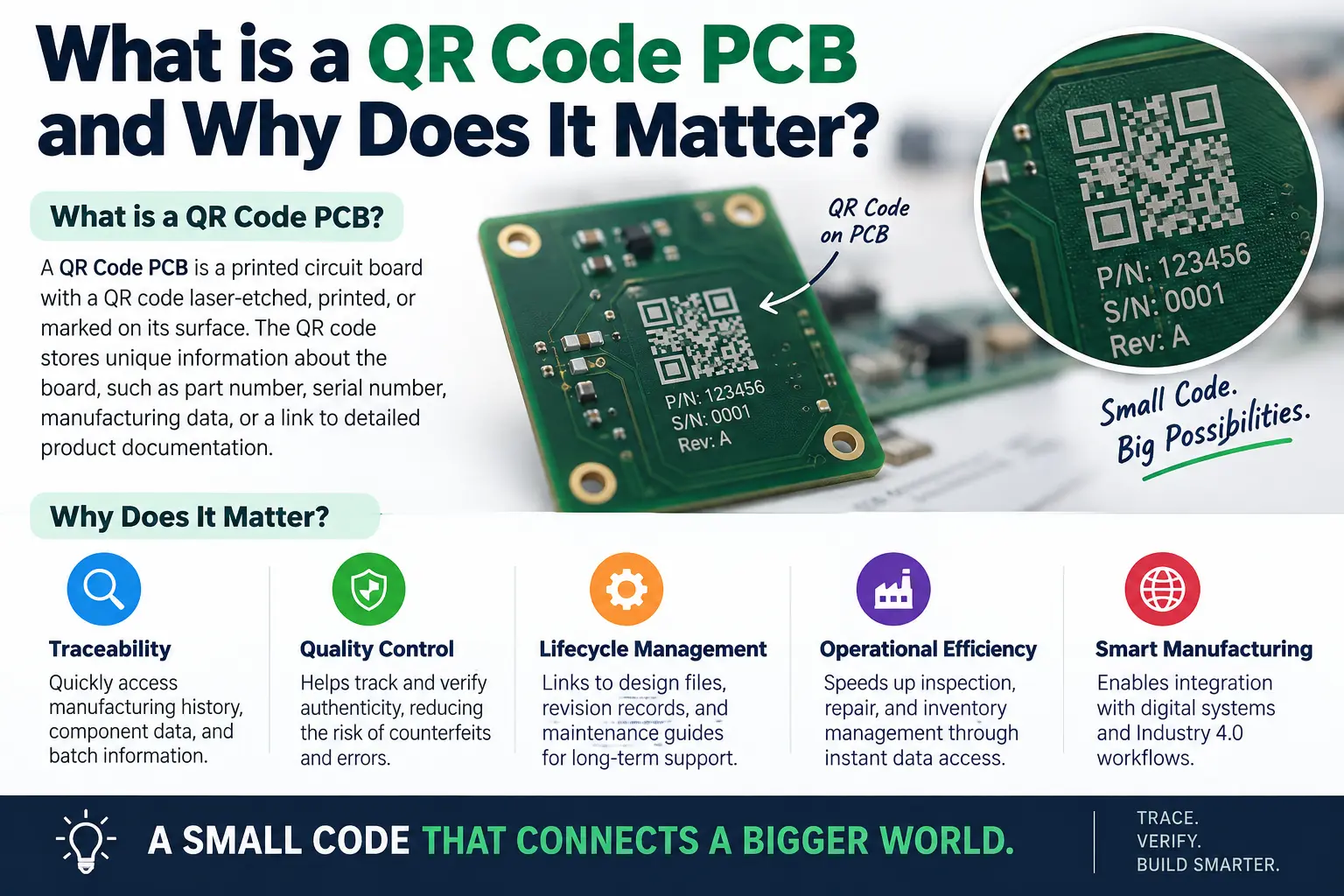
A QR code PCB is a printed circuit board featuring a machine-it readable code, typically a 2D code for example a QR code or Data Matrix, applied directly to the PCB surface during fabrication or assembly. These unique codes can encode very vital manufacturing data—from serial numbers and batch IDs to direct URLs for one online support.
Why QR and Data Matrix Codes?
- QR codes are often used when consumer readability is needed; they are fast, robust, and easily read by smartphones, making them ideal for applications like warranty activation in consumer-facing applications.
- Data Matrix codes excel in space-constrained industrial settings thanks to their small size and error correction features, which is critical for small electronic components.
By leveraging these codes, manufacturers can provide traceability for all circuit boards, from BOM (Bill of Materials) data to reflow process tracking and end-user support. Codes also tie directly into the genealogy of each product, allowing instant recall and problem isolation at the lot or serial level.
Expanded Example: Beyond Traditional PCB Traceability
Modern electronics factories no longer rely only on inked numbers or adhesive barcodes. Today, to using a laser marking machine or advanced inkjet printers, a good secure QR or Data Matrix can be applied—in order to persisting through reflow soldering, chemical washes, and years of service.
Industry-Driven Standards
Entities like a GS1, ECIA (Electronic Components Industry Association), and IPC govern how can PCB be marked for global trace ability or regulatory compliance, with 2D codes,it mandated for medical device and aerospace markets.
The Benefits of QR Code PCBs in Manufacturing & Lifecycle Management
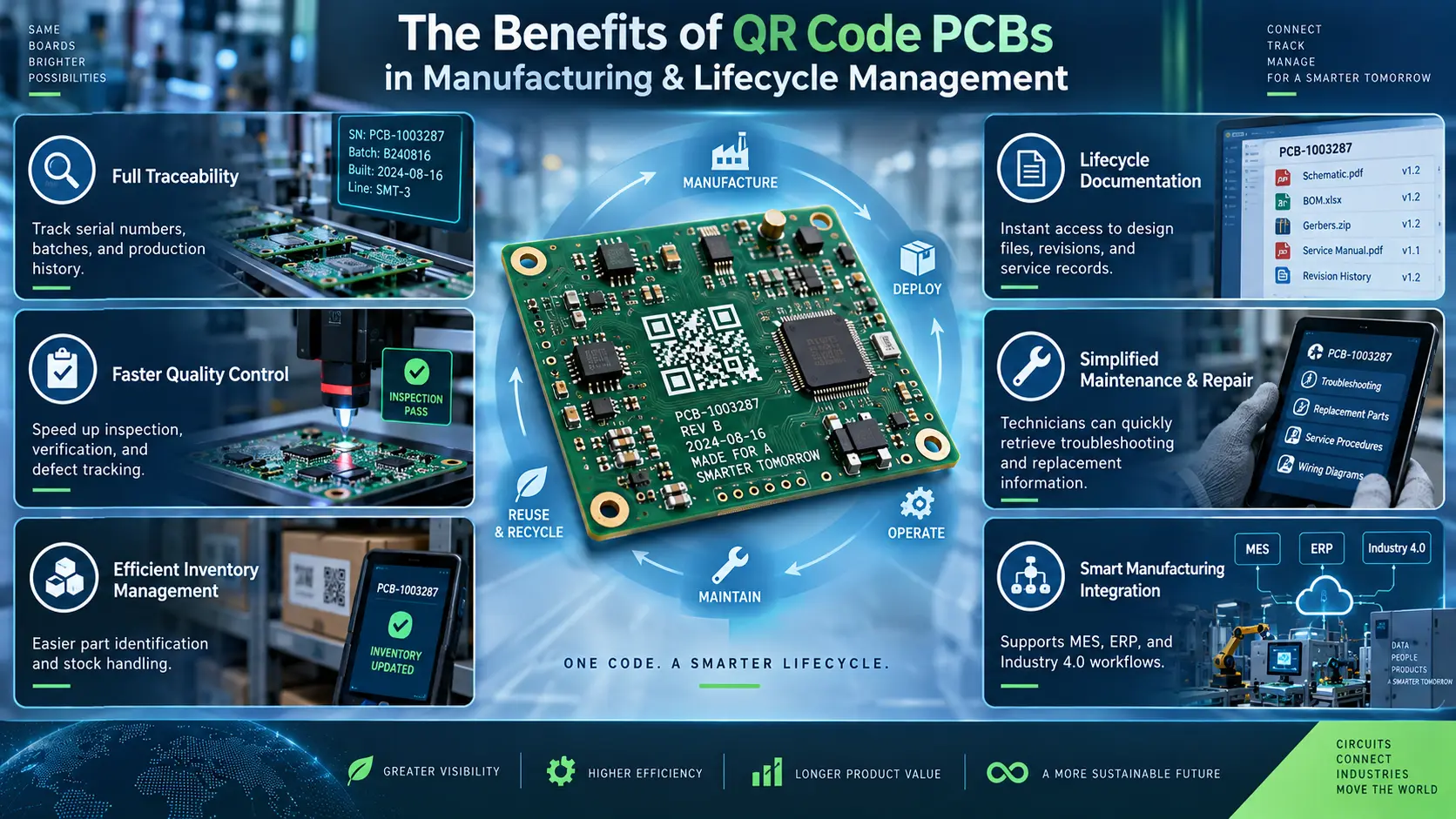
1. Full Traceability from PCB Fabrication to Field Use
- Each QR code or Data Matrix on a PCB allows for unbroken documentation of manufacturing, inspection, and logistics milestones. Whether for PCBs, full PCBA, or other circuit boards, the ability to scan and immediately retrieve batch, serial, or production data is essential for meeting industry best practices in traceability.
- Traceable batch tracking: Each board can be traced back to the material of the PCB, solder mask batch, and even the lot of the electronic components used.
- Example: An automotive firm using QR code PCB marking quickly contained a potential airbag recall with targeted lot-level notification—saving millions in unnecessary replacements.
2. Reliable PCB Identification for Anti-Counterfeiting
- PCB QR codesmarked with specialized equipment like fiber laser and UV lasers are integral to contemporary anti-tamper and anti-counterfeit programs.
- With code serialization and cloud-based authentication, brands can instantly verify real vs. fake boards during field service or warranty claims.
- Case:A regulated healthcare item supplier reduced counterfeit claims by 80% after switching to industrial-grade Data Matrix coding on all medical PCB assemblies.
3. Improved Workflow and Production Analytics
- Automated laser marking and real-time scanning on production lines,in order to ensure each board’s data,it is logged instantly into MES/ERP systems.
- Vision inspectionto use industrial scanners ensures no unreadable code leaves the factory, guaranteeing end-to-end PCB traceability.
4. Superior Durability and Compliance
- Laser marking machines and inkjet printers provide codes that survive solder and reflow, solvent washes, and abrasion.
- CO2 lasers, fiber lasers, and UV lasers allow for marking on a variety of solder mask colors and PCB surface finishes, opening up high-reliability applications across markets.
QR Code vs Data Matrix for PCB Coding — What Should You Use?
The two leading 2D code options for modern boards are the QR code PCB and the Data Matrix code PCB. Each offers distinct strengths for PCB identification and lifecycle tracking.
| Feature | QR Code PCB | Data Matrix Code PCB |
| Data Capacity | Up to 3,000+ characters | Up to 2,300+ characters |
| Code Size | 3mm x 3mm min (laser) | 1.5mm x 1.5mm min |
| Readability | All smartphones, industrial scanners | Mostly industrial scanners (some phones/apps) |
| Consumer-facing | Excellent | Limited |
| Industrial line use | Good | Excellent (micro-PCB, board surface constraints) |
| Error Correction | Up to 30% | Up to 30% |
Expanded Decision Tips
- QR codes have become a favorite for customer support, field apps, or when end-users must scan the board with a phone.
- Data Matrix codes excel when board real estate is tight, or reliable scanning is needed in automated AOI systems.
- Some PCBs use dual marking—QR for customers, Data Matrix for traceable factory use.
GS1, ECIA, and Industry Mandates
Organizations like GS1 and ECIA often specify which 2D bar codes or serialization schemes must be used for particular sectors (especially in electronic components, healthcare, and automotive). Always validate code type with your compliance team.
How to Add a QR Code onto a PCB: Methods Compared
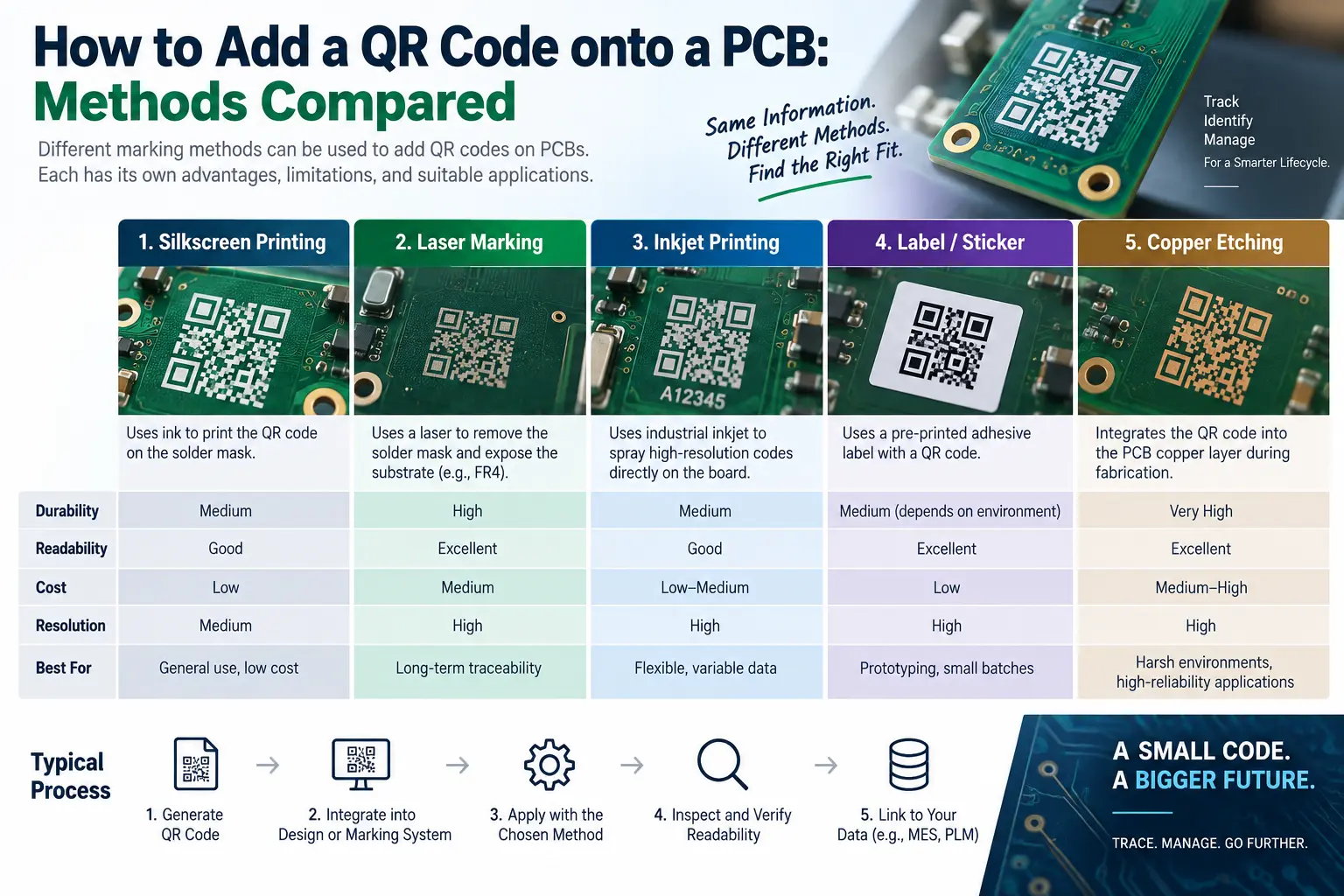
1. Silkscreen (Legend Printing)
- Silkscreen layer application means ink is printed directly on the board during standard PCB fabrication. This method is very cost-effective, easy to add through using PCB design tools like Altium Designer or KiCad.
- Inkjet printers and industrial ink jet methods are common for fast turnaround, though module size and line width are limited by ink bleed and mask absorption.
- Tips: Use the brightest ink available for low-reflection, dark solder masks. Consider a larger quiet zone to compensate for silkscreen misregistration.
2. Laser Marking
- Laser types for PCB QR code marking,it include fiber laser (for FR-4 and copper), CO2 lasers (for plastics/flex), and UV lasers (for fine detail or colored masks).
- A laser beam rapidly etches or modifies the coating on the board surface,can to allowing for marks that resist solder, abrasion, and chemicals.
- Inline laser marking machines can serialize thousands of PCBs per hour, providing rapid, cost-effective marking even on production lines.
3. Labeling (High-Temperature, Polyimide Labels)
- For post-fabrication or retrofit scenarios, high-temperature polyimide labels produced by thermal transfer printer or industrial inkjet printers can be used. These labels can withstand reflow soldering and harsh industrial chemicals. They’re ideal for field updates, low-volume orders, or marking PCBs,it weren’t coded during initial PCB fabrication. However, for ultimate trace ability in high-reliability or regulated markets, permanent laser marking is very typically holds the advantage.
4. Hybrid & Advanced Coding Methods
- Combination approaches: Some manufacturers will combine silkscreen for general product identification,with QR code laser marking or Data Matrix code for traceable serialization.
- Specialized equipment: Inline marking machines on production lines monitor coding quality in real time, rejecting unreadable codes before boards reach packaging.
PCB QR Code Design Guidelines: Size, Placement & Quiet Zone
Sizing and Resolution
Getting the size right means balancing scan reliability, available PCB real estate, and marking machine resolution:
- QR code min size: 3mm x 3mm on smooth, flat board surface when done with a fiber laser. For silkscreen or inkjet, keep to 4mm+.
- Data Matrix codes: Can go as small as 1.5mm square with a UV laser on a fine solder mask.
- 2D code module size: Each “cell” in a QR code or Data Matrix should be at least 0.15mm (laser) or 0.25mm (ink) for reliable decoding.
Quiet Zone and Placement Strategies
- Reserve a quiet zone of at least 4 modules or 1mm around any 2D code.
- Place codes on uncluttered areas of the PCB surface, away from component pads, fiducials, or vias that could interfere with printing or laser marking.
- For consumer-facing applications, consider putting the QR code in an accessible place directly visible to the end user.
- Check post-assembly with your 3D EDA viewer to ensure no tall components shadow the code.
Solder Mask, Reflow, and Surface Quality
- Always check with your PCB fabrication partner about the best solder mask finishes for contrast. Black, blue, and green solder masks generally provide the best backgrounds for white silkscreen or laser marking.
- Laser marking machines can be optimized for different solder mask chemistries and thicknesses. UV lasers are recommended for bright masks and small features.
From Schematic to Gerber: How to Incorporate QR Codes in Your PCB Design
PCB Design Tools and Process
- Popular PCB design tools like KiCad and Altium Designer offer plugins and generators for inserting 2D barcodes into the silkscreen layer or as copper artwork, supporting both static and serialized coding.
- After placing your QR code or Data Matrix in the design, always preview it at scale and print a physical mockup. Scan with both a smartphone and an industrial scanner for validation.
- When exporting to Gerber, ensure the code is on the correct layer (usually silkscreen/top overlay) and that module width lines up with fabrication limits.
- Provide your assembler and fabricator with documentation of code data, code type, and size.
Laser Marking and Coding Process for PCBs: End-to-End Workflow

Stepwise Process Overview
- Prepare digital code: QR and Data Matrix codes are rendered from a secure template or generated on-the-fly per board/lot.
- Configure marking parameters: The laser marking machine (fiber laser, CO2 laser, or UV laser) is tuned for beam intensity, focus, and marking speed based on solder mask and PCB material. Laser type is chosen for the best board surface contrast.
- Inline coding and real-time MES/ERP integration: As each PCB is fabricated, marked, and assembled, scanner vision systems verify readability. Data is logged by serial number into digital records.
- Automated scanning and inspection: Codes are verified again before packaging, achieving full traceability.
Process Control and Quality Tips
- Clean the PCB surface before marking for best results.
- Monitor for “burn-through” or incomplete marks, especially on high-speed production lines. Adjust laser power as needed.
- For full serialization in PCBA, audit your marking process at every reflow soldering, cleaning, or handling step to confirm lasting readability.
Medical and Regulated Industries: Special Considerations for QR Code PCBs
For medical device, aerospace, and other regulated industries, traceability is a legal and ethical requirement:
- Serial numbers and lot codes: Must uniquely map every finished item to raw materials, assembly date, and process data—ideally using secure QR or Data Matrix codes.
- GS1 and ECIA standards: These govern not only the 2D code format but also how coding data integrates with online product registration, long-term audits, or recalls.
- Regulated healthcare items often require proof that every PCB and component was produced, coded, and handled according to strict protocols.
Future Trends and Innovations in QR Code PCB Technology
The Evolving World of PCB Coding and Traceability
- Augmented reality field service: Scan a code and instantly visualize the board’s schematic, history, and test points in AR.
- Blockchain-powered traceability: Major OEMs are piloting distributed ledger systems where every QR code scan logs immutable data—ideal for regulated healthcare items and critical defense electronics.
- Cloud-enabled coding: Dynamic QR codes and Data Matrix codes that update product and warranty information, using secure cloud APIs.
FAQs About QR Code PCB
1. What is a QR code PCB?
A QR code PCB is a pcb,who marked with a QR code for identification, trace ability, then data access. It also can link to information for example PN, serial number, lot number, revision, or test files.
2. How do you add a QR code to a PCB?
A QR code can be added to a PCB silkscreen printing, a solder mask imaging, a copper etching, or laser marking. The right method usually depends on the required durability, contrast, size, and also scanning conditions.
3. Why use a QR code on a PCB?
A QR code on a PCB not only can improves product traceability and manufacturing control. But also helps track production batches, revisions, test results, and after-sales service more efficiently.
4. What information can a PCB QR code contain?
A PCB QR code can contain or link to PNs, serial numbers, date codes, lot numbers, revision levels, manufacturing records, inspection data, then product documentation.
5. What is the smallest QR code that can be used on a PCB?
The mini size depends on the QR code version, module size, marking accuracy, surface contrast, include scanner capability. In practice, the code will always be verified through real scanning tests before to mass production.
6. What makes a QR code on a PCB unreadable?
Unreadable PCB QR codes are usually caused a low contrast, overly small module size, insufficient quiet zone, poor print quality, reflective surfaces, contamination, or maybe physical damage during handling and assembly.
7. Can a QR code be placed on any area of a PCB?
Not every area is suitable. A PCB QR code should be placed on a flat, visible, non-functional area away from pads, vias, components, but soldering zones to avoid affecting readability and manufacture ability.
8. Do QR codes on PCBs expire?
A static QR code itself doesn’t expire as long as the mark remains readable. However, if the QR code links to an external website or database, the linked content may become unavailable if the system maybe changed or removed.
9. Can a PCB QR code be copied?
Yes. A visible QR code can be copied or photographed, so it shouldn’t be the only anti-counterfeiting measure. A better security, manufacturers usually combine QR codes with unique serial numbers, also database verification.
10. What file format is best for creating a PCB QR code?
Vector-based or Gerber-compatible artwork is one best for PCB manufacturing as it preserves precise geometry. If a raster image is used during design preparation, PNG is usually better than JPG because it avoids compression distortion.
Conclusion: Elevating PCB Traceability with QR Code PCBs
The future of printed circuits is digital, secure, and traceable. QR code PCB and Data Matrix code PCB marking enable cost-effective compliance, superior product identification, and robust tracking from factory to field. By investing in modern marking methods—laser, silkscreen, inkjet—and adhering to industry standards, your organization builds not just boards but trustworthy products with digital identities.
Whether for PCBs, PCBA, or complete assemblies, the right combination of design, process control, and real-time coding secures workflow, customer confidence, and regulatory standing.
Take your production lines to the next level:
- Use QR codes and Data Matrix codes for traceability, serialization, and customer support.
- Select the proper marking method: silkscreen, laser marking, or high-temperature labels.
- Leverage powerful PCB design tools and inline inspection to get marking, scanning, and tracking right from Gerber to field deployment.