
What is an Actuator? How Actuators Convert Energy into Motion
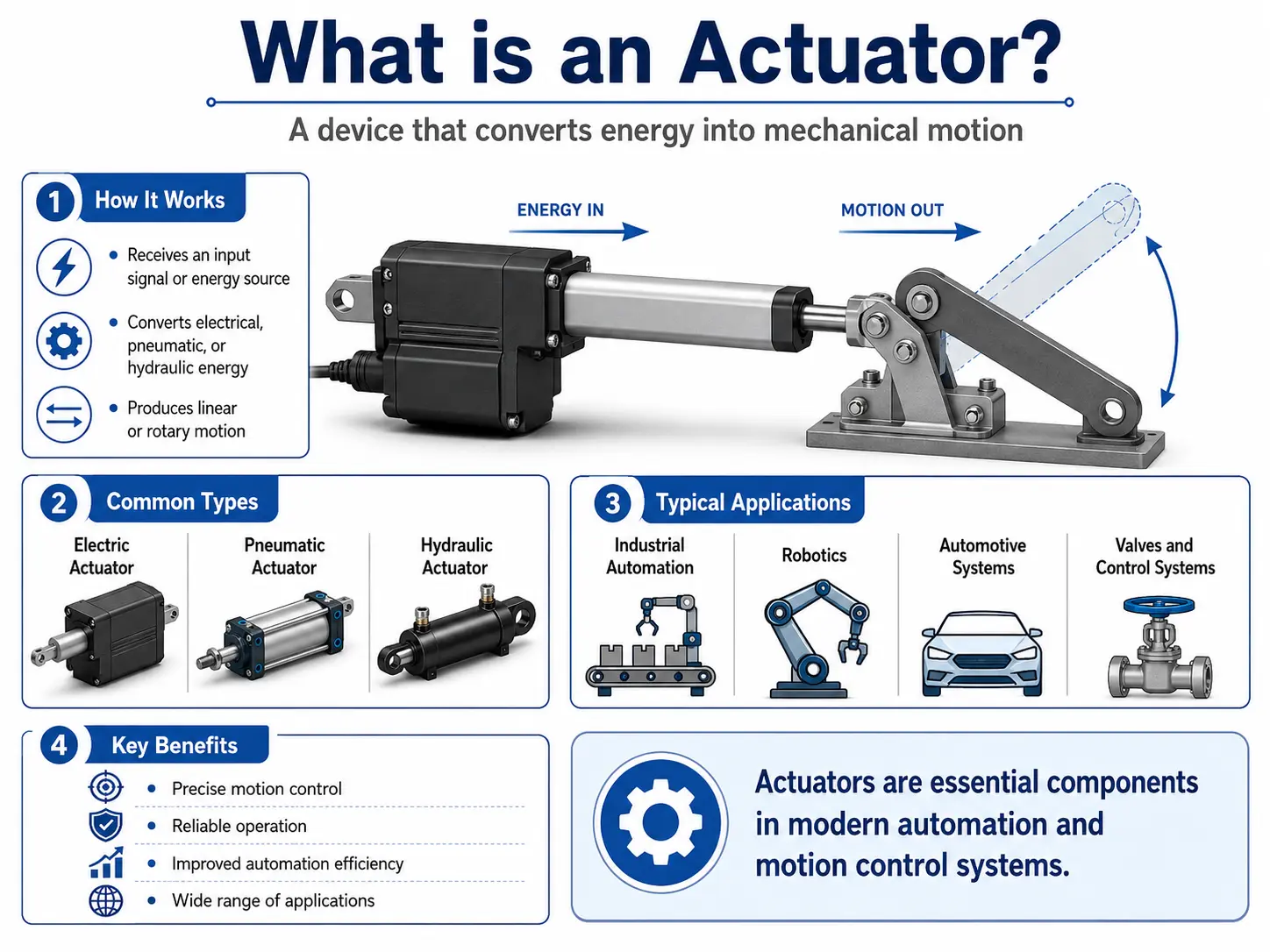
As the “muscle” of an automated system, an actuator is a precise device that converts control signals and energy sources into mechanical motion. LHD TECH is deeply engaged in actuator technology, dedicated to precisely converting various forms of energy such as electrical energy, hydraulic energy or compressed air into linear motion or rotational motion, enabling machines to flexibly perceive and respond to the external environment.
So, How do actuators convert energy into motion? ? Our actuator system acquires energy from sources such as power, hydraulic oil or compressed air, and precisely regulates the energy conversion process based on control instructions from switches, microcontrollers or industrial automation systems – electric actuators are driven by electricity, hydraulic actuators rely on pressurized fluids, and pneumatic actuators utilize compressed air. Through this precise energy management, LHD TECH provides stable and reliable automated motion solutions for numerous fields such as industry, healthcare, automotive, and consumer electronics.
Actuator Components: Inside the Actuator
Understanding actuator components is crucial for anyone working with automation or seeking to select the right actuator type. Although designs vary based on classification of actuators, most operate using a combination of the following:
- Electric motor (for electric actuators): The motor converts electrical energy into rotational motion, which is the most fundamental power source of the electric actuator.
- Gearbox: It is a combination of a “transmission” and a “power amplifier”.
- Lead screw (linear actuators): Convert the rotational motion of the motor into linear push and pull to achieve precise positioning of the linear actuator.
- Piston & cylinder (hydraulic/pneumatic actuators): When an actuator is driven by hydraulic oil or compressed air, its core components are the piston and the cylinder block, where pressure is converted into thrust through the piston rod.
- Feedback sensors (potentiometer, encoder, hall effect): Precisely control position and movement to achieve closed-loop control.
- Limit switches: It provides protection when the actuator reaches the mechanical limit.
- External housing: The “protective suit” of the actuator protects the internal components.
- Mounting brackets / clevis: Fix the actuator on the equipment and enable it to swing relatively flexibly.
Classification of Actuators: Understanding Types and Applications
In automation and industrial applications, the types of actuators are very diverse, such as linear actuators, rotary actuators, hydraulic actuators, pneumatic actuators, thermal actuators, and electric actuators, electric actuators. Different types of actuators each have their unique advantages and are respectively suitable for specific task requirements. So, how do we generally classify them? From an academic perspective, the classification of actuators is typically based on two fundamental dimensions: one is the form of energy they convert, and the other is the type of motion they ultimately generate.
| Classification | Actuator Type | Energy Input | Typical Motion | Common Applications |
| Electric Actuators | Linear, Rotary | Electrical energy | Linear or rotational | Robotics, home automation, industry |
| Hydraulic Actuators | Linear, Rotary | Pressurized hydraulic fluid | Linear or rotational | Heavy machinery, construction, marine |
| Pneumatic Actuators | Linear, Rotary | Compressed air | Linear or rotational | Packaging, assembly lines, food/pharma |
| Thermal Actuators | Linear | Expansion of metals | Linear | Fire safety, HVAC, simple triggers |
| Piezoelectric Actuators | Micro, Nano | Piezoelectric effect (voltage) | Micro-motion | Optics, medical devices, precision labs |
Types and applications vary widely. Understanding these distinctions is key when you must select the right actuator for your project.
Linear Actuators: Principles, Types, and Applications
What are Linear Actuators?
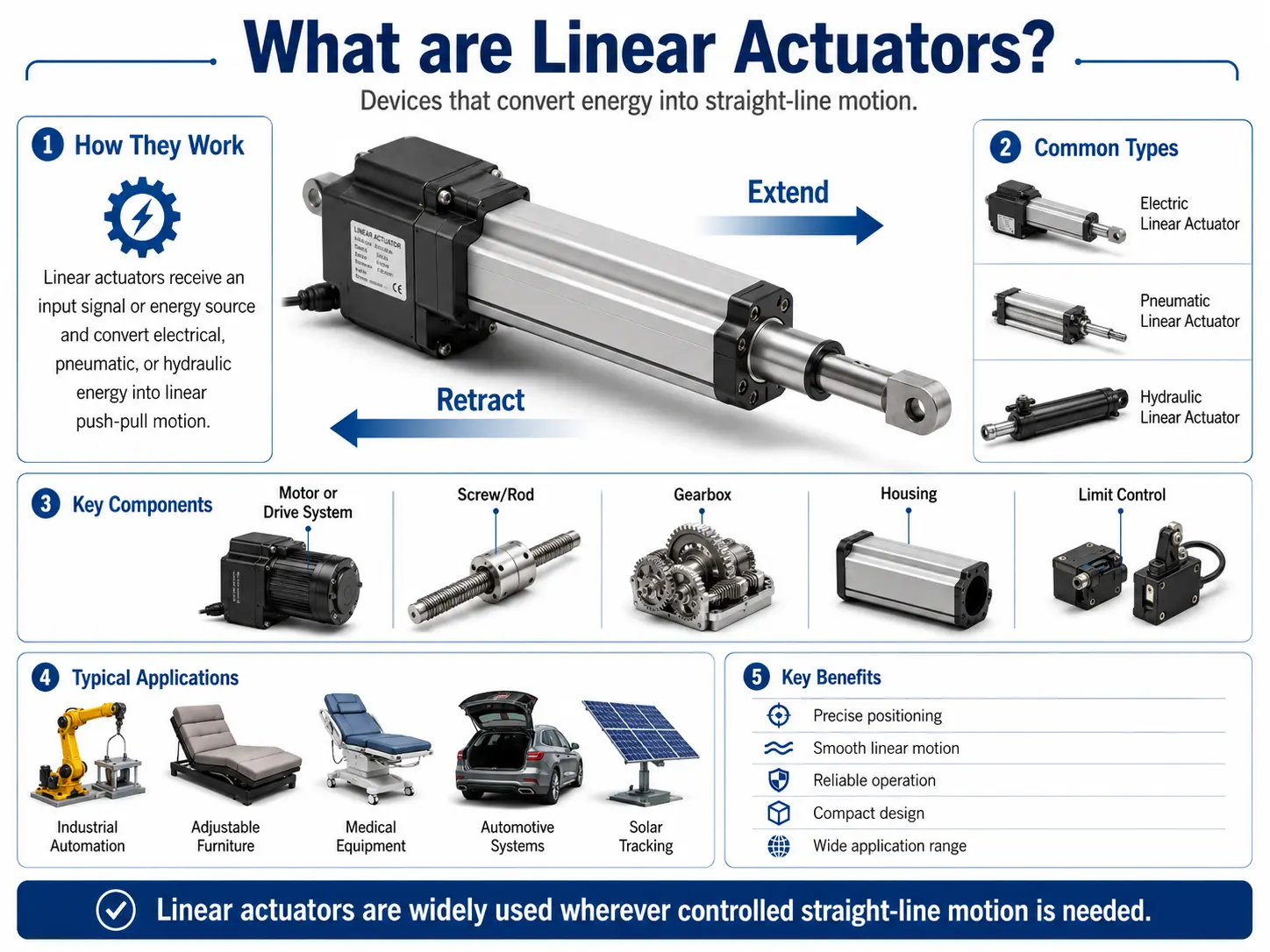
Linear actuators produce linear motion—refers to pushing or pulling the load along a straight line, achieved by the back-and-forth extension and retraction of the push rod or slide table. In automated systems that require back-and-forth linear movements, linear actuators are also the most common type.
Common Types of Linear Actuators
- Electric Linear Actuator: The core components are the motor, gearbox and lead screw. The rotation of the motor is transformed into linear push-pull through the lead screw. It features high control accuracy, programmable stroke setting, and a wide variety of specifications.
- Hydraulic Linear Actuator: Relying on hydraulic oil, cylinders and pistons, pressurized hydraulic fluid propels the cylinders to generate huge thrust, which is commonly seen in heavy industry and construction machinery fields.
- Pneumatic Linear Actuator: Pneumatic actuators use compressed air, which moves very fast and flexibly. It is commonly seen in the assembly lines of light industry.
- Thermal Linear Actuator: Based on the principle that materials expand when heated. Materials with metal or wax expand when heated, driving mechanical structures to move. It is commonly found in fire dampers and basic temperature switches.
- Micro Actuators: It can achieve extremely precise linear motion in a very small space. Precision adjustment in common medical equipment, focusing in optical instruments, and consumer electronic products.
A linear actuator typically is composed of several core components: a power system (such as a motor, hydraulic or pneumatic device), a lead screw or piston, a sensor module, and a housing that protects the internal parts. These components, when combined together, make the automation of various devices possible.
Why Choose Linear Actuators?
- It can achieve precise, reliable and programmable actions.
- Electric linear actuators are cleaner and easier to maintain than hydraulic actuators, and they are plug-and-play automation.
- If it requires great effort to create miracles and do heavy work – such as heavy industry trades like excavators and dump trucks.
- On automated production lines with high action frequencies and low load requirements, pneumatic linear actuators operate both quietly and efficiently.
Rotary Actuator: Fundamentals and Use Cases
What is a Rotary Actuator?
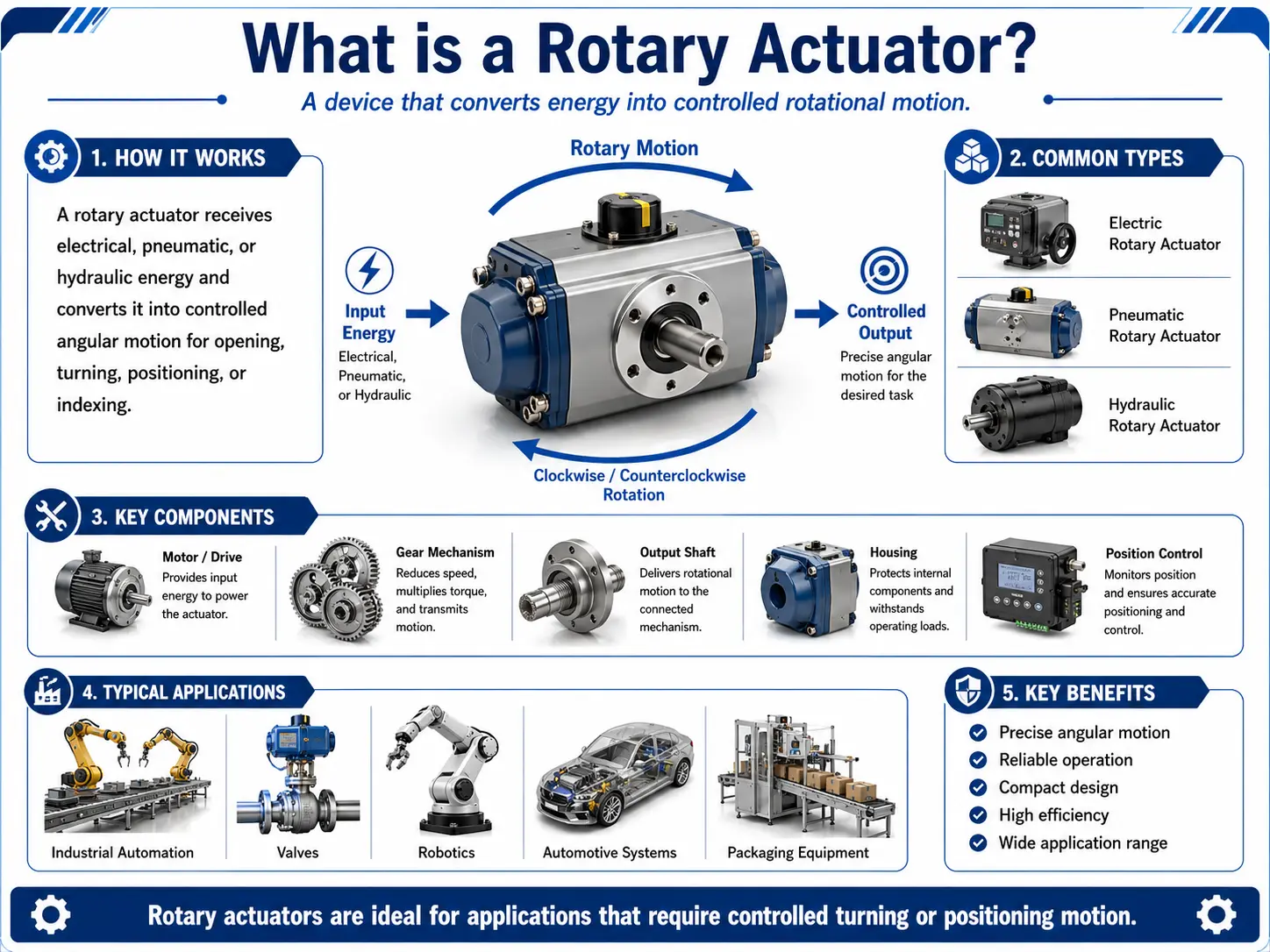
Therotary actuator makes a certain component rotate around an axis by generating rotational motion, rather than pushing and pulling in a straight line. Rotary actuators convert various forms of energy into angular or continuous rotational outputs. They are indispensable for controlling the opening and closing of valves, driving conveyor belts, and the flexible rotation of robot wrists.
Types of Rotary Actuators
- Electric Rotary Actuators: The motor can output rotational motion through gears or cams.
- Hydraulic Rotary Actuators: The pressurized hydraulic oil is used to push the blades or pistons installed on the rotating shaft, thereby driving the shaft to rotate.
- Pneumatic Rotary Actuators: Driven by compressed air, it can achieve rapid and controllable angular rotation.
- Servo Motors and Stepper Motors: All of them belong to highly precise rotary actuators and are often used in robots, CNC machine tools and other applications that require accurate position and fine control.
Where Are Rotary Actuators Used?
- Valve Automation: In oil refineries, water treatment plants and various process industries, rotary actuators are the “core brain” of automatic valve systems.
- Industrial Automation: Rotating a workpiece to a new position or rotating a part by an Angle is the job of a rotary actuator.
- Robotics: The joints of robots, end effectors, and the pan-tilt control of cameras all require rotating actuators. It can output rotational motion with torque control, high-speed continuous rotation, and precise fixation.
Key Insight: If you need precise angular positioning or continuous rotary actions with high torque, then a rotary actuator is the most suitable choice. It converts electrical energy, hydraulic energy or pneumatic energy into rotary output, becoming a key link in the automated process.
Practical Examples:
- Valve automation: Rotary actuators are commonly found in the petroleum, natural gas and water treatment industries. When the control system issues an instruction, the rotary actuator will quickly, accurately and reliably turn the valve to the designated position.
- Automation robots: The linear actuator is responsible for the lifting movement of the Z-axis, while the rotary actuator is responsible for wrist rotation or gripper control. The combination of the advantages of these two types of actuators enables the realization of complex tasks.
- Indexing tables: Rotary actuators are often used to drive heavy-duty turntables, enabling them to precisely rotate to the preset position.
Hydraulic, Pneumatic, Thermal, and Electric Actuators
Hydraulic Actuators
The working principle of hydraulic actuators use pressurized fluid- it pushes the piston by injecting pressurized liquid into the cylinder. Because liquids are incompressible, they can generate a huge thrust. Therefore, construction machinery, Marine flaps, and aircraft landing gears all need hydraulic actuators use.
Advantages
- High force density—move massive loads with compact size.
- It is resistant to high temperatures, dirt, moisture and dangerous environments.
- In the field of mining and earthmoving equipment, hydraulic linear actuators are the preferred choice.
Considerations
- Electric actuators have high environmental requirements. For the sole purpose of providing strong output, hydraulic actuators are the preferred choice.
- The maintenance cost of the hydraulic system is high, and it is prone to oil leakage, oil contamination and unstable pressure.
Pneumatic Actuators
Pneumatic actuators use compressed air to push the pistons in the cylinder. Repetitive linear motion, pneumatic linear actuator; For a fast rotation Angle, choose a pneumatic rotary actuator.
Where pneumatic actuators are commonly used:
- Scenarios such as packaging, food processing, and material handling – characterized by high speed and light load.
- Pneumatic actuators feature a simple structure, quick response and are particularly reliable.
Watch Outs
- Hydraulic actuators have a stronger output force than pneumatic actuators.
- Air leakage leads to reduced efficiency, so the maintenance of the compressor and filter is very important.
Thermal & Special Actuators
- Thermal actuators use the expansion to change position and basically does not require electronic control. It is most suitable for use in HVAC and fire protection systems.
- Piezoelectric and micro-actuators have extremely high precision and are widely used in the optical and medical fields, with precision reaching the sub-micron level.
Electric Linear Actuator in Automation and Industrial Applications
Electric linear actuators use electrical energy (DC or AC) to convert into controlled and programmable linear motion. It is the core of modern automation, featuring cleanliness, efficiency, precision and ease of control.
Why Use Electric Linear Actuators?
- Low maintenance: There is no oil leakage problem and no need for an air compressor. It can be directly connected to the control system and is plug-and-play.
- Programmable precision: It can be seamlessly integrated with PLC, control panels and intelligent automation systems, precisely and accurately.
- Customizable: All parameters such as stroke length, speed, thrust and feedback mode can be customized as needed.
- Quiet and efficient: The preferred choice for hospital beds, office height-adjustable desks, and laboratory automation equipment.
Electric Linear Actuator in Real Automation
Industrial applications include:
- Assembly lines: On the production lines of material picking, mounting and welding, electric linear actuators can provide precise and repeatable linear motion.
- Packaging equipment: In the processes of filling, capping and sealing, the linear actuator is responsible for controlling the entire travel trajectory.
- Medical automation: It is applied to the movement of the imaging examination table, the adjustment of surgical instruments, and the positioning of the patient’s position.
Electric actuators are generally preferred choice for high environmental requirements, low maintenance, and quick access to digital control systems.
Applications of Actuators: Where Are Actuators Used?
Actuators are commonly used everywhere automation or controlled movement is required. Their purpose spans practically every industry:
Industrial Applications
- Factory automation: Electric linear actuators are used on conveyor belts, mechanical arms on assembly stations, and rotary worktables rely on rotary actuators, each performing its own duties.
- Process industries: The rotary actuator is used to control the valve opening and regulate the flow of the medium in the pipeline.
Vehicle/Automotive Uses
- Automotive manufacturing: Linear actuators are applied in the electric seat adjustment, window lifting and lowering, and trunk opening and closing of vehicles.
- Heavy equipment: Excavators and bulldozers can only move with the help of hydraulic actuators, and their structures must be solid enough.
Consumer and Medical
- Home automation: Automatic window openers, smart height-adjustable desks and adjustable beds basically rely on actuators.
- Medical devices: Micro-actuators and electric linear actuators are often used in imaging examinations, surgical operations, and bed position adjustments.
Renewable Energy
- Solar trackers: Linear actuators are responsible for long-stroke and high-thrust telescopic actions, adjusting the Angle of photovoltaic panels and enhancing power generation efficiency.
- Wind turbines: The rotation execution changes the pitch Angle of the blades to adjust the wind force and achieve the best power generation effect.
Special Applications
- Aerospace: The control surfaces of the aircraft use hydraulic and electric actuators.
- Food & pharma: These occasions have high hygiene requirements. Stainless steel version actuators should be used and flushed to meet hygiene standards.
Choosing the Right Actuator for Your Needs
Step-by-Step Guide
Start with function: Do you need linear motion or rotational motion? What is the maximum travel distance in a straight line? What is the maximum rotation Angle?
Identify environment: When using an actuator, the right environment must be selected. The environment determines the protection level (IP level), and only by choosing the right one can it be durable.
Calculate load: To push the weight of an object, the impact and frictional resistance during acceleration and deceleration, if pushed on a slope, the load will also increase.
Determine speed and stroke: What speed, distance and rotation Angle do you need?
Evaluate duty cycle: Decide which specification of motor or cylinder to choose based on the usage frequency.
Choose energy source: electric, pneumatic, or hydraulic?
- Electricity usage is precise, clean and requires little maintenance, making it suitable for precision work.
- It uses high-pressure oil, has great power and is not afraid of dirty, messy and poor environments.
- With compressed air, it features fast movement and frequent back-and-forth repetitions, making it suitable for high-speed and light-load scenarios.
Define control method: Should it be a simple switch or connected to a PLC system with sensors to feedback the position? It depends on the requirements of the scene.
Confirm installation/mounting: Does the actuator fit your space and mounting options?
Common Pitfalls
- Oversizing = wasted power and costs.
- Undersizing = shortened life or failure.
- Ignoring the environment leads to corrosion, overheating, or early failure.
How to Select the Right Actuator: Actuator Comparison and Tips
Actuator Comparison Table
| Actuator Type | Best For | Strengths | Weaknesses |
| Electric Linear | Clean, precise, low-maintenance | Plug-and-play, programmable | Force/speed trade-off |
| Hydraulic Linear | Heavy lifts, rugged use | High force/output | Maintenance, leaks, noise |
| Pneumatic Linear | Fast, repetitive tasks | Quick cycle times | Lower precision, air demand |
| Rotary | Valves, conveyor, rotation | Compact high-torque, versatile | May require reducers for speed |
| Thermal | Simple triggers or sensors | No wiring needed, cheap | Slow, limited reuse |
| Micro | Small med/optical tasks | Ultra-precise, compact | Small loads only |
Actuator Selection Tips
- Linear actuators are generally preferred for direct lifting, pushing, pulling.
- Rotary actuators are best suited for valves, steering, or mechanism rotation.
- For automation, electric linear actuators are commonly best for ease of wiring and compatibility.
- Hydraulic actuators use pressurized fluids for applications with the highest force needs, such as earth-moving.
- Pneumatic actuators use compressed air and are often better for simplicity, reliability, and speed in light industrial applications.
Always select the right actuator for your needs by focusing on motion, force, speed, application, and control type.
How to Connect the Actuator: Wiring, Mounting, and Commissioning
Connecting Electric Actuators
- Two-wire electric linear actuators use direct power and polarity reversal for forward/reverse.
- For actuators with feedback, connect the added sensor wires as shown in the manufacturer schematic, ensuring correct voltage/application compatibility.
- Use properly rated fuses and relays; oversized loads can exceed safe capacity.
Mounting Considerations
- Ensure rigid, aligned mounting to prevent side loads on actuator rods (to preserve actuator life).
- Allow for clevis or trunnion mounts for articulating actuators; secure brackets tightly with lock washers.
- Confirm all safety devices (limit switches, covers) operate before go-live.
Commissioning
- Run through the full stroke/rotation before loading the actuator in production.
- Check for smooth, quiet motion—binding signals misalignment.
- Calibrate feedback (if available)—most smart actuators perform this automatically during the first cycle.
Expert Tips for Actuator Integration, Safety, and Maintenance
Integrating actuators into automation systems is where engineering skill and real-world experience combine. A poorly integrated actuator can lead to downtime and failures, while a well-integrated actuator will provide thousands—sometimes millions—of cycles of reliable service. Here are advanced tips for getting the most out of your actuator in automation:
Integration Best Practices
- Match the actuator type to your control system: For industrial automation with PLCs, select actuators with compatible feedback options (potentiometers, encoders, hall-effect sensors) and standardized control signals (i.e., 0-10V, 4-20mA, PWM).
- Account for system inertia: Large moving masses require actuators with controlled acceleration/deceleration and robust mounting. For electric linear actuators, always ensure the actuator can handle the load’s inertia at both starting and stopping.
- In multi-actuator applications, synchronize movement using a master controller or multi-channel driver, especially when the actuators must move at exactly the same speed and distance the actuator must extend or retract for each channel.
- Safety interlocks and overload protection: On critical systems or where actuator failure could be hazardous (lifting people, dangerous machines), utilize both internal and external limit switches and integrate current sensing or thermal cut-off. Never rely on software alone for safety-critical end-of-the-actuator travel limits.
Maintenance & Troubleshooting
- Routine inspection: Regularly check actuator components including connections, seals (for hydraulic actuators), motor brushes (for brushed electric motors), and mounting bolts. Clean debris and apply lubrication per the manufacturer’s specification for mechanical components such as the gearbox or lead screw.
- Watch for “creep” in hydraulic linear actuators: Over time, seals may degrade, causing the actuator to slowly move under load (“creep”). Address by resealing or replacing as needed, and confirm hydraulic fluid condition.
- Listen for noise: Unusual or increasing sound levels in electric linear actuators may indicate insidious wear of actuator components, misalignment, or imminent failure.
- Cycle testing and logging: For mission-critical uses (medical beds, industrial automation), maintain a log of actuator cycles and review for changes in speed, response, or precision—signs that maintenance or part replacement is needed.
- Diagnosing non-movement:
- Check that the actuator is powered, wiring is intact, and control signals are active.
- For pneumatic actuators, ensure air pressure is adequate and valves are not fouled.
- For hydraulic actuators, check for fluid levels, air in lines, or blockages.
Longevity Enhancers
- Install in clean, dry, and temperature-appropriate environments when possible.
- Apply proper duty cycles: Exceeding rated duty will shorten lifespan—give cooling time where required, especially for electric actuators in high-cycle settings.
- Use environmental protection: For outdoor or wet locations, choose actuators with the right IP rating and stainless steel or coated parts to resist rust and ingress.
Frequently Asked Questions About Actuators
Q: What does an actuator do in automation?
A: Actuators convert energy into motion, enabling machines to execute linear or rotational movements according to programmed logic—whether pushing a load, rotating a valve, or adjusting a robotic joint.
Q: How do you select the right actuator for your application?
A: Consider the required motion (linear or rotary), load capacity, stroke or angular range, speed, environmental conditions (IP rating), available power supply, and whether feedback or advanced control is needed.
Q: Which actuator types are best for high force?
A: Hydraulic actuators use pressurized fluid to deliver the most force for size and are commonly used in heavy industry. Electric linear actuators with heavy-duty gearboxes can deliver moderate to high forces for automation tasks requiring cleanliness and precision.
Q: Can one actuator type replace another?
A: Sometimes. For example, electric linear actuators can replace hydraulic actuators in many automation scenarios if the force requirement is moderate and clean, quiet operation is prioritized. But for extreme loads, hydraulic remains necessary.
Q: How are valves automated using actuators?
A: Rotary actuators turn valve stems to open or close flow. Linear actuators can open/close gate or globe valves. Actuators are commonly used in automated process control for water, oil, chemicals, and gas applications.
Q: Are there actuators for micro or miniature motion?
A: Yes! Micro actuators, piezoelectric actuators, and precision stepper motors offer extremely fine control and are best suited for medical devices, optics, and electronics manufacturing.
Q: Do actuators require regular maintenance?
A: Electric actuators typically require less maintenance; pneumatic and hydraulic actuators require periodic inspection of seals and fluid/air system health.
Conclusion: Actuators in Automation and the Future of Motion
Actuators are the crucial bridge between signal and mechanical action, fundamentally enabling the automation revolution. Whether their task is creating linear motion for a medical device, rotational control of a valve in a water plant, or high-speed cycles in a packaging factory, actuators convert energy into precise, reliable, and repeatable motion. As automation grows, so too do the demands for smarter, more reliable, sustainable, and networked actuator solutions.
Summary of Key Points
- Actuators convert energy into motion, providing either linear or rotational movement.
- Types of actuators include electric, hydraulic, pneumatic, thermal, and micro actuators.
- Electric linear actuators are leading the way in clean, connected automation for industrial and consumer use.
- The right actuator is selected by matching motion, force, speed, control, application environment, and duty cycle.
- Integration, safety, and maintenance are key for maximizing actuator lifespan and performance.
- The future is bright: expect to see more networked, diagnostic-rich, sustainable actuators across every field of automation.