
What is SMD? Full Definition and Origin
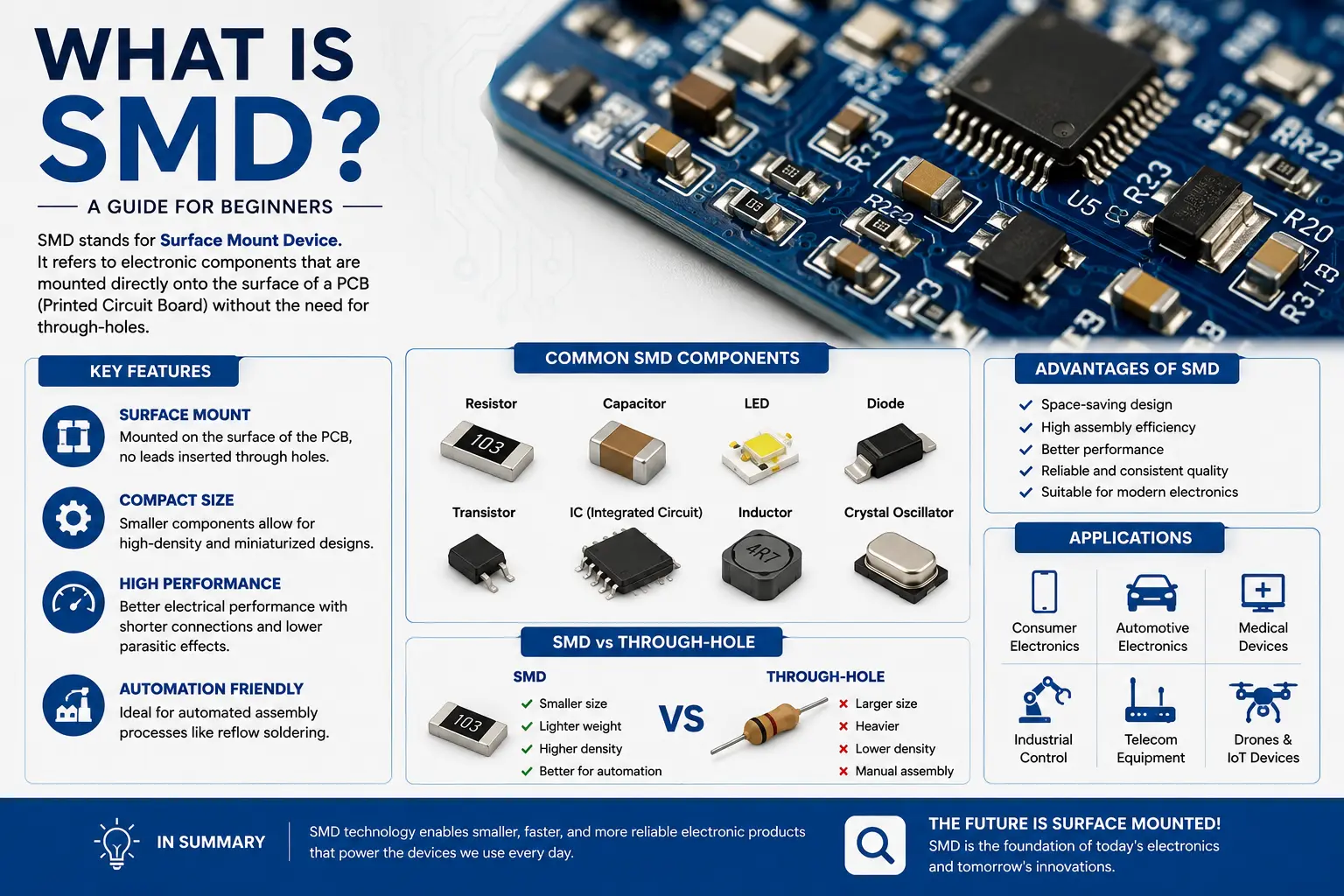
SMD means Surface Mount Device. What does SMD mean in electronics? An SMD, or surface mount device, is an electronic component, it engineered for automated assembly, mounted directly onto the surface of a printed circuit board (PCB). Not like traditional through-hole components, it require the holes drilled into the board for mounting, SMD components make contact with the PCB via and small metallized pads.
The meaning of SMD in electronics is intrinsically tied to mini and the drive for efficient, automated production. The found of modern electronics manufacturing is built on SMD technology: a smart phones and computers to automotive electronics or advanced medical devices.
Key Points:
- SMD in electronics means high-performance miniaturized components.
- SMD components are at the center of every modern electronic device.
- SMD is synonymous with personal gadgets, industrial controllers, and consumer electronics today.
Understanding SMD: How SMD Revolutionized Electronics
Before surface mount devices, the electronics industry relied solely on through-hole technology. As required for smaller, faster, and more affordable devices rose, SMD technology is emerged—it enable the mini and high-speed mass production, now dominate modern electronics.
How SMDs Revolutionized the Electronics Industry
- Smaller Size: The small size of SMD components can enable dense packing on board, freeing designers to create sleek, function
- Revolutionized the electronics assembly process: Automated SMT machines can place many SMDs to a PCB within minutes, far surpassing manual labor rates.
- Reliability & Performance: Shorter leads can result in better electric performance, lower resistance, and improved high-frequency behavior.
What is SMD Technology? SMD vs. Through-Hole Technology
What is SMD Technology?
SMD technology is the set of methods for designing, placing, and soldering surface mount devices onto PCBs. This includes the use of automated placement machinery, advanced soldering techniques, and quality inspection systems.
Surface mount technology (SMT) is often confused with SMD, but here’s the difference:
| SMD | SMT | |
| Definition | Surface mount device, the component itself | Surface mount technology, the manufacturing process for mounting SMDs |
| Role | Passive or active part on PCB | Enables high-speed automated SMD assembly |
| Example | SMD resistor, SMD capacitor, SMD IC | Solder paste printing, pick-and-place, reflow soldering |
“The difference between SMD and SMT: SMD refers to the component; SMT is the process that assembles these components onto the circuit board.”
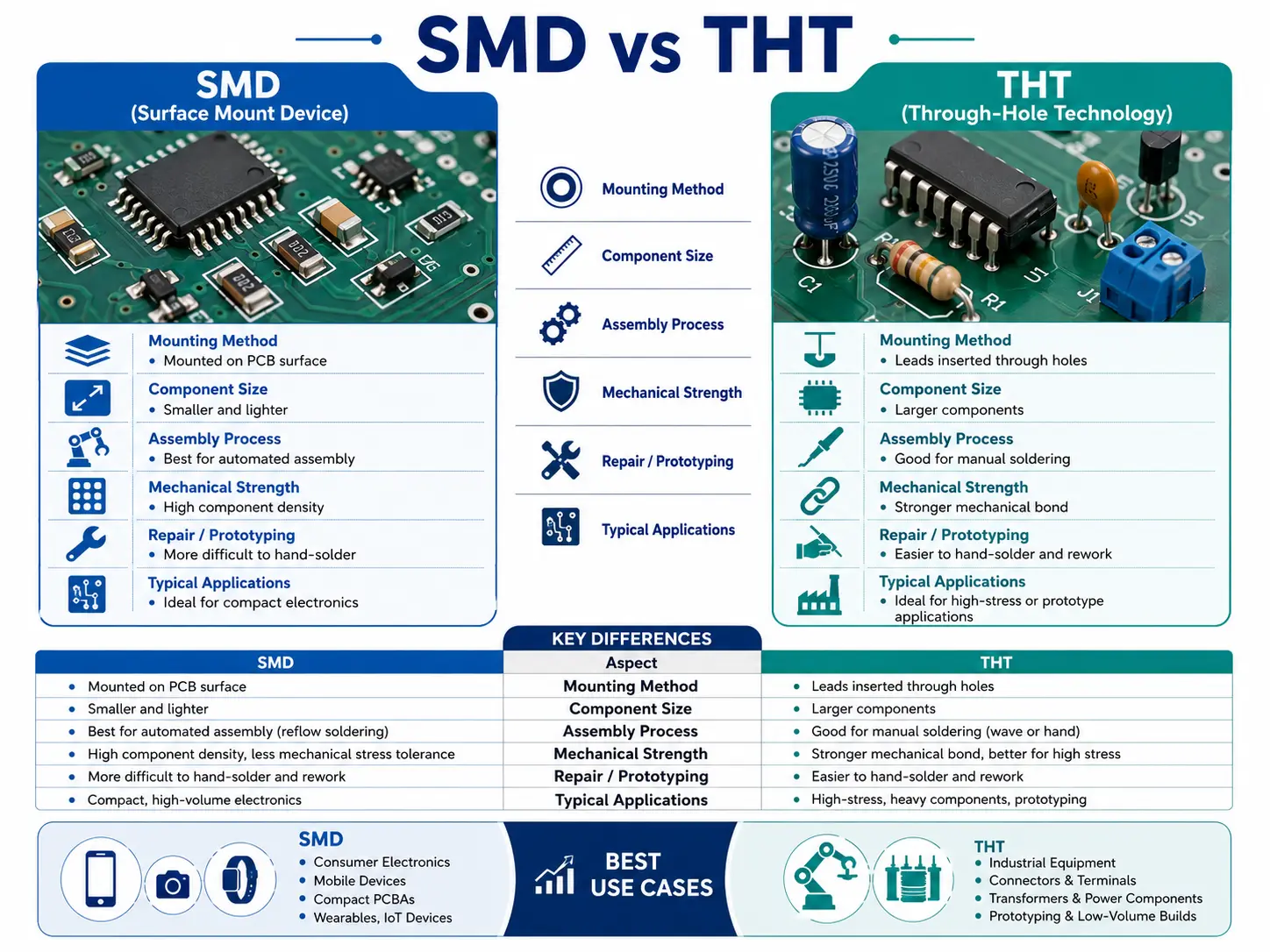
SMD vs. Through-Hole Technology
- Through-hole components require drilled holes; while SMDs
- Through-hole technology is slow, bulkier, and less suit to modern miniaturization.
- SMD assembly enables both sides of the PCB to be populated, maxa circuit density.
Table: SMD vs Through-Hole
| Feature | SMD/SMD Technology | Through-Hole/Traditional Technology |
| Placement | Surface of PCB (pads) | Holes through PCB, soldered on opposite side |
| Speed | High-speed automation | Manual/auto, but slower |
| Component Density | Extremely high | Moderate to low |
| Applicability | All modern electronics | Power, connectors, legacy, some prototyping |
| Repairability | Difficult (needs skill/microscope) | Easy to hand-solder, replace |
How Do SMD and SMT Work Together? The Manufacturing Process
The SMT Manufacturing Process
The journey of a surface mount device from the supplier to a finished board combines SMD and SMT:
- Solder Paste Printing: A stencil can place precise solder paste on PCB pads.
- Pick-and-Place: SMD components are rapidly and accurately placed by robotic suction heads.
- Reflow Soldering: The whole board enters a reflow oven, melting the solder paste can create strong, reliable solder joints.
- Automated Optical Inspection & X-ray: It can ensure correct placement, robust soldering, and absence of short circuits or bridges.
- In-Circuit & Functional Testing: Further guarantees the reliability of every assembly
Solder Paste: The Key to Strong Solder Joints
Solder paste—a mixture of powdered solder and flux—is crucial for soldering SMD. The right amount prevents defects like tombstoning or bridging. Soldering SMD components requires precise control and calibration at every step.
Why SMT/Use of SMD in Modern Electronics
- Consistency: SMT assembly enables good results, its critical for medical devices and automotive electronics.
- Efficiency: High-speed machines dramatically reduce the time and cost one board compared to traditional through-hole assembly.
Common SMD Types and SMD Package Codes
There are many types of SMD components, each suited to specific uses in modern electronics:
| Type | Function | Common SMD Package |
| SMD Resistor | Voltage/current control | 0402, 0603, 0805, 1206 |
| SMD Capacitor | Filtering, energy store | 0402, 0603, 0805, 1206, Tantalum A–E |
| SMD Inductors | Filtering, energy store | 0603, 0805, 1206, MLP |
| SMD Diodes | Rectification/protection | SOD-123, SOT-23, SOD-323 |
| SMD ICs | Computing/control | SOP, SOIC, QFP, QFN, BGA |
| SMD Transistor | Switching/amplification | SOT-23, SOT-89, SOT-223 |
| SMD Crystal Osc. | Timing/control signals | 2–4 pin SMD packages |
| SMD Arrays/Networks | Multiple resistors/capacitors | Custom, 1206, 2010 |
| SMD Transformers/Relays | Power/Signal | Custom, SMD, 1210 |
SMD Package Codes Table (Resistors, Capacitors, ICs)
| Package Code | Imperial Size (inches) | Metric Size (mm) | Common Use |
| 0402 | 0.04 × 0.02 | 1.0 × 0.5 | Smartphones, RF |
| 0603 | 0.06 × 0.03 | 1.6 × 0.8 | Wide SMD use |
| 0805 | 0.08 × 0.05 | 2.0 × 1.25 | Industrial/automotive |
| 1206 | 0.12 × 0.06 | 3.2 × 1.6 | Power, high-voltage SMDs |
Understanding SMD package codes ensures you select the right part for your manufacturing process. The small size of SMD components enables more compact designs, a major advantage over traditional through-hole technology.
In-Depth: SMD Components Explained
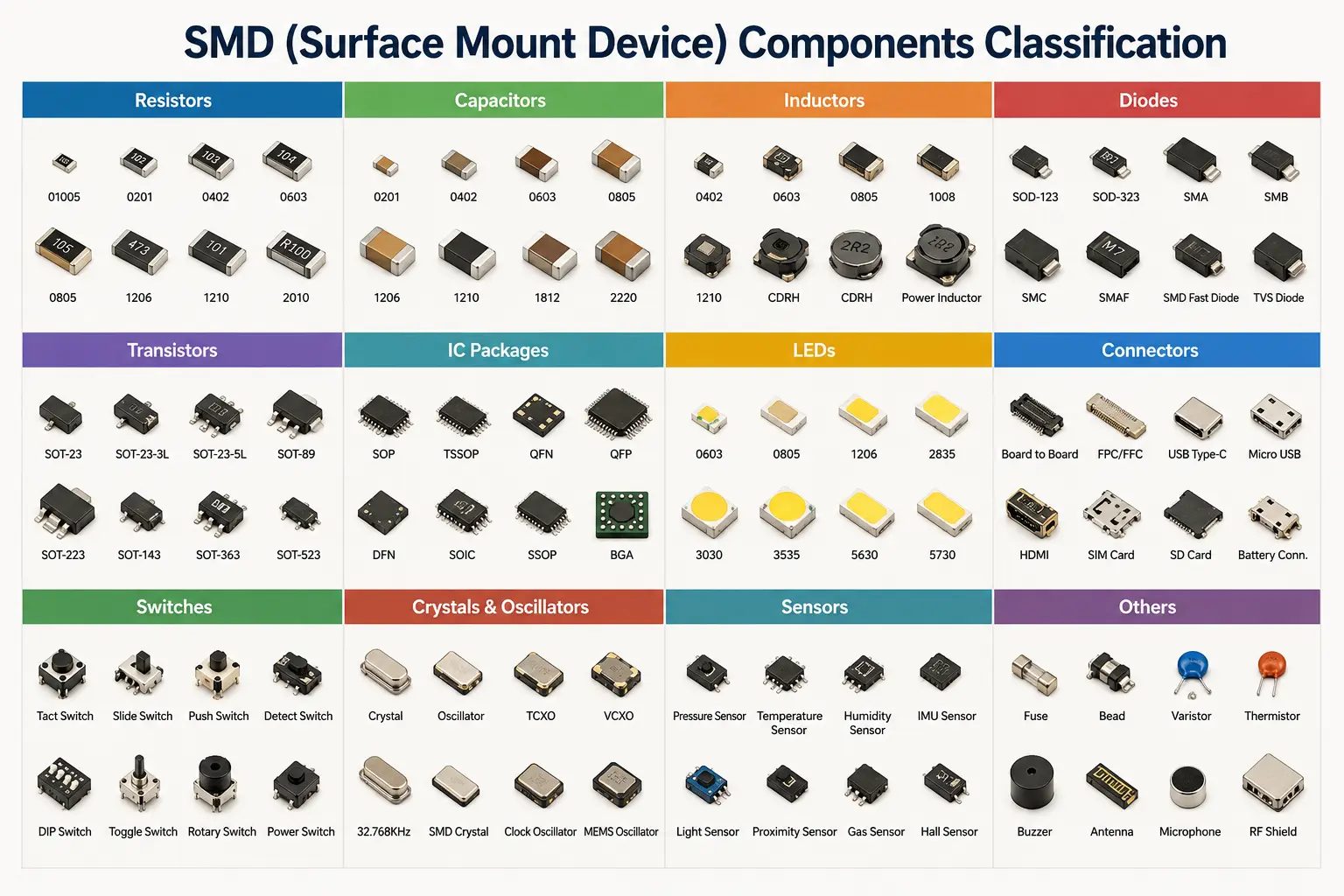
SMD Resistor
The SMD resistor is one of the most common SMD components in the electronics field. We found in nearly every surface mount assembly, the resistors can provide current limiting, voltage division, and then pull-up/down actions. As of their surface mount form, SMD resistors facilitate is very popular in circuit boards without sacrificing performance.
- Keyword Focus: SMD, resistor, SMD technology, SMD package, smd mean, smd component, modern electronics, electronics, surface mount device
Example Applications:
- Power supply regulation in consumer electronics
- Signal conditioning in automotive electronics
- Feedback and control loops in medical devices
SMD Capacitor
SMD capacitors, including MLCC (mult layer ceramic capacitor) and tantalum types, it enable energy storage, filtering, and decoupling in high-speed circuit boards. The small size of capacitors in SMD format is essential for mobile gadgets and miniaturized PCBs.
SMD Inductors
SMD inductors are vital for energy storage in power conversion and RF circuits. They offer excellent electromagnetic compatibility and, due to SMD technology, can be seamlessly integrated into even the smallest gadgets.
SMD Diodes
SMD diodes provide rectification, voltage regulation, and overvoltage protection. With SMD packages like SOD and SOT, these devices are found in high-speed USB ports, charging circuits, and consumer electronics protection designs.
SMD ICs (Integrated Circuits)
At the heart of every modern device, SMD ICs control logic, memory, communication, and more. With SMD package codes such as SOP, SOIC, QFP, QFN, and BGA, they’re the “brains” of any smart device—from medical devices to automotive electronics.
SMD Transistors
SMD transistors in SOT-23 or SOT-89 enable amplification and switching in compact, energy-efficient forms. Their use in SMD designs allows for advanced telecommunications and power management in modern electronics manufacturing.
Surface-Mount Device Arrays and Additional SMD Types
SMD resistor networks, small relays, oscillator modules, and magnetic beads add even more capability to surface mount circuits, supporting EMI filtering and miniaturized user interfaces.
Solder Paste, Soldering SMD, and SMT Assembly Tips
SMD Soldering & Solder Paste
- Solder paste Stencil printing of solder paste ensures uniform SMD soldering and sound joints.
- Reflow standard for SMD processing, relies on precise thermal profiles to melt paste and avoid tombstoning/bridging.
- Prototype or rework hand soldering of SMDs calls for fine-tip irons, flux and magnifiers; fine-pitch devices like QFP, SOP, BGA need hot air rework stations.
Soldering SMD Pro Tips:
- Clean pads before the solder paste step for maximum reliability.
- Use “no-clean” solder paste for assembly that skips post-solder wash.
- Inspect with AOI (Automated Optical Inspection) to catch common SMD issues.
SMD Footprints, Codes, and the Benefits of SMD Designs

SMD Footprints
Your PCB design need to match the SMD package code with the correct pad shape and size (footprint), follow the IPC-7351 for reliability and manufacture ability. Footprints is very important: misalignment leads to open solder joints or bridging.
- Use IPC-compliant libraries whenever possible.
- Always check that silkscreen markings for SMD diodes, capacitors, and ICs clearly indicate pin 1 or polarity.
Benefits of SMD
The Key Advantages of SMD:
- Miniaturization: More functions in a smaller area.
- Automation: Seamless SMT assembly maximizes throughput.
- Performance: To reduce lead length can better high-speed, high-frequency operation.
- Cost savings: Less manual labor, fewer materials, faster time-to-market.
Passive SMD components (such as SMD resistors, SMD capacitors) they are widely used on these benefits, now dominate circuit boards from wear ables to industrial PCBs.
Reliability and Common Failure Modes in SMD Manufacturing
Reliability is paramount in SMD assembly. Common issues unique to surface mount device technology include:
Common SMD Defects:
- Tombstoning: Occurs if solder paste is uneven or reflow is too fast.
- Solder Bridging: Caused by excess solder paste or fine-pitch errors.
- Opens/Voids: Insufficient paste or thermal imbalance.
- Cracking (“Popcorning”): Moisture in SMD ICs can explosively escape during reflow.
Reducing SMD Defects
- We can always use AOI and SPI to verify solder paste quality and part placement.
- To control the manufacturing process humidity to avoid MSL (moisture sensitivity) issues.
- Collaborate with your EMS provider to track DPMO rates for continuous improvement.
Key Advantages of SMD in Modern Electronics
Why SMDs Dominate Modern Electronics
Advantages of SMD and SMT process include:
- Supports all types of smd components for every function: capacitors, resistors, diodes, and SMD ICs.
- Precision and low cost for mass-produced consumer electronics and automotive electronics.
- High reliability—critical for medical devices, aerospace, and military electronics.
- SMD assembly is the core of all modern electronics manufacturing.
SMD for High-Speed, High-Density PCBs
SMD components excel in high-speed design, it is very necessary for some complex processors, Wi-Fi/Bluetooth modules, HD video devices.
Selecting the Right SMD Supplier and SMT Manufacturer
Choosing a reliable supplier for SMDs and SMT services ensures high efficiency and low failure rates:
- Demand IPC and ISO certification.
- It require transparency between BOM, SMD package codes, and shipped reels/trays.
- Pick some good suppliers with in-house AOI/X-ray and detailed traceability.
- For turnkey PCBA, we can choose manufacturers who can offer both SMT and through-hole for hybrid designs.
Example: LHDTECH for SMD Manufacturing
LHDTECH offers one-stop PCBA from BOM sourcing to SMT assembly, DIP soldering, inspection, and logistics—ensuring that your SMD components and circuits reach the highest quality standards.
SMD Trends and Future of Miniaturization
As miniaturization continues, SMD technology evolves:
- Ultra-small SMD package codes: 008004 and 01005 for the tiniest devices.
- 3D integration and embedded passives: SMDs built into PCB layers for wearables and high-frequency communications.
- AI-enabled SMT lines: Self-optimizing lines reduce defect rates and maximize throughput for modern electronics manufacturing.
Modern electronics will only accelerate the use of SMD, with ongoing research for more heat dissipation, improved solder paste, and exotic SMD materials meeting new environmental and performance requirements.
Conclusion: SMD’s Role in Modern Electronics and PCBs

The surface mount device (SMD), enabled by surface mount technology (SMT), is central to every smart, powerful, compact electronic device. Understanding SMD and the SMD vs SMT dynamic is vital for hardware engineers, purchasing managers, and innovators.
Whether designing a PCB for consumer electronics, automotive electronics, or critical medical devices, your choice of SMD components and SMT partner determines reliability, cost, and performance.
For the best results:
- Always match SMD package codes to footprints.
- Leverage automation and inspection tools for SMD soldering.
- Partner with experienced SMT assembly services for scalable, reliable electronics manufacturing.
FAQs about SMD, SMT, and PCB Assembly
What does SMD mean in electronics?
SMD stands for surface mount device. In modern electronics, an SMD is any electronic component designed to be placed and soldered directly onto the surface of a printed circuit board (PCB), rather than inserted into holes like through-hole components. SMD technology is the backbone of modern electronics manufacturing, supporting miniaturization, speed, and reliable assembly.
What is the difference between SMD and SMT?
This is a normal question in electronics manufacturing. SMD refers to the component (surface mount device) itself, such as an SMD resistor, capacitor, or IC. SMT it stands for surface mount technology, it is the manufacturing process,who used to place and solder SMDs onto a circuit board. The SMD vs SMT distinction is that one is the part, the other is the process.
Why did SMDs revolutionize electronics?
SMD components revolutionized electronics by enabling smaller, light, faster, and more reliable devices. This technology made compact smart phones, high-speed PCs and advanced car electronics possible. Unlike old through-hole parts, SMD eliminate drilled holes, supporting automated high-speed assembly and high-density PCBs.
What are the most common SMD types?
Among the thousands of SMT device types, these SMD components are very common:
- SMD resistor(e.g., 0402, 0603, 0805 packages)
- SMD capacitor(ceramic and tantalum)
- SMD inductors(power and filters)
- SMD diodes(signal, Schottky, TVS/ESD)
- SMD transistors (switching/amplification)
- SMD ICs(SOP, QFP, BGA, etc.)
To understand SMD package codes and SMD footprints, it can ensure each component fits precisely, it is critical for reliability and performance.
How reliable are SMD solder joints compared to traditional through-hole?
With the right solder paste, reflow profiles, and automated optical inspection, SMD solder joints usually more reliable than through-hole equivalents—especially in vibration- shock-prone environments such as automotive and aerospace electronics. Uniformity, speed, and repeatability in smt assembly further improve reliability.
Can I hand-solder SMD components?
Yes, you can, to solder SMD components by hand, but it is much more challenging than through-hole due to the small size of SMD components and fine pitch. For prototyping or repair, specialized tweezers, soldering irons with tiny tips, quality solder, flux, and magnification tools are essential.
Pro tip: For QFP or SOP packages, try drag soldering with abundant flux. For BGAs, reballing and reflow with a hot air station is required.
What are the most critical DFM tips for SMD assembly in modern electronics?
- Match SMD package codes and footprints exactly
- Ensure all pad shapes and sizes follow IPC-7351 or supplier datasheets
- Clearly mark pin 1 and polarity on diodes, capacitors, and ICs
- Use proper solder mask dams for fine-pitch parts
- Plan for thermal relief and proper heat dissipation near large SMDs (e.g., power regulators, LEDs)
How does miniaturization affect heat dissipation in SMD-based boards?
The compact footprint of SMDs allows dense layout yet traps more heat. For high-power SMDs, apply thermal vias, extra copper area, or exposed-pad packages to improve cooling and ensure long-term reliability.
Are SMD components suitable for all electronics applications?
Surface mount devices dominate modern electronics from consumer to automotive to medical devices. The only exceptions are very high-current or mechanical applications, a traditional through-hole components still offer better retention or ease of field repair.
What does understanding SMD package mean for a designer or engineer?
To understand SMD package codes, footprints, or the capabilities of each SMD type ensures you select parts that will fit, solder, and function correctly in customer’s PCB assembly process. This is fundamental for electronics design, cost control, and long-term reliability.
What are common failure modes in SMD assembly and how do I prevent them?
- Tombstoning: Use even solder paste and correct pad design.
- Solder bridging: Optimize stencil thickness and design.
- Component misalignment: Calibrate pick-and-place machines regularly.
- Voids/opens: Control reflow profiles and check solder paste quality.
Continuous AOI, X-ray, and review of DFM data with your SMT partner will quickly highlight and reduce these issues.
Is SMD technology the foundation of modern electronics manufacturing?
Absolutely! SMD technology, encompassing optimized smd and smt practices, is the foundation of modern electronics manufacturing. The use of SMD components has become the industry standard because of miniaturization, manufacturability, and performance.