

Introduction: Alumina, Conductive or Insulator?
When we consider a high-performance materials on thermal management or electrical insulation, alumina consistently in industrial applications is the top. Is alumina conductive? Knowing its conductivity helps professionals pick ceramic materials for high-temperature scenarios, power electronics and sophisticated electronic circuits.
Short Answer:
Alumina (aluminum oxide or aluminium oxide, Al₂O₃) isn’t electrically conductive. It serves as a premium electrical insulator with fine thermal conductivity. On such dual features, it is widely applied in ceramic boards, high-voltage insulators and thermal dissipation components.
What is Alumina (Aluminum Oxide / Aluminium Oxide)?
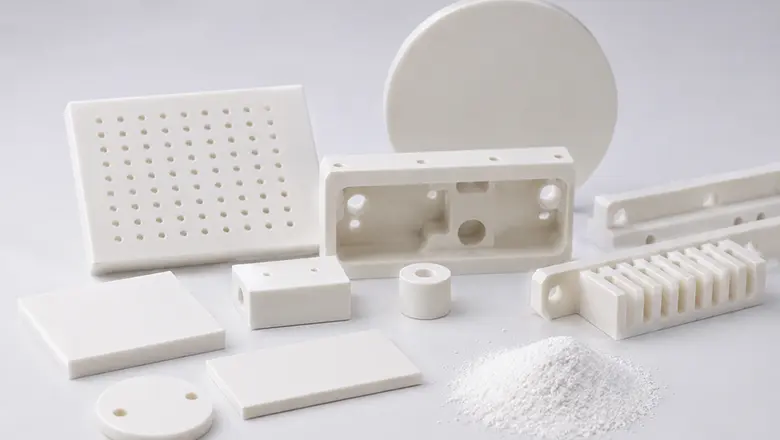
Alumina is the chemical compound with the formula Al₂O₃. It consists when aluminum workts with oxygen, to produc a crystalline, hard, and high-melting-point ceramic material. This natural mineral is found as corundum—it include the gemstones ruby and sapphire—but is also produced from bauxite ore in vast industrial quantities.
Key Properties of Alumina:
- Chemical formula: Al₂O₃ (2 aluminum atoms, 3 oxygen atoms)
- Crystal structure: Hexagonal close-packing (α-alumina)
- Color: White, colorless when pure; color different with impurities in crystals
- Hardness: Mohs 9 (second only to diamond)
- High melting point: ~2072°C (it is high for ceramic plates or components)
- Wear resistance: Good, outlasting most metals and polymers in abrasive settings
- Thermal stability: Outstanding, not decompose or melt under most practical conditions
Why Is Alumina Important?
- It is used as a raw material for alumina powder in some technical ceramics and advanced composites.
- Fundation to the manufacture of aluminum metal, abrasives, cutting tools, bio ceramics, capacitors, and some mores.
- Alumina ceramics usually used in a diverse range of high-temperature and applications.
Properties of Alumina: Why is it Used in Advanced Ceramics?
The properties of alumina normally makes the standard for electronic, structural, and high-performance ceramics. Here is why:
Key Thermal and Electrical Properties of Alumina (Al₂O₃)
| Property | Value (Typical) | Explanation |
| Density | 3.95–4.0 g/cm³ | High density, robust mechanical support |
| Hardness | 9 (Mohs) | Wear and abrasion resistance |
| Melting Point | 2072°C | Exceptional thermal stability for high-temperature use |
| Thermal Conductivity | 24–30 W/m·K | Good thermal performance, far better than glass or polymers |
| Electrical Conductivity | ~1×10⁻¹⁴ S/m | Very low, almost a perfect insulator at room temperature |
| Dielectric Strength | 10–20 kV/mm | High-voltage insulation, breakdown rarely occurs |
| Relative Permittivity (εr) | 9–10 | High dielectric constant, excellent for capacitors and RF circuits |
| Chemical Resistance | Excellent | Does not react with most chemicals or gases |
| Thermal Expansion Coefficient | 7–8 × 10⁻⁶ /°C | Matches many metals used in electronics |
Alumina Conductivity: Electrical and Thermal Conductivity Explained

Is alumina conductive? Let’s analyze both aspects—electrical conductivity and the thermal conductivity.
Electrical Conductivity:
- Alumina’s electrical conductivity is very low.
- Excellent electrical resistance beca use of the lack of 3 electrons or ion-conductive pathways.
- It is using in applications where electrical insulation is mandatory—such as spark plug insulators, substrate materials for power electronics, and housings.
Thermal Conductivity:
- Alumina is a thermally conductive ceramic material, and its thermal conductivity is much better than that of glass or other plastics.
- To allow heat to pass through efficiently on thermal management in electronic circuits and high-power LEDs.
- To combination of properties makes alumina unique: it is good thermal conductivity plus high electrical insulation.
Electrical Conductivity of Alumina Ceramics
Why is Alumina Not Conductive?
- There are strong ionic/covalent bonds in aluminum and oxygen the crystal lattice, it waslock electrons in specific positions simultaneously.
- Wide energy bandgap (8.8 eV+) prevents the flow of electric current.
Conductivity of Alumina vs. Other Materials
| Material | Electrical Conductivity (S/m) | Thermal Conductivity (W/m·K) | Use in Circuits |
| Aluminum | 3.8×10⁷ | 237 | Conductor, heat sink |
| Copper | 5.96×10⁷ | 400 | Conductor, heat sink |
| Alumina (Aluminum Oxide) | ~1×10⁻¹⁴ | 24–30 | Insulator, substrate |
| FR-4 (Epoxy/Glass) | <1×10⁻¹⁴ | 0.3–0.4 | PCB substrate |
| Alumina Ceramic Plate | ~1×10⁻¹⁴ | 24–30 | Insulator, heat spreader |
Is Alumina an Excellent Electrical Insulator?
Alumina stays a leadingceramic material thanks to superb electrical insulation. High-purity alumina keeps high resistivity under high voltage and frequency, blocking electric current efficiently.
Key Points:
- Dielectric strength: 10–20 kV/mm—cause value for ceramic materials.
- Minimal electrical leakage: The circuit is protected even when exposed to high-voltage surges, so the current flowing through the alumina substrate is almost negligible..
- Frequency stability: The insulating properties of alumina ceramics in the microwave range (GHz frequency) make them an ideal material for advanced communication equipment.
Why Use Alumina as an Electrical Insulator?
- In the field of power electronics, substrates that simultaneously possess high thermal conductivity and electrical insulation are advantageous, and are therefore commonly used in MOSFET and IGBT modules. Alumina, in particular, possesses both heat dissipation properties and the ability to prevent leakage between terminals.
- Alumina ceramics feature electric breakdown resistance and high heat resistance, widely used for automotive spark plug insulators.
- High-purity alumina substrates are preferred in RF and microwave units to reduce signal loss and interference. Its purity and crystal quality cut high-frequency energy loss effectively.
High Thermal Conductivity of Alumina: How Does It Work?

High thermal conductivity in alumin ceramics is not a coincidenc—it is result of both chemistry and processing:
Mechanisms of Thermal Conductivity:
- Phonons: Ceramics trans the heat through lattice vibrations instead of electronic The stable crystal structure of alumina can enable efficient phonon transmission.
- Grain boundaries and purity: High-purity alumina have few internal flaws and grain boundary resistance, but also gaining good thermal conductivity.
- Thermal stability: Alumina retains stable thermal performance moree 1000°C, outperforming polymers and glass materials.
Industrial Applications Requiring Thermal Management and Electrical Insulation:
- LED modules: Alumina normally use for ceramic PCB substrates, since it moves heat efficiently away from power a LEDs, can reduce thermal stress and improve the devices’
- Power transistors and amplifiers: High thermal conductivity can ensure the components remain cool even under max load, when the insulator properties prevent catastrophic failure.
- Semiconductor manufacturing: Wafer chucks and component carry is made of high thermal conductivity alumina, in order to ensure dimensional stability, also heat flow during rapid processing cycles.
Alumina Ceramics: Industrial Applications and Case Studies
Alumina ceramics are used in expanding range of fields, due to its unique combination of properties:
Leading Applications
- High Voltage Insulators: Transmission line insulators, circuit breaker supports, and bushing materials rely on alumina for both mechanical and electrical resistance.
- Wear-Resistant Components: Pump seals, valve seats, nozzles is use alumina ceramics for the resistance to abrasion but corrosion.
- Bioceramics: Orthopedic implants, dental prosthetics, surgical knife blades exploit the wear resistance, chemical inertness, and bio compatibility high purity alumina.
- Capacitors and Advanced Electronics: Alumina powder is the found of mult layer ceramic capacitors (MLCCs), temperature-stable filters, and passive components.
- Thermal Interface Materials: Alumina fillers will provide both electrical insulation and excellent thermal performance.
Case Study: High-Power LED Substrates
An LED manufacturer replaced FR-4 circuit boards with alumina ceramic boards for their industrial high-bay lighting line:
- Result: 5x longer product life, 30% lower operating temperature, zero field will return for insulation failures—attributed to the thermal conductivity and electrical insulation properties of alumina directly.
Insulating Properties of Alumina in High-Temperature Applications
High-temperature applications demand materials that include both thermal and electrical properties. Alumina’s thermal stability is the second cost-effective ceramics.
- No softening or melting below 2000°C: Alumina is dimensionally stable.
- Chemical resistance: Inert most acids, alkalis, and solvents more at high temperatures.
- No ion migration: In order to prevents current leakage and material degradation under electric field stress.
Use Cases:
- Industrial heaters and kilns: Alumina plates and tubes survive harshest cycles.
- Igniters and fuse components: Alumina electrical resistance is unchanged for years of high-voltage arce.
- Vacuum and aerospace: No out gassing—vital for high-reliability, mission-critical systems.
Manufacturing with Alumina Powder & Advanced Ceramic Composites
Alumina can be produced by several industrial processes, it starts from purified bauxite ore. The powder’s purit, particle size, morphology are tailored of the final component.
Processing Steps:
- Calcination: Produce phase-pure alumina powder in advanced ceramics.
- Forming: Techniques also include tape casting (for thin plates), iso static pressing (for dense shapes), extrusion (for tubes and rods).
- Sintering: The component is fire in high temperatures, in order to achieve full density and max both thermal conductivity and insulation properties.
- Finishing: Machining, metallization (for PCBs), the surface treatments is usually applied in order to meet electrical and mechanical requirements.
Ceramic Composites:
- When a higher performance is need, alumina is blended with zirconia, silicon carbide, or other reinforcements for tailore combination of properties (toughness, thermal shock resistance, etc.).
Grade and Purity: How Purity Alumina Affects Conductivity
High purity alumina (≥99%) is needed for below demand applications:
- Higher electrical resistance: Fewer ionic impuritis means less current leakage.
- Greater thermal conductivity: Impurity-free crystals can allow the more effective phonon travel.
- Stable dielectric constant: Needed for precision RF/microwave circuits, low-loss resonators.
How Purity Affects Alumina Properties
| Purity Grade (%) | Electrical Conductivity (S/m) | Thermal Conductivity (W/m·K) | Typical Applications |
| 96 | ~1×10⁻¹⁴ | 24 | Standard ceramics, PCBs |
| 99 – 99.6 | Lower (better insulator) | 27–29 | RF, bio, high-reliability |
| 99.99+ | Ultra-low | 30+ | Semiconductor/sapphire, high-frequency |
Comparing Alumina vs Other Oxide Ceramics and PCB Substrates
Alumina ceramics vs. FR-4 (epoxy/glass):
- Thermal conductivity: Alumina 24–30 W/m·K vs. And FR-4’s 0.3.
- Electrical insulation: Both good, only alumina remains stable at higher voltages & frequencies.
- High-temperature limit: Alumina will operate over 1000°C, FR-4 degrades at 130°C–150°C.
Alumina vs. Aluminum Nitride (AlN):
- AlN: Higher thermal conductivity (up to 170 W/m·K) but more sensitive to moisture and more expensive.
Frequently Asked Questions: Electrical Resistance, Insulation, and Conductive Behavior
Q: Is alumina conductive at high temperatures?
A: No, unless melted (~2072°C) or maybe high doped; it remains an excellent electrical insulator up to their point.
Q: Are aluminum oxide ceramics used in PCB manufacturing?
A: Yes! Alumina is important to ceramic PCBs, even for high-power and RF/high-frequency designs.
Q: Can alumina be made conductive?
A: Only by doping with specific metal oxides, and it loses their insulation benefits—rarely use in practice.
Q: Are all alumina ceramics the same?
A: No. Grade, purity, and microstructure (grain size, porosity) dramatical affect both thermal and electrical properties.
Visual Examples: Alumina in Real-World Devices
- Industrial power module: Ceramic plate was made by 96% alumina for thermal conductivity and electrical insulation.
- Medical implant casing: It made of high purity alumina for biocompatibility and electrical isolation.
- LED module: SMD power LED usually bonded to an alumina ceramic substrate, it can ensure longevity, thermal performance.
- RF filter substrate: 6% alumina also tune for high dielectric constant in low loss tangent.
Conclusion: Why Alumina Remains Crucial for Conductivity & Thermal Management
Alumina—well known as aluminum oxide (Al₂O₃) or aluminium oxide—it stands unrivaled in the world of advanced ceramics due to their unique combination of electrical insulation and good thermal conductivity. It combination of properties can makes alumina ceramics indispensable in critical industrial applications demanding both high thermal performance and electrical safety.
Key Takeaways
- Alumina is not electrically conductive and serves as an excellent electrical insulator in the most demanding environmens. Its electrical properties are stable on a very high voltages and frequencies, it making the substrate of choice for RF, microwave, and power electronic systems.
- The thermal conductivity of alumina far surpasses most oxide ceramics and all good plastics, it deliver efficient thermal management for components and it generate significant heat, for example LEDs, power modules, and automotive electronics.
- High purity alumina can ensures the lowest electrical conductivity, highest reliability, and consistent dielectric properties, it is necessary for medical, aerospace, and high-frequency telecommunications applications.
- Alumina is used because it resists wear and chemical attack, also it will preserves its insulating properties, a performance even in high-temperature and high-stress settings.
Practical Advice for Engineers and Designers
- When designer for high thermal conductivity and electrical insulation, we can verify the grade alumina and ask about micro structure, impurity content. Higher purity and dense grain structure will result in better performance.
- For ceramic PCB substrate selection or high-temperature applications, we need consider alumina’s unmatched thermal stability, wear resistance, and chemical properties.
- In applications electrical insulation and thermal dissipation are equally crucial—for example high-power LED lighting, RF boards, power transistors—alumina is normally used in order to ensure device longevity safety.
- For advanced ceramic designs, to incorporating alumina powder with other ceramic materials, is using composite structures not only can fine-tune properties but also default to alumina for the best combination of efficiency and reliability.
Looking to the Future
As electronics continue to be with higher power densities and smaller factors, the conductivity and electrical insulation properties of materials such as alumina ceramic will become more importantly. Alumina content and the usage of high-purity, one advanced ceramic plates, composites, and substrates, it lead new frontiers in thermal management, electronics manufacturing, and industrial equipment durability.
Is Alumina Right for Your Application?
If customer is looking for a ceramic material, which can handle thermal extremes, preserve electrical isolation, and last years without degradation, alumina remains a top choice. their application stretches from the humblest ceramic board to the highest tech semiconductor component. The science is clarify: for a blend of insulation properties, good thermal conductivity, and resilience below stress, nothing outperforms for alumina ceramics.
Ready to harness the unique potential and durability of alumina ceramics for your next project?
Consult with a technical ceramics supplier, specify the right grade and purity alumina for your needs, and unlock a new level of performance in your industrial, automotive, power, or high-frequency electronic designs.
Alumina is not just a ceramic. It’s the foundation of thermal management and electrical safety for the future of electronics.