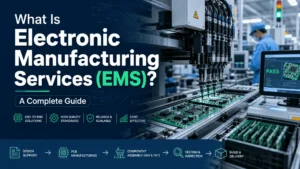

Pick up almost any electronic device on your desk right now, and there’s a good chance the company whose logo is on it never actually built the thing. This is how the electronics industry works today.
Behind most consumer brands is a network of manufacturing partners who handle the actual assembly/testing and packaging. That’s the world of Electronic Manufacturing Services (EMS).
What Is Electronic Manufacturing Services (EMS)?
Electronic Manufacturing Services (EMS) are contract manufacturing and value-added services that handle the manufacturing side of electronics on behalf of Original Equipment Manufacturers (OEMs). EMS companies may get involved in designing, assembling, testing, compliance, and shipping products under someone else’s brand name.
The integrated EMS model helps OEMs access specialized processes and skilled personnel without large in-house investments. They don’t have to build their own factories and source every component. They hand all such activities to the EMS provider and focus their own energy on product design and sales.
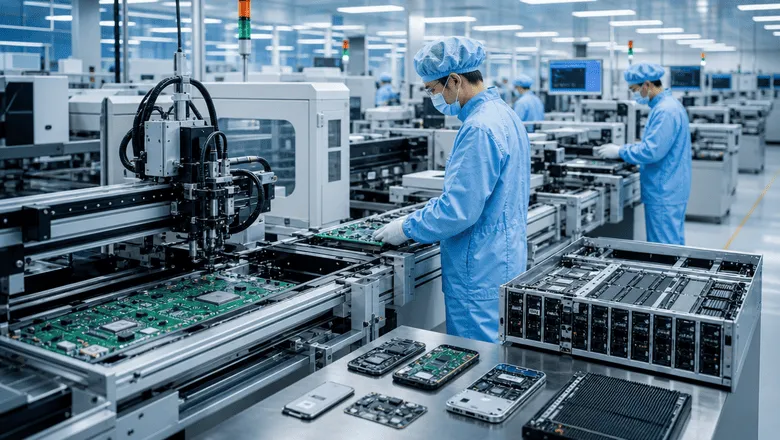
This is the arrangement of many of the world’s top electronics brands, which rely on global EMS partners such as Foxconn, Jabil, and Pegatron to mass‑produce smartphones, servers, medical devices, and automotive electronics.
What Are Core Electronic Manufacturing Services (EMS) Capabilities/Offerings?
A good EMS partner offers a wide range of services under one roof. Some of the common offerings are as follows:
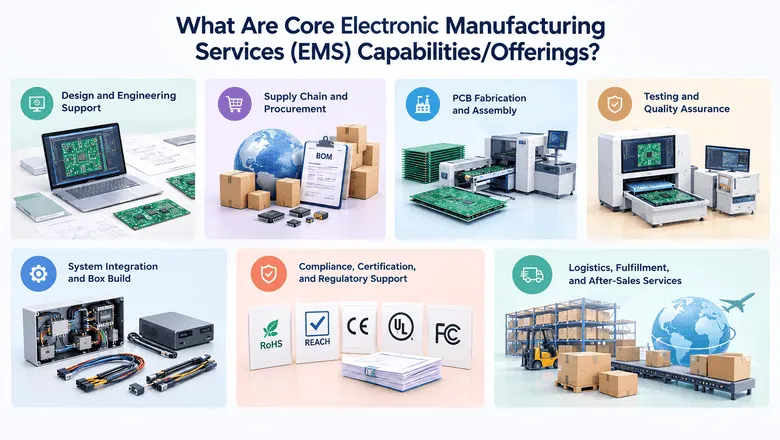
Design and Engineering Support
- Schematic capture and printed circuit board (PCB) layout assistance
- Design for manufacturability/testability/cost (DFM/DFT/DFC) reviews
- Prototyping and New Product Introduction (NPI) support
- Component selection, lifecycle and obsolescence planning
- Value engineering and cost‑optimization suggestions
Supply Chain and Procurement
- Turnkey component sourcing from authorized distributors
- BOM management and risk mitigation (shortages, EOL)
- Vendor‑managed inventory (VMI), just‑in‑time (JIT), and consignment models
- Counterfeit‑part controls and traceability by lot/serial
PCB Fabrication and Assembly
- Bare PCB fabrication coordination or in‑house production
- Surface‑mount technology (SMT) assembly for high‑density boards
- Through‑hole (THT) and mixed‑technology assembly
- Fine‑pitch, BGA/QFN placement
- Rigid‑flex and HDI capabilities
- Conformal coating/potting and other protective processes
Testing and Quality Assurance
- In‑circuit test (ICT), flying probe, and functional test (FCT)
- Automated optical inspection (AOI) and X‑ray for hidden joints
- Environmental and reliability screening
- Test‑fixture design and software/firmware loading
- Quality systems aligned to IPC, ISO 9001, ISO 13485, AS9100, etc.
System Integration and Box Build
- Full electromechanical assembly
- Cable and wire‑harness fabrication and testing
- Sub‑assembly integration into finished products
- Labeling, kitting, packaging, and ready‑to‑ship configuration
Compliance, Certification, and Regulatory Support
- Guidance on RoHS, REACH, WEEE, CE, UL, FCC, and other marks
- Documentation support for audits and customer requirements
- Industry‑specific compliance (medical, automotive, aerospace, defense)
Logistics, Fulfillment, and After‑Sales Services
- Warehousing and order fulfillment, along with global distribution
- Configure‑to‑order and last‑mile customization
- Repair and RMA handling
- End‑of‑life management and last‑time‑buy coordination
Don’t expect every electronic manufacturing services company to showcase all the above capabilities.
Benefits of Using EMS
Electronic manufacturing services (EMS) solves many real problems for companies and gives them the room to focus on product innovation and brand building.
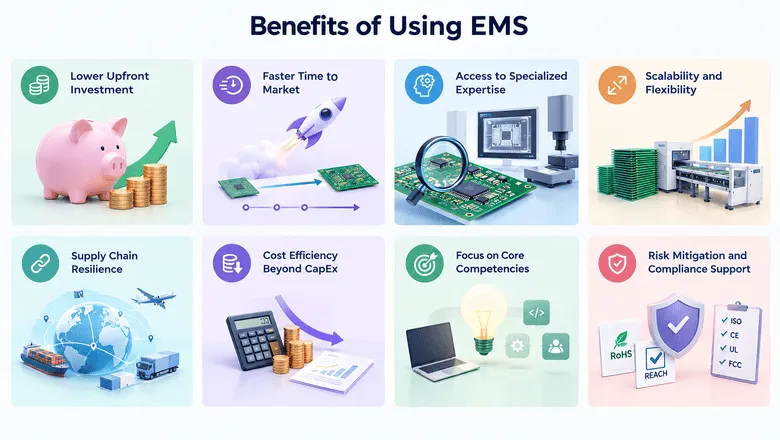
Lower Upfront Investment
Building a factory and buying equipment is capital‑intensive. EMS turns those fixed costs into variable ones, so you pay per unit without ever funding a whole production line.
Faster Time to Market
EMS partners already run mature lines and NPI processes. That means quicker handoffs from prototype to volume, which can cut weeks or months off your launch timeline.
Access to Specialized Expertise
Fine‑pitch soldering, X‑ray inspection, complex multilayer PCB assembly, and similar activities require equipment and know-how that most companies don’t have reason/capacity to build internally.
EMS providers keep investing in advanced lines and engineering talent, so you get high yields and fewer respins without hiring specialists yourself.
Scalability and Flexibility
Demand swings are easier to handle when you don’t own the factory floor. EMS partners absorb spikes and seasonal runs, along with design changes, without leaving you with idle capacity or layoffs.
Supply Chain Resilience
Established EMS providers have stronger supplier relationships and more flexibility to navigate shortages or disruptions than a single company sourcing independently. Their centralized procurement and risk programs help you ride out shortages and avoid line stoppages.
Cost Efficiency Beyond CapEx
Outsourcing saves on factory and machinery costs, but there is more to offer. It also reduces labor, overhead, and other hidden costs, such as excess inventory and write‑offs. Mature lean processes and volume purchasing often deliver significantly lower total manufacturing costs.
Focus on Core Competencies
Handing off production frees your team to work on R&D, software, branding, and IP, which are the real differentiators. This shift speeds innovation and reduces day‑to‑day manufacturing headaches.
Risk Mitigation and Compliance Support
Experienced EMS providers embed quality and regulatory compliance (RoHS, REACH, ISO, industry standards) into the build process. That lowers the risk of recalls and failed audits.
Industries That Rely on EMS
Electronic manufacturing services have integrated into every corner of the electronics world. Their use case is evident in:
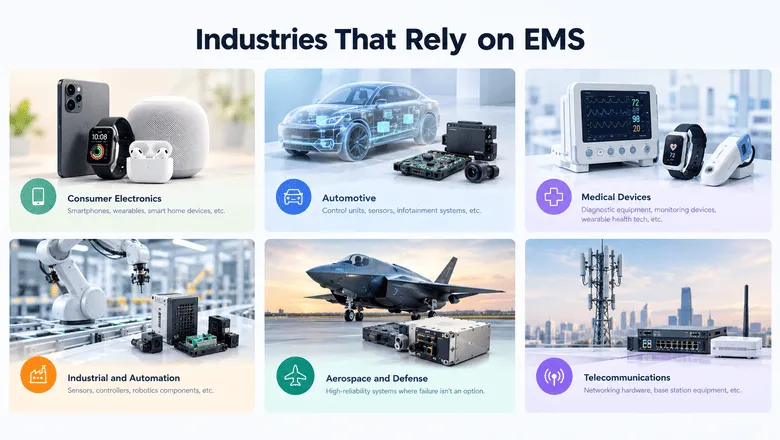
- Consumer electronics: smartphones, wearables, smart home devices, etc.
- Automotive: control units, sensors, infotainment systems, etc.
- Medical devices: diagnostic equipment, monitoring devices, wearable health tech, etc.
- Industrial and automation: sensors, controllers, robotics components, etc.
- Aerospace and defense: high-reliability systems where failure isn’t an option.
- Telecommunications: networking hardware, base station equipment, etc.
Each of these industries brings its own certification requirements and quality standards. So, choosing the right EMS company matters so much because not every provider is equipped to handle every kind of product.
How to Choose the Right EMS Company
Different electronic manufacturing services companies have different expertise. This requires matching their certifications and technical capabilities to your product’s requirements before you commit. You can explore our guide on Top 15 PCB Assembly Manufacturers in China or consider the following factors in shortlisting the right EMS company:
Certifications and Compliance
Look for ISO 9001 as a baseline, plus industry‑specific marks like ISO 13485 (medical), AS9100 (aerospace/defense), IATF 16949 (automotive), and so on. Confirm RoHS/REACH compliance and workmanship standards such as IPC‑A‑610 to match your product’s risk profile.
Technical Capabilities
Make sure the provider can handle your board’s complexity, such as fine‑pitch components, high layer counts, mixed SMT/THT, and any special processes (conformal coating, potting, box build). Ask about their test coverage (AOI, X‑ray, ICT, functional test) and whether they support DFM/DFT feedback early in the design cycle.
Industry Experience
A partner that has shipped products in your sector will have a better understanding of failure modes and compliance traps. Review case studies or references in your space (medical, industrial, automotive, consumer) to gauge how well they will translate your requirements into reliable builds.
Capacity and Scalability
Confirm they can cover your current volumes and scale during demand spikes or product refreshes. Look for multi‑site options and flexible line allocation with clear NPI‑to‑volume pathways.
Communication and Location
When problems come up, or schedules change, clear communication and reliable logistics become crucial. Prefer providers with responsive engineering contacts and transparent reporting (yield, lead times, inventory). Plus, a mix of onshore/offshore and nearshore operations can help balance supply chain risk.
Supply Chain Strength
Strong EMS companies run authorized component channels and manage obsolescence. They help identify potential BOM risks early. Ask how they handle shortages, alternates, and manage lifecycle changes. The right partner should help prevent supply issues from stopping production halfway through a run.
EMS vs. OEM vs. ODM
Before we wrap up, let’s clarify these three terms that get mixed up constantly:
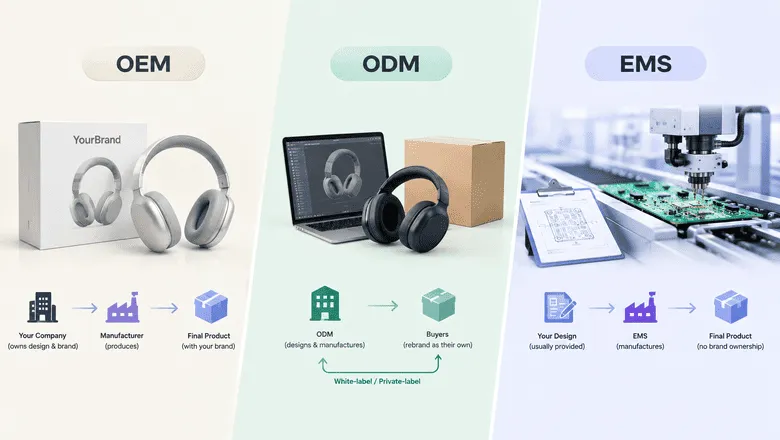
An OEM (Original Equipment Manufacturer) is the company whose name ends up on the finished product. It owns the product design and specifications, but may outsource the actual physical production to a third-party factory.
An ODM (Original Design Manufacturer) is the company that designs and manufactures a product from scratch. Other companies then buy these ready-made products and rebrand them as their own (known as white-labeling or private-labeling).
An EMS (Enterprise Manufacturing Services) sits somewhere in between. It manufactures according to a design that’s usually handed to it, without owning the product or brand itself. However, many EMS companies now offer design support too, so the distinction between EMS and ODM has blurred.
Conclusion
Enterprise manufacturing services have become a backbone of the modern, fast-paced electronics industry. It is encouraging companies to focus on designing great products while letting someone else handle the complicated and capital-intensive work. So, partner with a reliable EMS partner like LHD Tech that offers turnkey PCB assembly and ISO/UL/RoHS-certified quality, with no minimum order quantity.