
Introduction
With the rise of surface-mount technology and ever-smaller electronics, the task of reading a capacitor code and translating capacitor markings into usable values has become crucial for everyone in electronics. Whether you’re an engineer, hobbyist, tech, or student, proper capacitor identification prevents expensive mistakes and keeps circuits healthy.
This guide covers all aspects of capacitor codes: from the classic 3-digit and 4-digit code systems on SMD capacitors, through EIA code schemes, to alphanumeric codes, letter code systems for voltage and tolerance, and even ceramic disc and SMD tantalum capacitor markings. Discover the meaning behind capacitor values like 104, 106, or 227, learn to identify ceramic capacitors, recognize surface-mount codes, and use a capacitor code calculator or smd capacitor code calculator for those truly cryptic cases.
What Is a Capacitor Code?
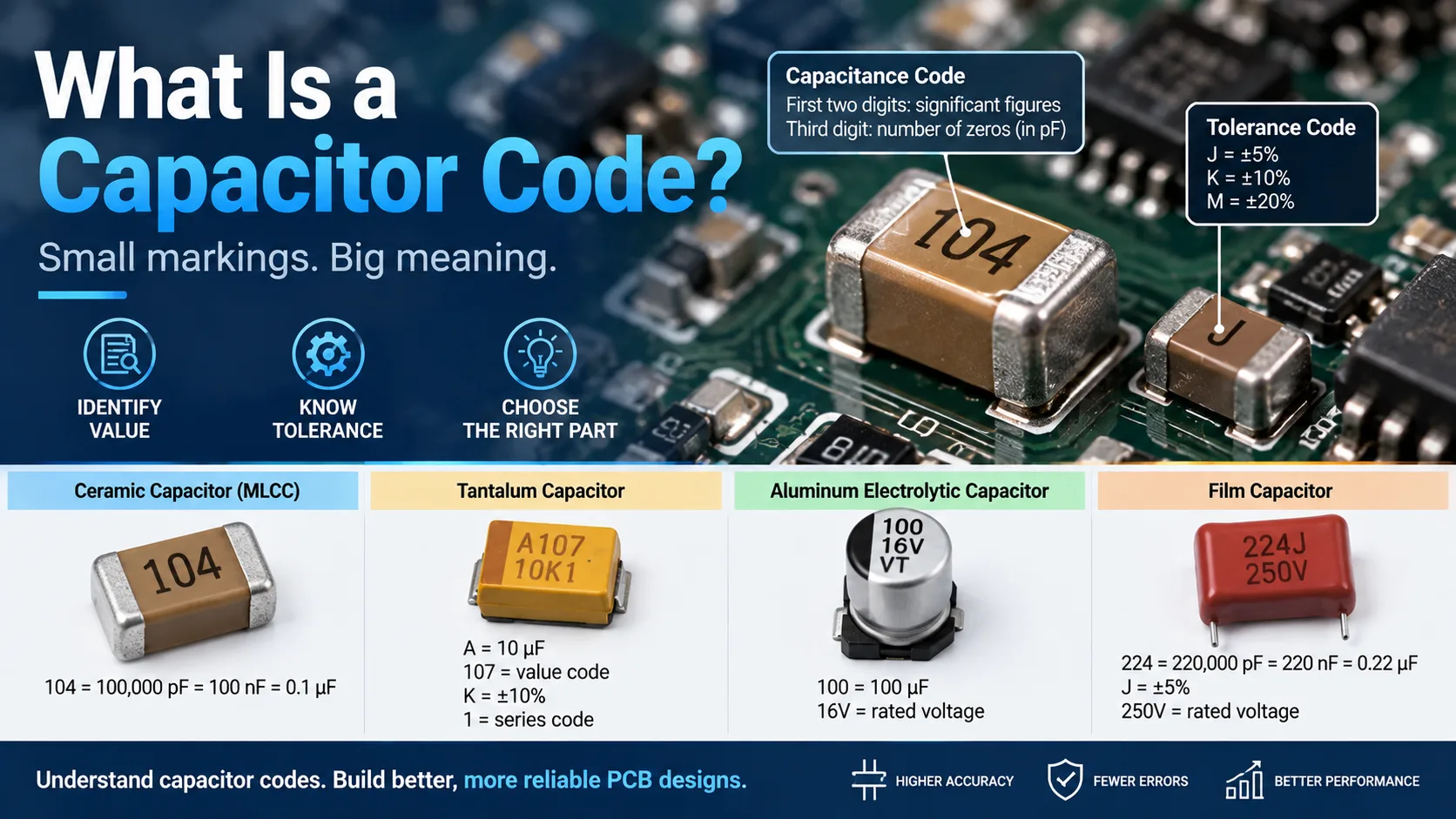
A capacitor code is a standardized number, letter, or color-based system printed on capacitors to convey essential electrical parameters. These parameters typically include:
- Capacitance value (in picofarads (pF), nanofarads (nF), or microfarads (μF))
- Voltage rating (maximum voltage the capacitor can safely withstand)
- Tolerance code (variation from the stated capacitance under normal conditions)
- Temperature coefficient (for some ceramic capacitor types)
- Polarity (for polarized electrolytic and tantalum capacitors)
- Case code and series (primarily for SMD and tantalum capacitors)
Capacitor codes are needed because components have become so small that only a few digits or letters can be printed on the actual body, especially with SMD capacitors.
Understanding the Capacitance Value
The capacitance value tells you how much electrical charge a capacitor can store. It is usually given in:
- Picofarads (pF)
- Nanofarads (nF)
- Microfarads (µF) (microfarads; e.g., electrolytic capacitors, tantalum capacitors)
A capacitor value like 104 means 100,000 pF or 0.1 μF, as explained in the next sections.
Why Are Capacitor Codes Important?
The correct interpretation of a capacitor code is not just about getting the right component in your PCB but also about:
- Preventing circuit failure: The wrong voltage rating or tolerance can result in malfunction, drifting, or complete failure.
- Board integrity: Misreading a polarity marking may cause a tantalum capacitor or aluminum electrolytic capacitor to short or explode.
- Design flexibility: Knowing how to read all types of capacitor markings allows you to freely swap equivalent parts or perform effective troubleshooting.
- Manufacturing traceability: PCB assembly needs reliable information, often based on the code format found on smd capacitors.
Why SMD and Ceramic Capacitor Codes Matter Today
With the dominance of surface-mount capacitors, understanding every type of smd capacitor code is crucial for anyone handling modern electronics. But not all SMD capacitors are marked: many MLCCs (multilayer ceramic capacitors) have no marking and rely on the Bill of Materials (BOM) for traceability.
Understanding Different Capacitor Marking Systems
Capacitor marking systems are categorized based on component type, physical size, and international standards.
Numeric/3-Digit and 4-Digit Codes (EIA-198 and Others)
- 3-digit code system: First two digits = significant figures, third digit = number of zeros added in pF.
-
- Example: 104 → 10 (first two digits) + 4 (third digit) = 100,000 pF = 0.1 μF
- Example: 102 = 1 (first) 0 (second) and 2 zeros = 1000 pF
- 4-digit code: Used where more precision is needed; first three digits = significant figures, fourth digit = number of zeros.
| Code Format | Example | Decoded Capacitance Value |
| 3-digit | 104 | 100,000 pF (0.1 μF) |
| 4-digit | 2003 | 200,000 pF (0.2 μF) |
Note: Use a calculator or code chart for rapid decoding!
Alphanumeric Codes and Letter Systems
- Alphanumeric codes: Add a letter code for tolerance after the numeric value, e.g., 104K (0.1 μF ±10%).
- Voltage code: Often a letter or pair of letters (EIA, IEC) are used: e.g., “A” = 10V, “B” = 16V, “C” = 25V.
- Tolerance letter code: “K” (±10%), “J” (±5%), “M” (±20%), “Z” (+80/–20%), “F” (±1%), etc.
Color Codes (Legacy)
Though rare on smd capacitors, some older ceramic disc and film types use resistor-like color code markings. A color band system is mapped to numbers, multipliers, and tolerances.
Deep Dive: SMD Capacitor Code Explained
The Basics of SMD Capacitor Codes
SMD (surface-mount device) capacitors dominate current PCB design. The challenge is that many smd capacitors (especially MLCC) are unmarked due to their tiny size, relying entirely on reference designators and the BOM.
For those that are marked, you’d typically see:
- A 3-digit or 4-digit EIA-198 code (e.g. 104, 226)
- A unit, such as µF or nF (common for electrolytic SMD capacitors)
- Sometimes voltage, tolerance, or case letter codes if space allows
Quick Tips:
- MLCC (ceramic capacitor): Often unmarked! Always reference your BOM or use an LCR meter.
- SMD tantalum capacitors: Bar or stripe indicates the positive terminal; codes like “106A” mean 10μF, 10 volts, case size A.
- SMD aluminum electrolytic capacitors: Often labeled with value and voltage (“10 16V”), negative stripe on casing shows polarity.
Table: SMD Capacitor Code Features
| SMD Type | Typical Marking Format | Polarity | Application |
| MLCC (ceramic) | None or 3-digit | Not polarized | Decoupling, RF, logic |
| SMD tantalum capacitors | 3-digit + letter code | Stripe = positive | Power, analog |
| SMD aluminum electrolytic capacitors | μF + voltage | Stripe = negative | Filtering, power rail |
Decoding Numeric and Alphanumeric Capacitor Codes
3-Digit Code System: How to Decode
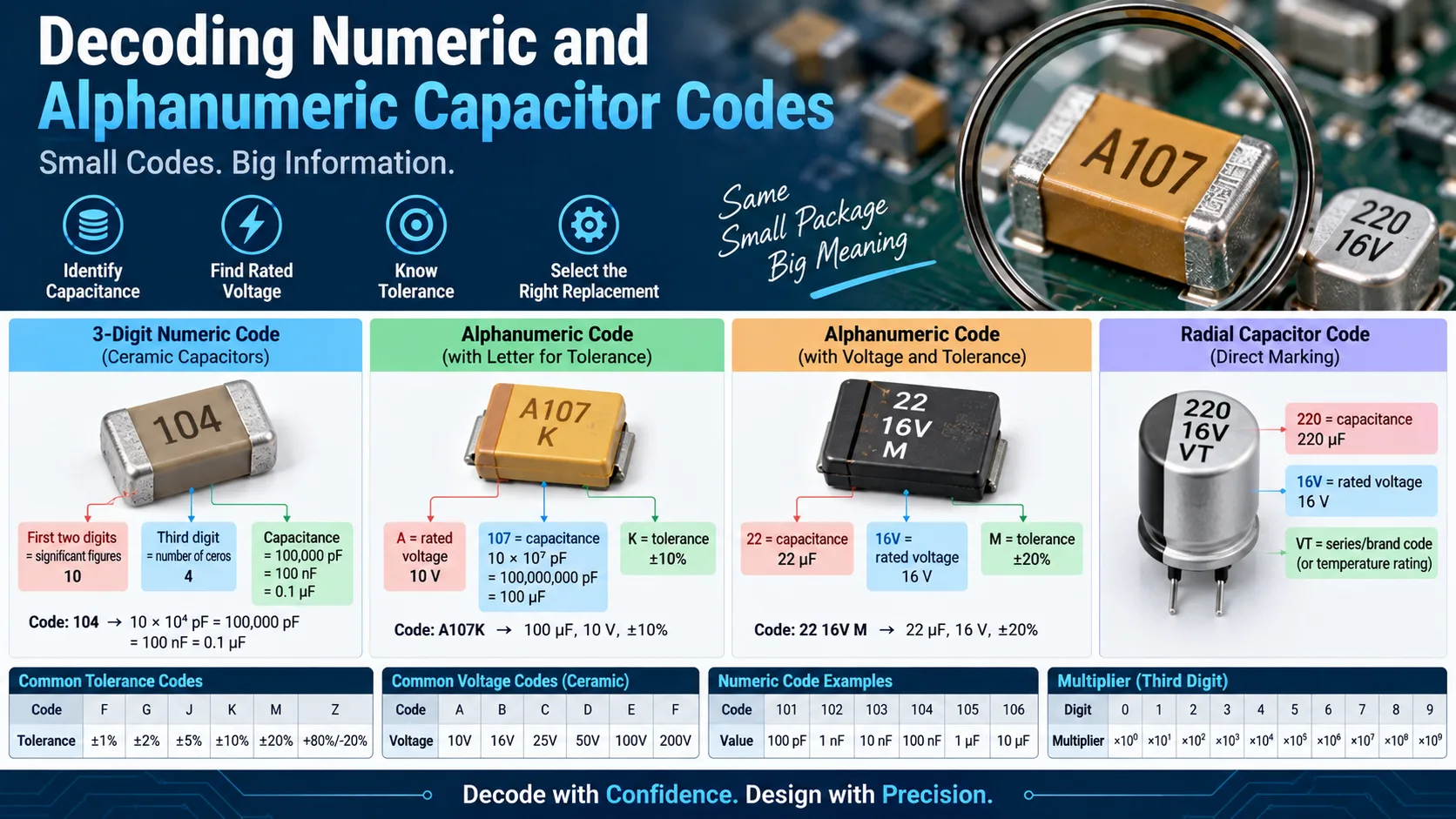
Many small, ceramic capacitor, film, and even tantalum capacitors use the EIA 3-digit code to show value (in pF):
- First two digits: Significant figure.
- Third digit: Number of zeros to add.
3-Digit Code System: More Examples
- 102 = “10” + two zeros = 1,000 pF (picofarads), or 1 nF (nanofarad, since 1,000 pF = 1 nF)
- 221 = “22” + one zero = 220 pF
- 472 = “47” + two zeros = 4,700 pF
- 682 = “68” + two zeros = 6,800 pF
How to Convert a 3-digit Code to a Capacitance Value:
- Identify the first two digits (significant figure)
- The third digit tells you the number of zeros
- The result is the value in picofarads (pF)
- If needed, convert to nanofarads (nF) or microfarads (μF)
-
- 1 nF = 1,000 pF
- 1 μF = 1,000 nF = 1,000,000 pF
Common Capacitor 3-digit Codes and Capacitance Values
| 3-Digit Code | Value in pF | Value in nF | Value in μF |
| 101 | 100 | 0.1 | 0.0001 |
| 102 | 1,000 | 1 | 0.001 |
| 103 | 10,000 | 10 | 0.01 |
| 104 | 100,000 | 100 | 0.1 |
| 105 | 1,000,000 | 1,000 | 1 |
| 223 | 22,000 | 22 | 0.022 |
| 473 | 47,000 | 47 | 0.047 |
| 332 | 3,300 | 3.3 | 0.0033 |
4-Digit Codes: More Precision in High-End or Large Value Capacitors
Certain high-value or precision capacitors (including tantalum capacitors) use a 4-digit code:
- First three digits: Significant figure
- Fourth digit: Multiplier (number of zeros)
- Value is also in pF, and can be converted as above
Alphanumeric Codes and Letter Codes
Alphanumeric capacitor codes incorporate letters for tolerance, voltage rating, and sometimes dielectric material.
Tolerance Code Table (EIA/IEC Standard, see also Tolerance Letter keyword):
| Letter Code | Tolerance |
| F | ±1% |
| G | ±2% |
| J | ±5% |
| K | ±10% |
| M | ±20% |
| Z | +80/-20% |
Voltage Code Table (EIA, see also Voltage Code keyword):
| Letter | Voltage (max) |
| A | 10V |
| B | 16V |
| C | 25V |
| D | 35V |
| E | 50V |
Special Considerations for Ceramic Capacitors and Ceramic Disc Capacitors
Ceramic capacitors (especially MLCCs and ceramic disc types) frequently use EIA 3-digit or 4-digit codes, sometimes with tolerance and temperature coefficient:
- C0G (NP0), X7R, Y5V: These are dielectric codes, not value or voltage codes.
-
- C0G/NP0 = best stability for timing/RF
- X7R = general use (±15% across temp)
- Y5V = large value, lower stability (up to +22%/-82% across range)
SMD Tantalum and SMD Aluminum Electrolytic Capacitors
For surface-mount tantalum capacitors:
- The code often reads “value + voltage + case/mfr suffix” (e.g., 106A, 227C)
- Stripe denotes the positive terminal (anode)
- Tolerance is usually ±10% (K) or ±20% (M)
- Always check maximum voltage and polarity before installation!
For smd aluminum electrolytic capacitors:
- Marking may be large: “10 16V” means 10 μF, 16V maximum voltage.
- Stripe on the can = negative terminal.
- Capacitance tolerance is usually ±20% (M).
- Known for large capacitance value (e.g., 47 μF, 100 μF, 220 μF) at low voltages, ideal for power filtering.
EIA Code, EIA-198, and Other Standardization Bodies
- EIA-198 is the most common standard for three-digit and four-digit capacitor codes, especially for SMD and ceramic capacitor formats.
- Always check which code format your supplier or component series uses! Some Japanese, European, or legacy US capacitors use alternate systems (or direct decimal point and letter markings for microfarads or nanofarads).
Tolerance Code, Value in Picofarads, and Decimal Point Tips
- For codes that include a decimal point (such as “4.7n”), this usually means nanofarads (nF), but some capacitors use “4u7” for 4.7 μF in surface-mount.
- Value in picofarads is always without decimal point; e.g., 104 = 100,000 pF.
- Tolerance letter code is always right after the numeric code, e.g., “103J” or “224K”.
Using Online Capacitor Calculators & Tools
Capacitor identification is made easier with digital tools:
- Capacitor code calculator: Input the 3-digit or 4-digit code, get the capacitance value in pF, nF, and μF.
- SMD capacitor code calculator: Specialized for SMD style marking systems, particularly with EIA-198 and alphanumeric codes.
- Use calculators to convert or decode codes like 104, 106A, or 227C when referencing unfamiliar smd capacitor code systems.
Practical Applications and Troubleshooting
Common Problems & How to Avoid Them
- Wrong value: Substituting a 104 for a 105 could mean the difference between 0.1 μF and 1 μF—ten times the capacitance.
- Polarity errors: SMD tantalum capacitors and aluminum electrolytic capacitors are polarized—reversing polarity can cause catastrophic short or explosion.
- Wrong voltage rating: Installing a 10V on a 12V rail may cause failure; always confirm the voltage code or marked voltage value.
- SMD identification: For unmarked MLCCs, always refer to BOM or verify with LCR meter.
- Mixing up nanofarads: 223K is 22 nF, 224K is 220 nF. The third digit tricks many, especially when switching between pF and nF.
Tips and Advanced Tricks for Decoding Capacitor Codes
- When no marking is present (common in tiny SMD capacitors), consult your PCB’s BOM or measure with an LCR meter.
- Look for decimal point clues: “4u7” (surface-mount) or “4.7μ” means 4.7 μF. “1n0” means 1.0 nF (nano, or 1,000 pF).
- Case size matters: Especially with smd tantalum capacitors. Code like 106A = 10 μF, A case, 10 V.
- Be cautious of code overlaps: The code 104 can mean 0.1 μF, but never 1 μF.
- Remember EIA code standards vary internationally and by series—double-check with datasheets.
How to Decode SMD and Ceramic Capacitor Values in Practice
Step-by-step example with an SMD capacitor code:
- Suppose a SMD capacitor has the code “104K”.
-
- “104” → first two digits: 10; third digit: 4 zeros → 100,000 pF.
- Convert to nF: 100,000 pF ÷ 1,000 = 100 nF.
- Convert to μF: 100 nF ÷ 1,000 = 0.1 μF.
- “K” tolerance code: ±10%.
- If it’s a ceramic capacitor, this is a common decoupling value.
For a SMD tantalum capacitor marked “227C”:
- “227” → 22 × 10,000,000 = 220,000,000 pF = 220 μF.
- “C” → voltage rating code, typically 25V (check the EIA code chart).
- Stripe denotes positive (anode) terminal in SMD tantalum capacitors.
Capacitance Code Calculators and Tools
Whenever you encounter a 3-digit code, or an unfamiliar value, online tools come to the rescue. Try “capacitor code calculator” or a “smd capacitor code calculator” for rapid conversion between code and standard units.
- Input ‘104’: Output will be 0.1 μF, 100 nF, or 100,000 pF.
- Input ‘223’: Output will be 0.022 μF, 22 nF, or 22,000 pF.
- Tools sometimes also reference tolerance, EIA-198 coding, and SMD case.
FAQs about Capacitor Codes and SMD Capacitor Identification
Q1: What is the difference between a 3-digit code and a 4-digit code?
A: The 3-digit code uses two significant digits plus a multiplier (the third digit gives the number of zeros in pF, based on EIA-198). A 4-digit code uses three significant digits and a multiplier (the fourth digit represents number of zeros), which allows for larger or more precise values.
Q2: Why are some SMD and ceramic capacitors unmarked?
A: Especially in the smallest surface-mount packages, there is physically no room to print a marking. Manufacturers rely on BOM traceability, reference designators, and assembly records to ensure the correct part is placed on the PCB.
Q3: What is the tolerance letter on a capacitor code?
A: After the numeric code, a letter (like K, J, M, or Z) designates the tolerance. For example, K is ±10%, J is ±5%, and M is ±20%. The tolerance code is essential for filter, oscillator, and timing applications.
Q4: How do I know the polarity of a SMD tantalum or SMD aluminum electrolytic capacitor?
A: For SMD tantalum, the stripe marks the positive terminal (anode). For SMD aluminum electrolytic capacitors, the stripe on the case marks the negative terminal (cathode).
Q5: I see “102” and “104” on two capacitors; which has the higher capacitance value?
A: “104” = 100,000 pF; “102” = 1,000 pF. So, 104 has the higher value.
Q6: Can I use a ceramic capacitor in place of an electrolytic or tantalum capacitor?
A: Sometimes, for decoupling applications, but be careful—ceramics are non-polarized, have different ESR, and may not offer enough capacitance at high values or low voltages. Always check voltage rating and application needs.
Q7: How do I convert µF, nF, and pF for capacitor values?
A:
- 1 μF = 1,000 nF = 1,000,000 pF
- 1 nF = 1,000 pF Use these conversions alongside your code calculator.
Q8: Is there a marking for maximum voltage on all capacitor types?
A: Not always, especially on very small ceramic capacitors. For tantalum, aluminum, and SMD types, look for a voltage rating or voltage code marking (e.g., “C” for 25V).
Conclusion & Next Steps
Understanding every aspect of the capacitor code—from the 3-digit and 4-digit systems to tolerance and voltage rating codes—is fundamental for modern electronics design, repair, and production. From the tiniest unmarked MLCC to the largest SMD aluminum electrolytic capacitors, correct identification means reliable circuits, easy repair, and confident design.
Action steps:
- Bookmark or print the tables and use a code calculator for speedy decoding.
- Always verify the marking system, format, and code chart against your physical component.
- Remember, the BOM and schematic are your ultimate references for unmarked SMD capacitors.