
Introduction: The New Era of Electronics Contract Manufacturing
To bringing products in market in the rapid electronics industry requires more than a creative idea. It demands innovation backed by world-class manufacturing expertise, scale processes, also a reliable electronics contract manufacturing company that delivers high-quality, on-time, and cost-effective production.
Contract manufacturing is a business model, it has a complete transformed on how OEMs (original equipment manufacturers) scale production, manage risk, we need keep pace with technology. Top electronic contract manufacturers now offer a range of services, including PCB assembly, testing, supply chain solutions, and lifecycle support, becoming true extensions of our team.
Why This Guide? No matter you’re an engineer, operations manager, or sourcing specialist, to master the world of electronic contract manufacturing can mean the difference between market success and obscurity. This can expanded guide explores contract manufacturing services across design, engineering, assembly, after-sales support, and supply chain—offering actionable strategies, tips, and best practices for selecting the right manufacturing partner.
Market Pressures and the Role of Electronics Contract Manufacturers
Why Contract Manufacturing is a Business Model for the Future
Today’s electronics industry faces relentless competition, shorter product cycles, and complex supply chain reality. Contract manufacturing companies allow OEMs to:
- Accelerate time to market for both consumer electronics and industrial solutions
- Reduce capital expenses by leveraging specialist facility, also advanced equipment
- Access specialized manufacturing and assembly technologies such as SMT, automated inspection, include high-reliability sub assembly services
- Optimize global reach and flexibility through multi, regional, and nearshore contract manufacturing
Role of Electronics Contract Manufacturers
A top electronics contract manufacturer acts not more than a supplier; they become an extension of our team, to provide expertise in design, process optimization, compliance, and also customer logistics. This deep integration is vital for OEMs launching complex electronic products in regulated markets like medical device and aerospace.
What Are Electronic Manufacturing Services (EMS)?
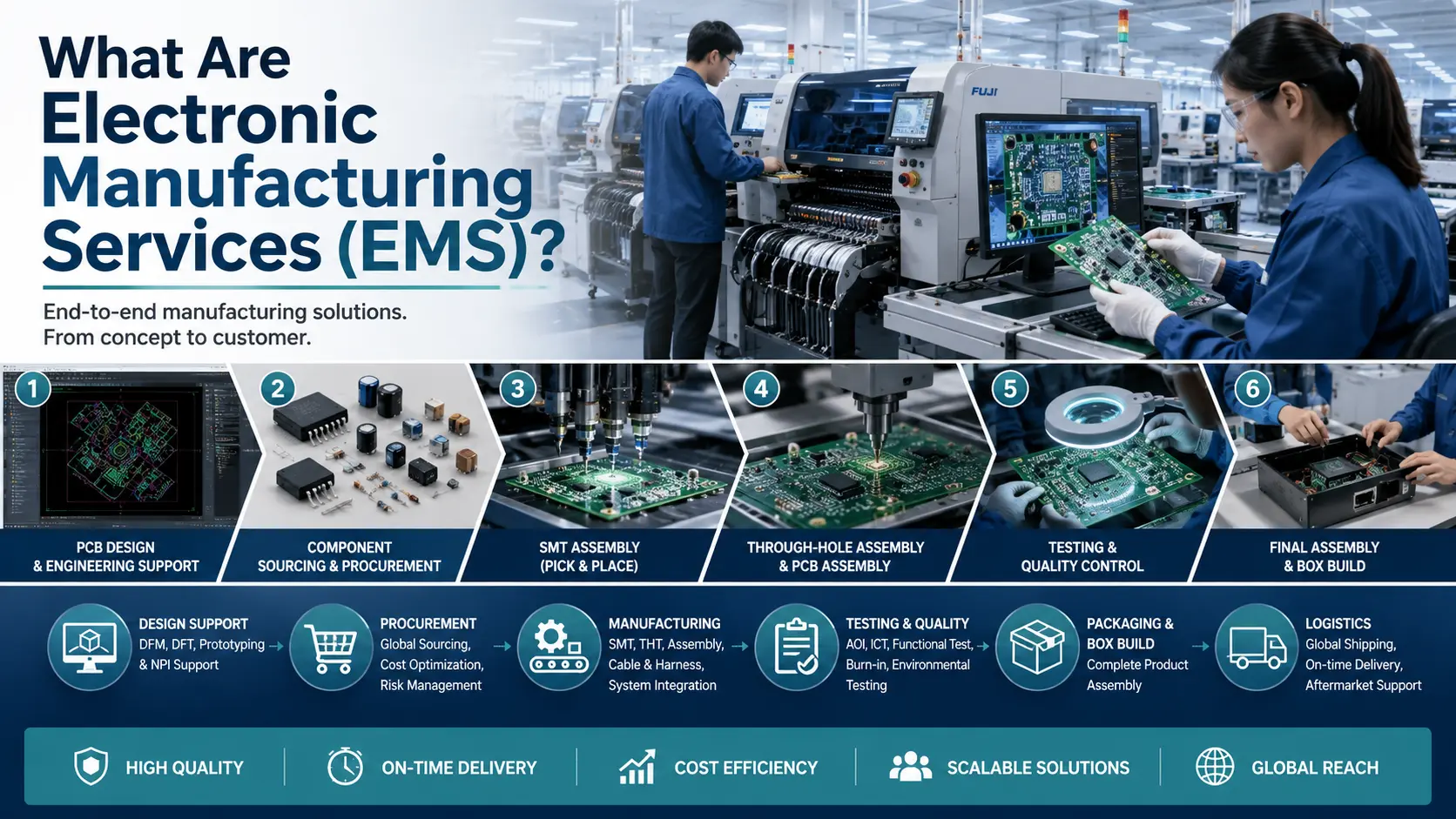
Electronic manufacturing services (EMS) encompass a suite of services delivered by specialized companies already known as EMS providers or contract manufacturers. These production services are designed for OEM and to outsource key manufacturing processes, benefit from advanced engineering, and scale production without heavy capital investment.
Services Vary, But the Core EMS Suite Includes:
| Service Category | Capabilities & Examples |
| PCB, PCBA, & Printed Circuit | Surface mount, through-hole, BGA, HDI, rigid/flex; quick-turn PCB manufacturing and PCB assembly |
| Cable Assemblies & Subassembly | Custom cable harnesses, over-molded connectors, panel builds, and mechanical subassembly services |
| System Integration & Box Build | Complete product assembly, including enclosures, configuration, testing, labeling, and packaging |
| Testing Services | AOI, functional, ICT, environmental, X-ray, and reliability testing services |
| Design Services & Engineering | DFM, DFT, BOM optimization, layout, prototyping, NPI support |
| Supply Chain & Logistics | Global sourcing, vendor managed inventory, traceability, fulfillment, supply chain risk mitigation |
| Aftermarket Services | Calibration, repair, refurbishment, field upgrades, and end-of-life management |
Integrated EMS partners provide manufacturing solutions that include rapid prototype services, multi-market certification, and a full digital record for traceability and compliance.
The Electronic Contract Manufacturing Process: From Concept to Fulfillment
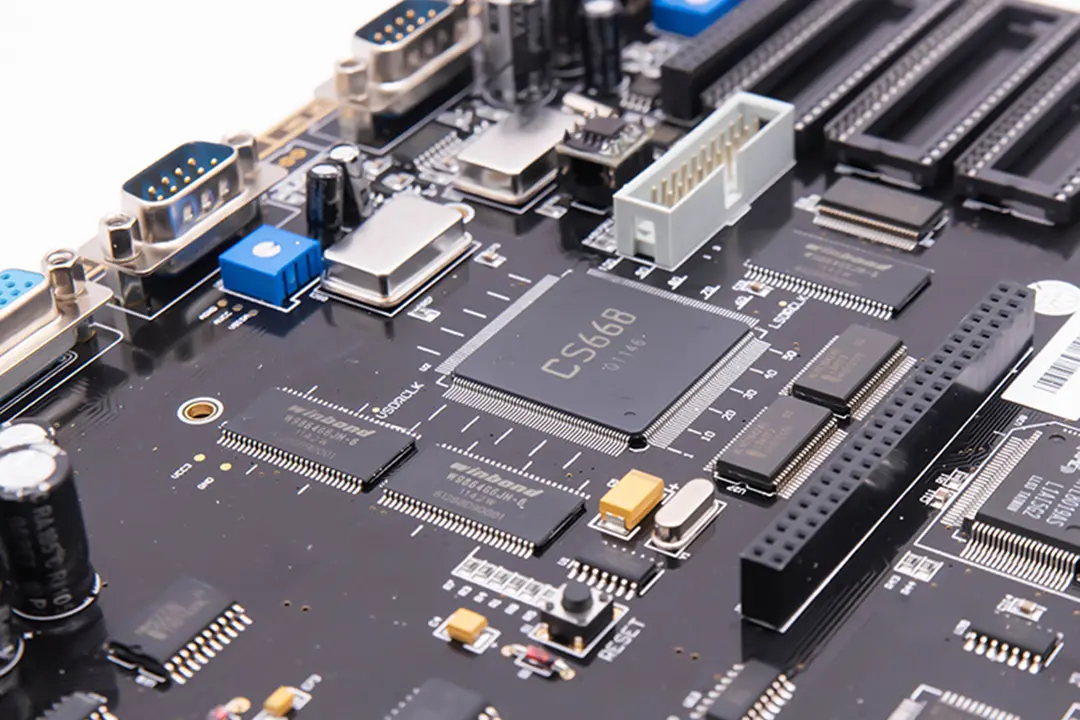
Contract manufacturing services span the entire product lifecycle—starting from design input, through printed circuit board assembly, to direct fulfillment and aftermarket care.
Key Steps in the Contract Manufacturing Journey
Design and Engineering Collaboration
- Early engagement with DFM/DFT experts to optimize designs for manufacturability and testability
- Schematic capture, PCB layout, simulation, and documentation delivered alongside risk and cost analysis
Prototype Development and Quick-Turn Assembly
- Rapid turnaround for PCB assembly—from single prototypes to pilot builds
- Use of advanced machinery and smart supply chain management for timely delivery
Sourcing, Procurement, and BOM Management
- Dynamic supplier evaluation and electronic components substitutions for resilience
- Use BOM management tools to optimize cost and guarantee availability
PCB Manufacturing and Assembly
- High-speed, precision manufacturing services using surface mount technology and automated inspection
- Support for single-sided, multi-layer, HDI, and rigid-flex assemblies
Integration, Subassembly, and Final Assembly
- Subassembly services including cable assemblies, wire harness, power modules, and mechanical subassembly
- System integration, packaging, labeling, and kitting for market-ready final electronic assemblies
Validation and Testing
- Electrical, functional, and reliability testing services—whether it’s AOI, ICT, HALT, or RF signal verification
Aftermarket Services and Obsolescence Management
- Ongoing lifecycle management including repair, refurbishment, recalibration, and redesign for end-of-life components
Global Logistics, Fulfillment, and Customer Distribution
- Direct shipping programs, bonded warehouses, and regional stock for reduced lead times
Certifications and Quality Standards in Electronics Contract Manufacturing
Certification is non-negotiable in the electronics industry. Regulatory bodies demand proof of processes and repeatable excellence, especially for medical device, aerospace, and industrial markets.
Core Certifications and Quality Frameworks
| Certification | Application | Why It Matters |
| ISO 9001 | Quality management for all products | Proven system for consistent results |
| ISO 13485 | Medical device manufacturing | Market access for medical OEMs |
| AS9100 | Aerospace, defense, and high-reliability parts | Essential for aerospace contracts |
| IPC-A-610 | IPC standard for PCB assembly workmanship | Guarantees assembly quality across the board |
| ITAR/REACH/RoHS/Nadcap | Compliance for defense, hazardous, or global trade | Market entry, safe materials, export clearance |
Tips for Certification:
- Always request up-to-date audit documents and examples of continuous improvement initiatives.
- The top electronic contract manufacturers provide copies of certifications, customer awards, and explain their ongoing staff training.
Core Manufacturing Capabilities: PCB, Assembly, and Beyond
The foundation of any electronics contract manufacturer is their suite of manufacturing capabilities. From basic PCB manufacturing to complex assemblies and final testing, the best providers go far beyond “board stuffing”.
PCB & PCBA Manufacturing
- Printed circuit board (PCB) fabrication with high-precision, high layer, and HDI technologies
- PCB assembly with surface mount technology (SMT), through-hole, or mixed; BGA and QFN package experience
- Printed circuit board assembly (PCBA) with advanced soldering, automated inspection, and in-line functional testing
Cable Assemblies, Subassembly, and Mechanical Integration
A trusted electronics contract manufacturing company doesn’t stop at PCBs. By offering cable assemblies, wire harnesses, custom power modules, mechanical subassembly services, and enclosure integration, EMS providers ensure OEMs get a true turnkey solution. Whether you’re building a medical device, industrial controls, or cutting-edge consumer electronics, the precision manufacturing of both electronic components and assemblies is essential for system reliability.
Subassembly services include:
- Modular subassemblies for automation equipment or telecom
- Control panels wired, tested, and serialized before shipment
- Custom enclosure assembly and configuration management for compliance markets
Advanced Manufacturing Capabilities & Integrated Testing
Complex electronic products require more than just basic soldering. Leading EMS partners deliver advanced manufacturing capabilities such as:
- Surface mount technology lines for miniaturized assemblies
- BGA rework and X-ray inspection for high-density PCB assembly
- Automated optical inspection (AOI), in-circuit testing, and statistical process control (SPC) for consistent results
Through rigorous testing services, manufacturers reduce defects, shorten debug cycles, and verify every function and interface. For OEMs, this translates into proven quality and regulatory compliance, whether for medical, aerospace, or advanced industrial devices.
Advanced Product Development and Engineering Support
Product development is where the right EMS partner delivers lasting impact. With integrated design services and DFX (Design for Manufacturability, Testability, Reliability, Cost, Fabrication), manufacturers can optimize both yield and scalability while keeping costs low. This is crucial for high-volume programs, medical device launches, or any situation where direct market access and compliance are at stake.
Services include:
- Schematic capture, PCB layout, and prototype validation—all overseen by experienced electronic and mechanical engineers
- Component selection, cost-down analysis, and supply chain alternative sourcing
- On-site or cloud-based design collaboration tools for rapid data sharing and BOM updates
A right electronics contract manufacturing partner will help OEMs “design for sourcing” by recommending second-source, drop-in-replacement, or even form/fit/function alternatives before BOM lock. This is increasingly valuable amid global component shortages.
Testing, Prototyping, and Quality Assurance
Testing and quality control are at the heart of reliable electronics contract manufacturing. From prototype to mass-produced, every electronic assembly must pass a suite of diagnostics:
Expanded Testing Services
- Electrical and functional testing for finished assemblies and electronic products
- Flying probe testing, ICT, and burn-in for catching latent failures
- AOI and 3D X-ray for solder joints, BGA, and fine-pitch IC inspection
- Environmental and HALT (Highly Accelerated Life Testing) for mission-critical industries such as aerospace and defense
Aftermarket Services & Obsolescence Management
Even the best electronic assemblies require ongoing aftermarket services to remain market-relevant. Leading EMS partners support their OEM clients long after initial shipment:
- Calibration, refurbishment, repair, and field upgrade programs
- Proactive obsolescence management using live supply chain data feeds
- End-of-life redesign (new layout, updated BOM) for products using discontinued electronic components
With constant advances in electronics, scalability and lifecycle support have become major differentiators between ordinary contract manufacturing companies and those truly invested in OEM success.
Strategic Supply Chain Management in Contract Manufacturing
Supply chain resilience is now central to every contract manufacturer’s value proposition. Digital supply chain tools, predictive analytics, and robust global manufacturing networks are used to mitigate disruptions and optimize inventory. Key elements include:
- Multi-region sourcing and vendor-managed inventory for both common and rare electronic parts
- Advanced traceability for every printed circuit, cable assembly, and subassembly shipped
- Real-time supply chain monitoring dashboards and bonded local inventories
At the best EMS partners, supply chain management isn’t just a service: it’s woven into every step of the process, from sourcing to shipment. For regulated or fast-moving industries—be it consumer electronics, medical device, or aerospace—this can be the difference between a successful launch and a costly delay.
Benefits of a Right Electronics Contract Manufacturing Partner

The true value of a right partner for contract manufacturing goes beyond price per build. What sets reliable electronics contract manufacturing companies apart?
Business Benefits and Competitive Advantages
- Accelerated Time to Market: Streamlined prototyping, DFX, and validation get products to market faster than competitors.
- Lower Costs, Higher Quality: No need for CAPEX or in-house advanced manufacturing infrastructure. Benefit from an OEM-grade quality system, mature global supply chains, and automation.
- Scalable Production: Move smoothly from pilot to high-volume, high-mix orders, all within the same factory ecosystem.
- Superior Reliability and Compliance: Certified manufacturing processes ensure each PCB assembly, cable harness, or box build fully meets market requirements.
- Full Lifecycle Support: From new product launches to aftermarket repair, field upgrade, and EOL redesign for longevity in the electronics industry.
How to Select the Right Electronics Contract Manufacturing Company
Tips for Selecting the Right Electronics Contract Manufacturing Partner
- Audit Manufacturing Capabilities: Ensure the EMS vendor has demonstrated experience manufacturing your product type—be it prototype, high-volume consumer electronics, or regulated medical device.
- Evaluate Certifications: Request copies of every core certification (ISO 9001, ISO 13485, AS9100, IPC standards) and ask about recent audit results.
- Assess Engineering and Integrated Services: Prioritize contract manufacturers who offer in-house design services, rapid prototyping, and configuration management.
- Understand Supply Chain Strength: Insist on visibility into supplier management, inventory strategies, and traceability from PCB manufacturing to final assembly.
- Prioritize Communication: The best EMS provider is an extension of your team, offering dedicated account management and digital project dashboards.
Key Partner Evaluation Metrics
| Evaluation Area | What to Look For |
| Technology Fit | PCBA/Assembly lines tailored to your application |
| Certifications | ISO/IPC/market-specific and audit transparency |
| Engineering Support | DFM/DFT for reliability, scalability, and quick design feedback |
| Supply Chain Management | Proactive shortage strategies, VMI, fulfillment tracking |
| Lifecycle Support | Aftermarket services, EOL and redesign experience |
Conclusion: Building the Future With the Right Electronics Contract Manufacturing Partner
To Choose the right electronics contract manufacturing partner is central to product reliability, market success, and long-term growth. The right electronics contract manufacturing company need to do is helps optimize cost, also shorten time to market, to ensure the prototype, high-volume, or mission-critical electronic product exceeds both customer demands and regulatory requirements.
A genuine EMS partner works as an extension of our original equipment manufacturer (OEM) team, it can guiding us from initial product development through PCB manufacturing, assembly, testing, and aftermarket services. Their specialized manufacturing expertise, suite of services, and commitment to quality set the found for produce a reliable, market-leading electronic devices, it can withstand both competition and technological evolution.
From select the right electronics contract factory—one with a strong supply chain series, a full range of services across every manufacturing stage, proven certifications, and a reputation for reliability—our secure company’s place in the future of the global electronics industry.
Frequently Asked Questions About Electronic Contract Manufacturing
1. What is an electronic contract manufacturer?
An electronic contract manufacturer is a third-party company, it will manufactures electronic products or assemblies for OEMs. Their service include PCB fabrication, PCB assembly, component sourcing, testing, box build, and final product integration.
2. What does CEM mean in electronics?
CEM stands for Contract Electronics Manufacturer. A CEM provider outsourced electronics manufacturing services, it was based on the customer’s designs, specifications, BOM, Gerber files, also quality requirements.
3. What is the difference between EMS and OEM?
An OEM designs and sells products under their own brand, while an EMS provider electronic products, include assembly for other companies. EMS services often include PCBA, sourcing, testing, engineering support, and system assembly.
4. How does electronic contract manufacturing work?
The process normally starts with design files, BOM list, Gerber files, and production requirements. The contract manufacturer not only can handles sourcing, PCB fabrication, assembly, inspection, testing, but also delivery according to the agreed specifications.
5. How much does electronic contract manufacturing cost?
The cost depends on PCB technology, component prices, order quantity, assembly technology, testing requirements, tooling, and production location. Higher volumes usually can reduce the manufacturing cost per pieces.
6. What are the benefits of electronic contract manufacturing?
Electronic contract manufacturing can reduce capital investment, shorten production lead times, provide access to specialized equipment and expertise, also make it easier to scale production from prototypes to larger volumes.
7. What are the risks of electronic contract manufacturing?
Potential risks include supply chain disruptions, quality inconsistencies, communication problems, intellectual property concerns, and delivery delays. To choose an experienced manufacturer with high quality and supply chain controls can reduce these risks.
8. What are some examples of electronic contract manufacturing services?
Common services include PCB manufacturing, SMT and through-hole assembly, component sourcing, final testing, programming, conformal coating, cable assembly, box build, and whole system integration.
9. How can electronic contract manufacturing reduce production costs?
Contract manufacturers can reduce costs through a purchasing, optimized production processes, to shared factory equipment, DFM improvements, and more efficient component sourcing and supply chain management.
10. How do you choose an electronic contract manufacturer?
Evaluate the manufacturer’s technical capabilities, quality certifications, component sourcing network, testing equipment, production capacity, engineering support, lead times, and experience with products similar to yours.